
Evidence-led buying guide
Choosing an airline dog carrier
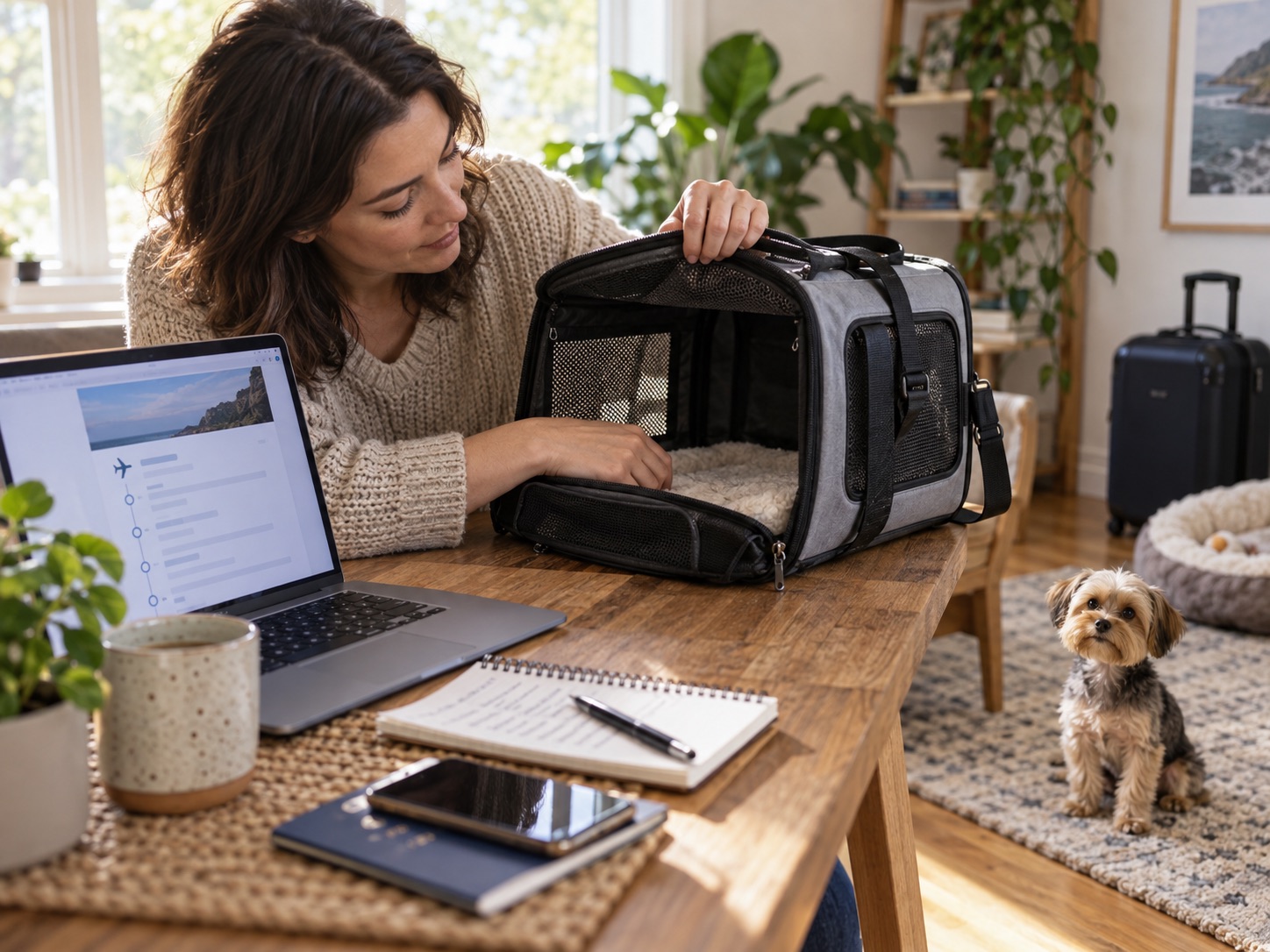
Check whether your dog can travel on the exact route, then measure the closed carrier, combined weight, ventilation and animal fit before buying.
Our recommendations
Compact carriers to measure
These are dimensioned examples for very small dogs on eligible cabin routes, not flight approvals. The second listing has conflicting stated internal and external height, so confirm usable dimensions independently.

Sherpa Original Deluxe carrier, small
Best for: A tiny dog that fits a low soft carrier on a route permitting cabin pets
A soft carrier listed at 15 × 10 × 8.5 inches, roughly 38 × 25 × 22cm, with top and side entry, mesh panels and lockable zips.
What stands out
- Low published height
- Multiple mesh panels
- Top and side access
Keep in mind
- Suitable only for a very small dog
- Soft compression must not remove headroom or airflow
- No universal airline acceptance
- About 38 × 25 × 22cm external
- Listed up to 8lb
- Top and side entry

Petskd 43cm expandable pet carrier
Best for: A tiny dog that fits the unexpanded interior on a compatible route
A soft carrier listed at 43 × 28 × 24cm closed, with mesh on several sides and zipped openings. Its roof expansion is not a way to gain extra in-flight headroom unless the airline permits it.
What stands out
- Closed outside size is explicit
- Multiple mesh faces
- Zipper security features
Keep in mind
- Very small usable interior
- Expanded roof exceeds many cabin heights
- Marketing airline lists may be outdated
- 43 × 28 × 24cm closed external
- Expandable top
- Multiple mesh panels
Scroll horizontally to see all columns →
| Carrier | Closed exterior | Listed load | Key uncertainty |
|---|---|---|---|
| Sherpa Original Deluxe small | About 38 × 25 × 22cm | Up to 8lb | Dog posture in low interior |
| Petskd expandable 43cm | 43 × 28 × 24cm | Verify with seller | Conflicting internal-height figure |
The route decision comes before the purchase
Write down origin, destination, transit points, travel dates, flight numbers, operating airline and aircraft where available. Check the pet policy for each flight, not only the booking website's airline logo. A route can permit a small pet in the cabin outbound and prohibit the same arrangement on return. Ordinary pets, recognised assistance dogs and animals transported as cargo have different processes.
This matters particularly for UK travel. British Airways says ordinary pets do not travel in its cabin. KLM publishes a cabin-pet option on some flights, with a closed carrier no larger than 46 × 28 × 24cm and a combined pet-and-carrier maximum of 8kg, but states that pets cannot travel to the UK as passenger baggage. It says the restriction does not apply to travel from the UK. Those facts do not authorise a specific flight. For entry to Great Britain, also check government-approved routes and pet-entry rules. Obtain the operating airline's confirmation before you pay for a pet place or a carrier.
Two dimensioned cabin examples
Sherpa Original Deluxe small: low exterior
This model lists roughly 38 × 25 × 22cm closed external dimensions and an 8lb pet-load limit. Its low roof may meet some numerical height caps yet leave inadequate headroom for a dog with long legs or upright ears. The seller's airline language is not a guarantee. Measure the closed usable interior, bedding and dog in natural postures, then check the operating airline's exact acceptance process.
Petskd expandable 43cm: wider numerical envelope
This listing gives a 43 × 28 × 24cm closed exterior. Its expandable top may be useful outside the aircraft, but should not be counted as in-flight space without specific permission. More importantly, the seller's stated internal height is greater than its external height, so that specification is inconsistent. Obtain reliable usable measurements and confirm the dog can stand, turn and lie without flattening the roof.
Cabin versus hold
Cabin travel typically has a small under-seat envelope and a combined weight ceiling; hold carriage has a different container, reservation and handling process. Do not buy a soft cabin bag for a hold booking, or infer that a hard kennel fits a cabin seat. The IATA container explainer separates those frameworks. For cabin travel, measure the dog and carrier together; for either mode, acclimate the dog well ahead of travel and confirm paperwork with the airline and destination authority.
Common questions
Frequently asked questions
Are there airlines that allow a dog in the cabin from the UK?
Policies differ by airline, route, direction and cabin. For example KLM publishes a cabin-pet service on eligible outbound journeys, but says pets cannot travel to the UK as passenger baggage; check the exact operating flight before booking.
Does British Airways allow pet dogs in its cabin?
British Airways says ordinary pets do not travel in its cabin. Recognised assistance dogs follow a different process. Confirm the current policy directly for your itinerary.
Is an IATA-approved carrier a guarantee?
No. IATA does not approve or certify commercial carrier models. The operating airline decides acceptance under its rules for that flight and animal.
Can I open an expandable top during a cabin flight?
Do not assume so. Judge size and animal comfort with the carrier closed as required in flight; ask the airline whether an expansion is permitted at any stage.
Will a soft carrier that squashes under a seat pass?
Not if compression removes the dog's natural space or blocks vents. Meet the airline's dimensions without sacrificing welfare, and get confirmation for the exact carrier.
Sources
- IATA — guidance for passengers with cabin pets
- KLM — travelling with pets
- British Airways — travelling with pets
- GOV.UK — approved air routes for pets entering Great Britain
- Amazon UK product pages linked from the product cards