
Topic guide
Dog crates for real UK homes
Choose and place a household dog crate using individual measurements, door access, cleaning needs and current welfare guidance.
Compare dog crates →Browse all guides ↓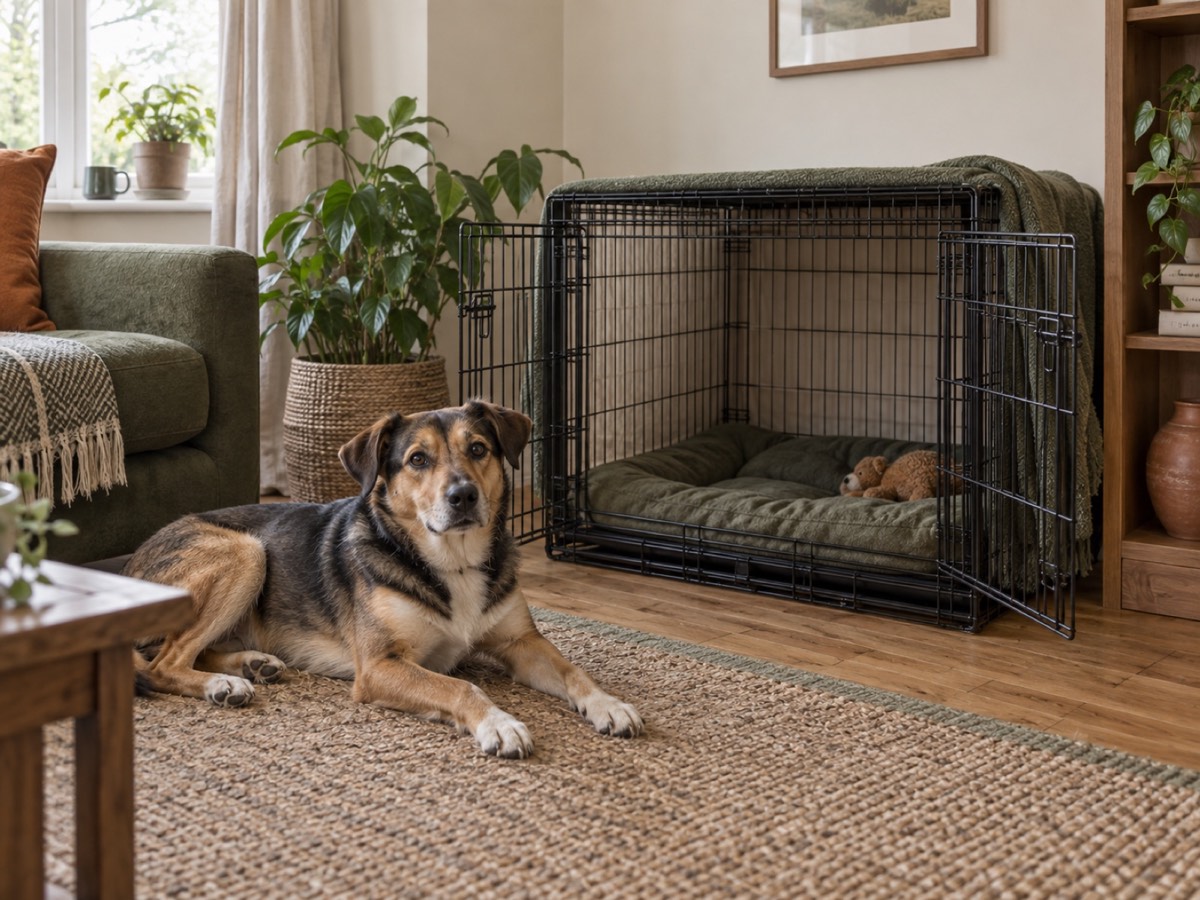
A good household crate gives a dog enough usable internal space to stand and sit without touching the top, turn round, lie naturally, wag their tail and stretch out. PDSA's crate guidance advises that too big is better than too small. Start with the dog's measurements, then check the manufacturer's internal dimensions wherever they are published. If you are choosing between two standard sizes, use the dog's posture rather than the label on the box.
Start with the decision you need to make
For a first purchase, compare the main crate formats and decide whether the equipment will stay in one room or be moved and stored regularly. If you already have a crate and are checking fit, go straight to internal versus external measurements or the guide to falling between sizes. For a puppy, consider today's comfortable space and the future adult size separately; a secure divider can help only while it leaves room to move naturally.
Which type belongs in the room?
Wire crates offer airflow, visibility and fold-flat storage. A cover can reduce visual stimulation for some dogs, but ventilation must remain clear. Plastic crates feel more enclosed and are often easier to wipe, while furniture-style crates make sense when the equipment will stay permanently in a living room. Soft crates are lighter but PDSA notes that they are less durable, harder to clean and unsuitable for puppies or dogs that chew. The material comparison separates these trade-offs without assuming one format suits every household.
The household checks people miss
External size is only the beginning. Allow room for the chosen door to open fully, keep the crate out of direct sunlight and draughts, and do not block a walkway. Check whether the tray slides out towards a wall, whether a cover reaches a radiator and whether the folded crate can actually pass through the cupboard or stair route where it will be stored. Our room-placement guide turns those checks into a floor plan. A thick bed or attached water bowl changes usable room; check the bedding and bowl allowance before ordering.
Introduce it at the dog’s pace
RSPCA's introduction guidance and PDSA both describe a gradual, reward-based approach with the door initially secured open. A crate must not be used as punishment. Water, suitable bedding and a calm location matter; so does noticing distress. Persistent panting, cowering, frantic escape attempts or injury need a slower approach and, where concerns continue, help from a vet or qualified behaviour professional. Read the puppy introduction and distress signs before assuming a different crate will solve the problem. A pen, gate or safe room may be the better answer.
Explore this topic
Useful guides and comparisons
Choose a crate format
Compare wire, plastic, furniture, soft and portable options by the job they need to do.
Best dog crates for UK homes
Compare practical layouts, their published dimensions and the households each one suits.
Read the guide →Buying guideBest wire dog crates
Compare ventilated fold-flat crates from compact puppy models to 122cm frames.
Read the guide →Buying guideBest puppy crates
Choose a divider, doors and easy-clean tray around current fit and expected growth.
Read the guide →Buying guideBest folding dog crates
Plan the assembled footprint, stored size and route between the two.
Read the guide →Buying guideBest furniture dog crates
Compare internal space, sliding doors and permanent living-room footprints.
Read the guide →Buying guideBest soft dog crates
Find a lightweight destination space for a settled dog that is safe around fabric.
Read the guide →Buying guideBest large dog crates
Compare 106cm and 122cm options without relying on vague XL labels.
Read the guide →Buying guideBest plastic dog crates
Compare rigid shells on measured fit, ventilation, cleaning and the intended journey.
Read the guide →Buying guideBest portable dog crates
Weigh folded storage and carrying convenience against comfort at the destination.
Read the guide →Buying guideBest small dog crates
Find a genuinely usable compact footprint for a small dog's individual shape.
Read the guide →Evidence-led buying guideHeavy-duty dog crates explained
Compare documented construction without treating stronger panels as a distress remedy.
Read the guide →Measure and fit
Turn the dog's posture and the room's footprint into a usable size and access plan.
How to measure a dog for a crate
Take length, sitting height and width measurements, then check sleeping posture.
Read the guide →Comparison guideInternal vs external dimensions
Separate the dog's usable interior from the footprint the room must accommodate.
Read the guide →Sizing guideStandard crate sizes explained
Translate common inch labels into centimetres without treating them as a fit guarantee.
Read the guide →Comparison guideMetal vs plastic vs fabric crates
Compare airflow, cleaning, storage and behaviour fit across the three materials.
Read the guide →Comparison guideSingle-door vs double-door crates
Choose an access layout that works for the dog and the room around the crate.
Read the guide →Sizing guideHow to check a crate's door opening
Measure the clear width, height, threshold and full swing of the actual door.
Read the guide →Sizing guideWhen your dog falls between crate sizes
Compare usable interior, resting posture and the space a larger crate asks of the room.
Read the guide →Practical sizing guideAllowing room for bedding and bowls
Check how a bed and water bowl change the usable interior and headroom.
Read the guide →Practical guideHow to size a crate divider
Set a secure divider by the puppy's posture and move it as growth changes.
Read the guide →Sizing guidePuppy crate sizing as your dog grows
Plan today's fit, adult dimensions and regular checks during rapid growth.
Read the guide →Puppy setup and crate training
Plan a calm introduction, observe the dog's response and adjust the setup as they grow.
Move or resize a puppy's crate
Change the usable interior or room position without unsettling the puppy.
Read the guide →Room guideA puppy's first-week home layout
Prepare one safe base with rest, water and a clear route to the toilet place.
Read the guide →Welfare guideWhen a dog refuses a crate
Check fit, fear and health before rebuilding voluntary entry or choosing an alternative.
Read the guide →Training guideHow to introduce a puppy to a crate
Build voluntary entry, calm door movement and brief absences with reward-based steps.
Read the guide →Practical guideA puppy's first night with a crate
Keep the puppy close, plan toilet breaks and respond calmly to waking.
Read the guide →Problem-solving guideWhen a puppy cries in a crate
Check physical and emotional needs, then make the training step easier.
Read the guide →Welfare guideHow long can a dog stay in a crate?
Understand welfare limits and why age, health and behaviour change the answer.
Read the guide →Welfare guideSigns of distress in a dog crate
Recognise loud and quiet signs, respond safely and know when to get help.
Read the guide →Welfare guideCrates and separation anxiety
Learn why confinement is not a treatment and when it can increase risk.
Read the guide →Accessories, cleaning and safety
Add only what fits safely, and keep the crate clean and structurally sound.
Best dog crate covers
Choose a cover by exterior fit, adjustable openings and airflow.
Read the guide →Practical guideShould you cover a dog crate?
Learn when a partial cover helps and when it should come off.
Read the guide →Buying guideBest crate water bowls
Compare secure clip-on bowls by capacity, bracket fit and cleaning.
Read the guide →Buying guideReplacement crate trays
Match the exact model, pan measurements and material before ordering.
Read the guide →Care guideHow to clean a dog crate
Clean the tray, frame, bedding and bowl, then inspect for damage.
Read the guide →Safety guideWhen a dog escapes its crate
Check for injury and identify the cause before using the crate again.
Read the guide →Common questions
Frequently asked questions
Should I choose a dog crate from the breed label?
No. Dogs within the same breed differ in length, height and resting posture. Measure the individual dog, check usable internal space after bedding and then allow for the door and cleaning access in the room.
Does a household dog crate also work for car travel?
Not automatically. A home rest space and a vehicle restraint have different jobs. Check the exact product's travel instructions, compatible installation and any model-specific test evidence rather than relying on a travel label.
Is a crate always better than a pen or dog-safe room?
No. A crate is one possible managed resting space, not a requirement for every dog. A pen, gate or dog-safe room may fit the household better, especially when the dog cannot settle comfortably in a crate.