
Freestanding dog gate buying guide
Best freestanding dog gates
Compare freestanding dog gates for UK rooms by panel height, support feet, floor footprint and whether a dog respects a movable boundary.
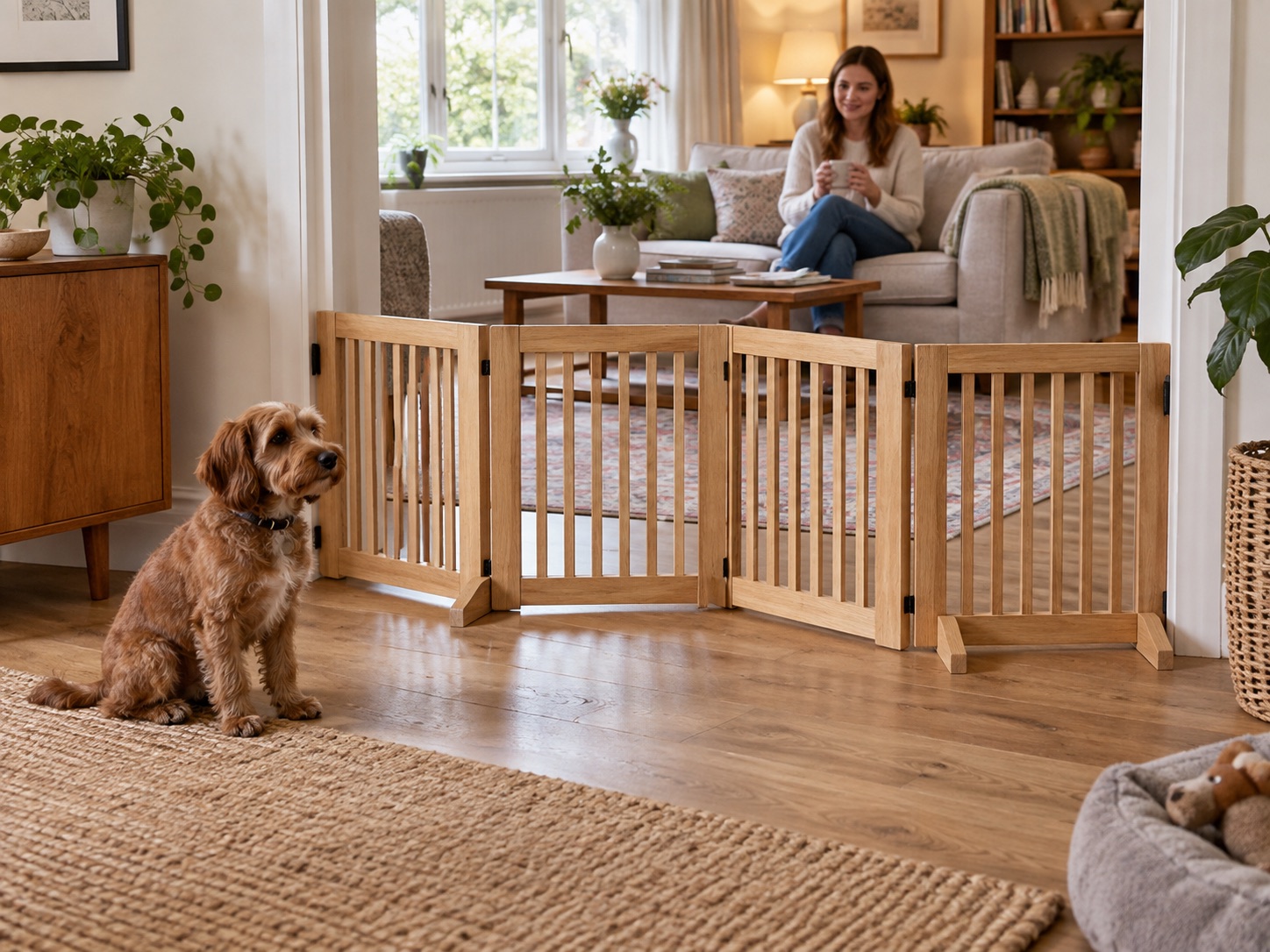
Our recommendations
Movable dividers to compare
Two formats show the trade-off between more panels and more height. Check the support feet and the depth created by a stable zigzag layout.

The Fellie four-panel freestanding dog gate
Best for: A calm dog and a broad level-room boundary that can be moved
A four-panel wooden folding barrier listed at 184cm wide and 82cm high with two support feet.
What stands out
- 184cm listed width
- Four hinged panels
- Support feet included
Keep in mind
- Can move under force
- Needs floor space for stable shape
- No fixed latch to walls
- 184cm wide
- 82cm high
- Four wooden panels

Yaheetech 91cm freestanding wooden dog gate
Best for: A calm dog needing a higher visual boundary between level rooms
A three-panel wooden divider with two support feet, flexible hinges and a listed height of about 91cm.
What stands out
- About 91cm high
- Three folding panels
- Two support feet
Keep in mind
- Not fixed to wall
- Takes depth when zigzagged
- Not safe at a fall edge
- About 91cm high
- Three panels
- Two support feet
Scroll horizontally to see all columns →
| Gate | Panels | Listed height | Best use |
|---|---|---|---|
| The Fellie | Four | 82cm | Broad calm-room division |
| Yaheetech | Three | About 91cm | Taller visual boundary |
Treat a freestanding gate as a visual boundary
The appeal is obvious: no drilling, little fitting time and the ability to move a divider when the room changes. The limitation is just as important. Support feet and folded angles increase stability, but the gate is not mechanically secured. A dog can push, drag or jump it, and a person can trip on its feet.
Choose a position between level rooms where a shifted panel would not expose the dog to stairs, an exterior door, cooking or a fire. The product title may mention stairs; that wording does not turn a movable wooden divider into a safe top-of-stairs gate. Our stair gate guide addresses the different installation standard.
The freestanding options in detail
The Fellie: four panels across a broad room edge
The selected four-panel Fellie gate is listed at 184cm wide and 82cm high, with two support feet. It can make a gentle angled run across a broad living-room opening where you still want a sightline through the wooden bars.
The listed width is the panels opened out; a stable zigzag consumes more floor depth and covers a shorter straight-line distance. Mark the proposed foot positions on the floor before ordering. Check that a dog cannot squeeze around either end or use a nearby sofa as a step.
Yaheetech: a taller three-panel version
Yaheetech's three-panel wooden divider stands about 91cm high and includes two support feet. Its extra height may help as a visual boundary for a dog that ignores a very low rail, but it does not make the gate push-proof.
Check the actual span at the angle needed for stable support. A higher panel can also be heavier to carry and store. If the dog has ever thrown its weight against a barrier, choose a suitable fixed gate or rethink the room boundary rather than relying on this portable design.
Floor, furniture and access checks
Both ends need a surface that does not let the feet slip. On a thick rug, feet may sit at different heights; on polished timber, they may slide. Follow the maker's anti-scratch and support-foot instructions. Leave a human route that does not require stepping over the divider; repeated inconvenience invites people to leave it open or move it unsafely.
Keep chairs, pet beds and baskets away from the dog-facing side. A small dog may squeeze through the bar spacing or under a panel, so inspect the full lower edge rather than judging height alone. For a fixed doorway boundary, see indoor dog gates.
Introduce and monitor the boundary
Start while you remain present. Reward the dog for waiting away from the gate and moving calmly when you open a route. If the dog repeatedly paws, bites, pushes or tries to scramble over it, do not leave them alone behind the barrier. Change the layout and seek behaviour advice where distress is driving the attempts.
Inspect hinges, feet, finish and floor contact each time the gate is moved. A cracked panel or missing support foot changes its suitability immediately.
Common questions
Frequently asked questions
Can a freestanding dog gate be used at the top of stairs?
No. A movable gate can tip, slide or be pushed out of position. Use an exact manufacturer-approved fixed stair gate attached to sound structure.
Will a freestanding gate stop a large dog?
Do not assume so. A large or determined dog can move a barrier even when it is tall. These gates are most appropriate for dogs that already respect a light room boundary.
Should I set a folding gate in a straight line?
Follow the maker's instructions. A slight zigzag and correctly placed support feet often provide more stable floor contact than a fully straight run, but the required shape depends on the model.
Can a freestanding gate replace a puppy pen?
No. It marks a room edge rather than enclosing a complete activity area. A puppy that explores, pushes or climbs may need a more secure, supervised layout.
How do I store a freestanding gate?
Fold it as instructed after removing the dog from the area, then store it where it cannot topple. Measure the folded thickness and the weight before buying for frequent moves.
Sources
- RoSPA — fixed safety-gate rationale
- PDSA — making your home dog friendly
- Amazon UK product listings linked from the guide