
Evidence-led car crate guide
Crash-tested dog crates explained
Compare published dog-crate crash evidence by exact model, configuration, test method and scope, without treating different ratings as a safety ranking.
Our recommendations
A crate with clearly documented testing
Read the model-specific fit and installation instructions alongside the manufacturer's published testing information. Choose only a size and vehicle setup that meet those requirements.

Thule Allax car dog crate, small
Best for: A compatible car and dog where model-specific test documentation matters
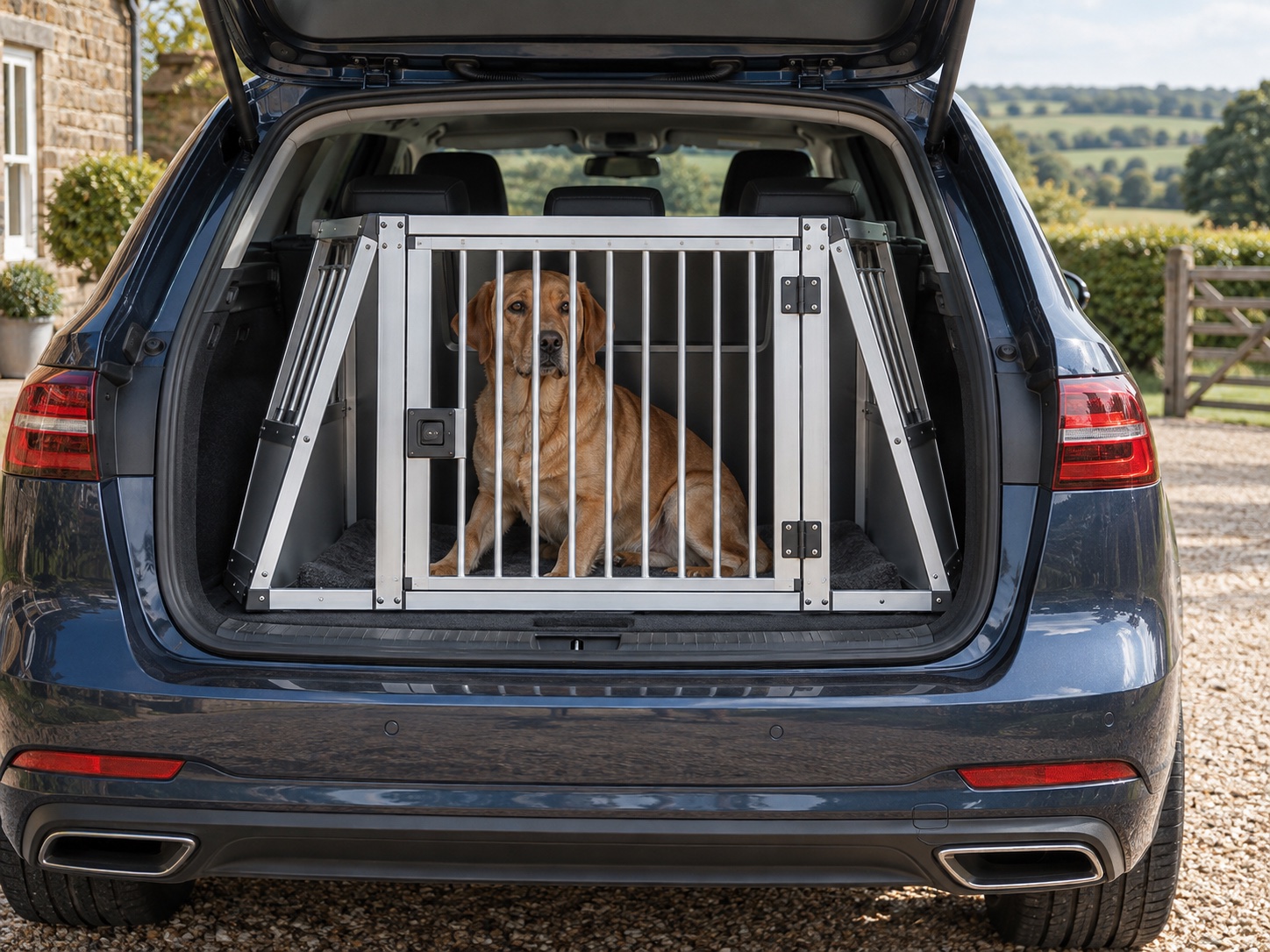
An adjustable-depth aluminium car crate with a crumple zone, locking door and rear escape hatch. Thule describes front, rear and simulated roll-over testing for the Allax range.
What stands out
- TÜV SÜD reference published by Thule
- Adjustable depth
- Rear escape hatch
Keep in mind
- Premium price
- Heavy rigid installation
- Vehicle compatibility must be checked
- Small variant
- Adjustable depth
- Crumple zone
- Built-in lock
Scroll horizontally to see all columns →
| Question | Published evidence | Why it matters |
|---|---|---|
| Which product page? | Allax S, model 770001; range-level test wording | Exact product identity is not the same as exact test configuration |
| Which directions? | Front, rear and simulated roll-over | Shows more than one impact scenario |
| External certification? | Thule cites TÜV SÜD reference Z1 013709 0039 | Distinguish a manufacturer's reference from the full certificate scope |
| Installation conditions? | Vehicle fit, tension bands and cargo loops | The result depends on correct attachment |
| Design geometry? | Built-in 10–13cm crumple-zone provision | Not an invented universal additional gap behind every crate |
Why the words alone are not enough
“Crash tested” can describe anything from an internal prototype exercise to a published test with identifiable procedures and third-party certification. The claim becomes useful only when a buyer can connect it to the exact crate they are considering.
A black aluminium box can look more protective than a plastic carrier, but visual strength is not a result. Join design, door retention, attachment, vehicle interaction and controlled deformation can matter as much as the panel material.
The evidence checklist
Exact product and version
The document should name the model family, size or version. If a retailer groups several variants, establish which one the evidence covers. A test on a premium range does not validate a cheaper model from the same manufacturer.
Test direction and setup
Front, rear, side and roll-over events load a crate differently. Look for the directions tested, vehicle or sled setup, speed or pulse, dog mass or dummy and the position of the crate.
Pass criteria and result
A useful report explains what counted as success: door retention, attachment integrity, dummy containment or forces on passengers. “Tested” without the result can mean the product was simply placed in a test.
Installation method
The tested attachment is part of the safety system. If the test used specified cargo loops and tension straps, wedging the crate between luggage does not recreate it. Replacement straps also need the correct rating and manufacturer approval.
Certification scope
A named organisation and certificate number are stronger than a free-floating badge. Check that the certificate belongs to the product and remains current; do not assume a vehicle child-restraint standard means the product is formally approved as a child seat.
Published evidence by exact model and configuration
The records below illustrate different kinds of primary evidence, not a ranked shopping list. They name the product or tested object, attachment, method and reported result together. Where a product page makes a range-level statement, the matrix keeps it at that level rather than filling in an imagined size-specific test.
Scroll horizontally to see all columns →
| Model / primary record | Configuration | Method / load | Reported outcome | Scope boundary |
|---|---|---|---|---|
| Thule Allax S · 770001; Thule product page cites Z1 013709 0039 | Range claim on exact S page; manual requires cargo loops and approved tension straps | ECE R17 / R129 methods; front, rear, simulated roll-over; S-specific test load not stated in product summary | TÜV SÜD certification referenced by manufacturer | Certificate reference, not a full model-specific report; range wording does not establish S-specific load or setup. |
| MIM Variocage III SL (Single Large) · SP PX21239A, 2012 | Left-side Volvo V70N chassis; straps at two left luggage corners | SPCT rev. 2; 45kg dummy; front 49.8km/h, rear 30km/h, tilted 70cm drop | Overall green; rear-left strap attachment broke in frontal test; front-left remained attached | Historical tested object only; green is this protocol's category, not a cross-brand rating or current-model certification. |
| Gunner G1 Intermediate · CPS V15572, June 2015 | Intermediate size with strength-rated anchor straps | CPS-002-016.01; 75lb test dog | Passed; CPS five-star result | Exact certified size and strap configuration; not all G1 variants or a comparison with SPCT or ECE methods. |
Read a historical report as a historical report
SP's 2012 PX21239A report concerns the Variocage III SL (Single Large) tested under SPCT revision 2. Its green overall result must be read alongside the reported rear-left strap-attachment break during the frontal event. The crate remained attached at the front-left point. The report confines its findings to the tested object; it is not evidence that every current Variocage model or alternative installation has the same result.
The 45kg dummy is a test input, not an instruction to put a 45kg dog into any version. Similarly, the CPS entry's 75lb test dog and strength-rated straps belong to the Gunner G1 Intermediate entry, not an all-size G1 approval.
Keep methods and outcome scales separate
A specified speed alone does not make two tests equivalent. Pulse, direction, vehicle or sled geometry, load placement, attachment and success criteria affect what a result describes. The SPCT report's green category and the CPS five-star result belong to different systems. They cannot establish a numerical ranking against each other or against a manufacturer-cited TÜV certification.
If an advertised product differs in size, latch, strap system or generation, return to its exact documentation. Do not bridge the difference with a generic material claim or a familiar brand name. Our car-harness evidence guide applies the same exact-model approach to a different restraint format.
Thule Allax S: product identity versus test scope
The exact S page identifies model 770001, but its test wording describes the Allax range. Its certification reference is a manufacturer-attributed statement, not a reproduction of the full certificate or an S-specific report. Keep the product's pet-weight limit separate from any test-dummy load. Use the applicable model scope and installation instructions rather than assuming every detail is established by the summary.
Thule describes a built-in crumple-zone provision adding 10–13cm even at the shallowest setting. This is part of the design geometry, not a rule to add an arbitrary extra 10–13cm behind every candidate crate. Plan the complete adjustable profile and preserve the installation specified for the exact model.
The linked product is the small Allax variant. Use Thule's dog and vehicle fit tools for that exact size; do not copy another size's dimensions or limits. Record the candidate's profile in the car-boot measuring worksheet before ordering.
What the evidence does not promise
The documented tests do not guarantee a dog will be uninjured in every real collision. Crash angle, speed, vehicle deformation, another object in the boot, dog position and installation can all differ from the test.
Nor does certification correct an unsuitable dog fit. A dog needs the posture and movement allowance set out by the manufacturer. An undersized “safer” crate is not a responsible compromise.
Common weak claims
Be cautious when a listing says only “crash tested”, “impact tested”, “airline approved”, “heavy duty” or “meets safety standards” without naming the standard or report. Customer reviews cannot verify crash performance, and videos of a crate being pushed or dropped are not vehicle crash tests.
Likewise, “Rule 57 compliant” is often marketing shorthand. Rule 57 describes suitable restraint outcomes and examples; it does not issue a product certificate.
How to install a tested crate responsibly
Read the instructions before ordering so you know which vehicle cargo loops, straps, clearance and tools are required. Use the manufacturer's compatibility check, then physically measure the car boot and aperture.
Follow the approved attachment and strap-tension procedure, preserve the specified design and installation clearances, keep the escape hatch accessible and remove loose luggage that could strike the crate. Recheck straps and locks before every journey. A push by hand is not proof that an installation recreates a collision test.
When a tested crate will not work
Some boots are too small, lack suitable attachment points or cannot preserve the required clearance. Some dogs are too large or become distressed in a crate. In those cases, do not force the fit.
A properly fitted, documented car harness on a compatible rear seat may be the better route. Compare the evidence and practical trade-offs in our harness versus crate guide, and read the full Highway Code Rule 57 explanation.
Common questions
Frequently asked questions
Is there a UK standard for crash-tested dog crates?
There is no single consumer label in Highway Code Rule 57 that automatically certifies every dog crate. Manufacturers may use vehicle-related methods and third-party certification, so read the exact report and scope rather than relying on the words crash tested.
Is TÜV SÜD certification useful?
It is a named independent certification signal when the certificate and product scope can be identified. It still does not remove the need for correct dog size, vehicle compatibility, clearance and installation.
Are all aluminium dog crates crash tested?
No. Aluminium is a material choice. A crate may be strong for daily containment yet have no published collision test. Evidence for one brand or model does not apply to another.
Does a crash-tested crate guarantee no injury?
No safety product can guarantee an outcome in every collision. Testing describes performance under defined conditions; real crashes, incorrect installation, vehicle deformation and the dog's size can differ.
Does evidence for one size apply to every size in a range?
Not automatically. Read the document's model and size scope, test load, attachment and configuration. A range-level statement cannot fill in missing size-specific details, and a historical report does not establish a later revision's result.
Can I compare a green result with a five-star crash-test rating?
Not as if they were the same scale. Protocols can use different impact scenarios, loads, attachments and pass criteria. Keep each published result tied to its own method rather than creating a cross-brand safety ranking.
Sources
- Thule UK — Allax product, testing and TÜV SÜD certificate details — exact S identity; manufacturer-attributed range testing and certificate reference
- Thule — Allax instructions — vehicle compatibility and installation requirements
- SP — Variocage III SL laboratory report PX21239A — historical laboratory-authored report; tested object, configuration and attachment result
- Center for Pet Safety — Gunner G1 Intermediate entry V15572 — exact certified size, strength-rated straps, protocol and test load
- GOV.UK — Highway Code Rule 57 — UK restraint guidance
- Amazon UK — Thule Allax S — retailer listing for the selected small variant