
Awkward-opening gate fit guide
Dog gates for awkward openings
Plan a dog gate for angled walls, broad openings, banisters and offset doorways without improvising fixings or losing a safe walk-through route.
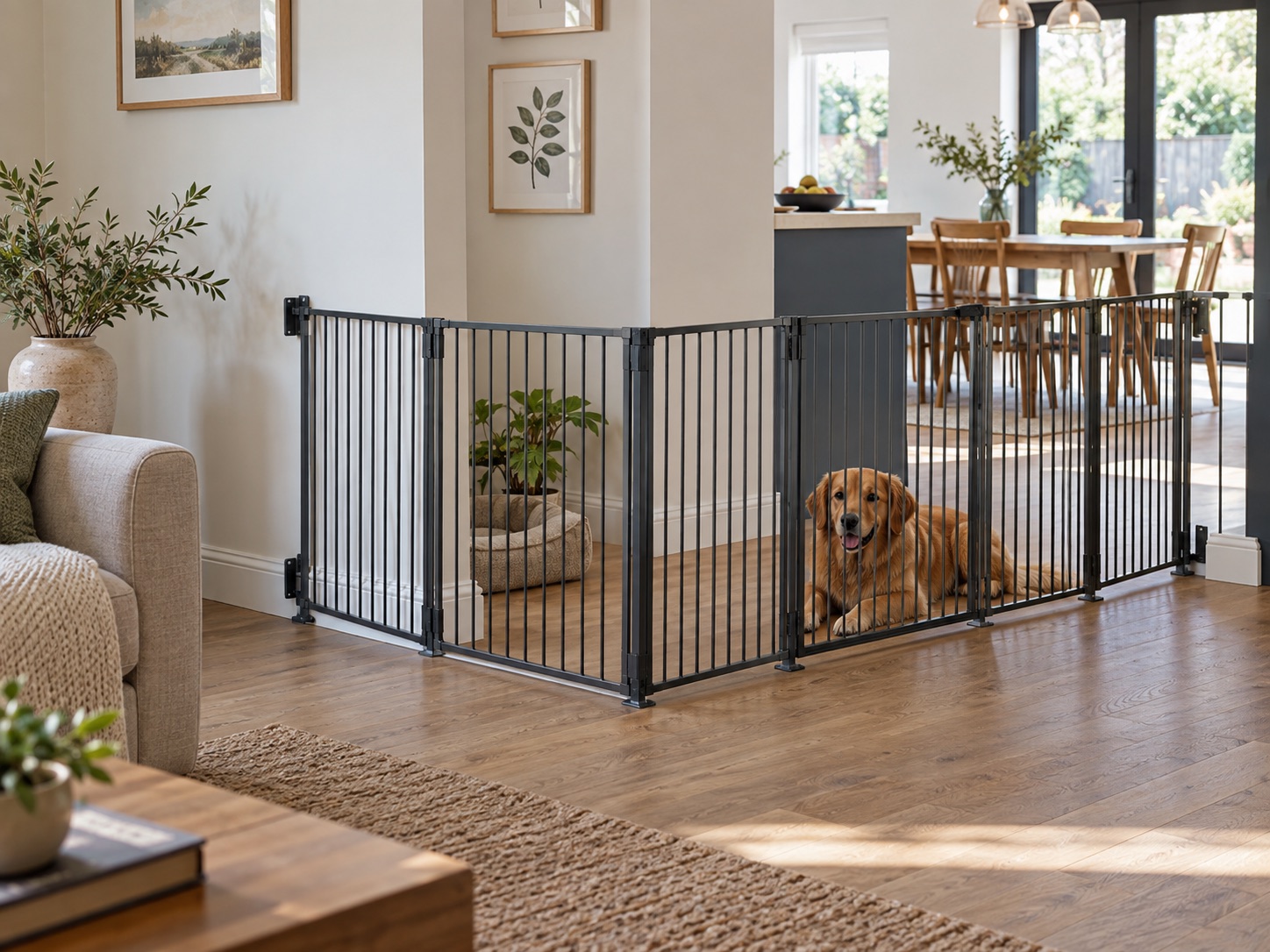
Map both fixing points and the whole panel path from above.
Record widths at three heights and every projection or handrail.
Use only manufacturer-approved joints, extensions and mounting hardware.
Describe the awkward part precisely
“Awkward opening” can mean several different problems: an opening too wide for a standard gate, a corner that needs a panel turn, a door frame offset by skirting, or a banister with no flat fixing face. These require different answers. Start with a top-down sketch that marks walls, furniture, steps, door swings and the route people must still use.
Measure the proposed line at its actual bracket positions, not the shortest distance between two convenient points. Note floor, middle and upper widths as explained in our gate measurement guide. Record wall construction as carefully as width: a long gate fixed to weak plasterboard is not rescued by an extra panel.
Scroll horizontally to see all columns →
| Opening problem | Format to investigate | Reject if |
|---|---|---|
| Wide or angled room edge | Modular wall-mounted panels | No sound end fixings |
| Offset ordinary doorway | Flexible wall-mounted gate | Brackets cannot sit level |
| Rounded banister | Approved adapter with suitable gate | Post or adapter is unverified |
| Only furniture at one end | Move the boundary | Furniture is used as a fixing |
Use modular panels for a broad turn
BabyDan Flex L is a wall-mounted modular example with a listed 90–223cm range. Linked sections can form an approved angled run, making it more appropriate to a broad open-plan edge than a straight pressure frame stretched to its limit.
The supplied sections and door position determine the real shape. Sketch each panel to scale and check that the door clears seating and does not open into the dog's resting spot. Its standard height also needs to suit the dog's jumping ability.
For a still broader route, Flex XL extends the listed range to 278cm. It needs more floor space and careful planning of every joint; it is not an unsupported 2.78m straight rail.
If the final span relies on a cabinet or kitchen island to act as an end wall, move the boundary or ask a competent installer to assess whether an approved structural mounting solution exists.
Treat offset ordinary doorways differently
A short wall return, architrave or uneven reveal may make a straight pressure frame difficult even when the width is ordinary. BabyDan FlexiFit offers flexible wall-mounted positioning within a listed 67–105.5cm range. Its fittings can sit inside or outside an opening as the instructions specify.
That flexibility does not mean a bracket may be screwed into decorative trim or a hollow surface without suitable support. Check skirting-board fitting and make a final bracket-level measurement before drilling.
Banisters, stair edges and human routes
Rounded or open banisters need a gate-and-adapter combination expressly approved by the maker. A flexible newel post may move under pressure, and a decorative baluster may not carry a screw fixing. RoSPA's safety-gate evaluation explains why fixed attachment and a threshold-free opening matter at the top of stairs. Apply the stair guide before deciding a modular product belongs there.
Leave enough walk-through width for daily use and evacuation. A gate that blocks a narrow hall or requires climbing over is a poor room plan, even if the dog cannot cross it. Test the latch from both sides and confirm it can be operated while holding ordinary household items.
After installation, inspect all hinges, bracket screws and lower gaps, not only the central door. A dog that repeatedly slams or climbs the new barrier needs an adjusted space and behaviour plan rather than more improvised reinforcement.
Common questions
Frequently asked questions
Can a dog gate turn a corner?
A modular system designed for angled sections can, provided the maker approves the configuration and both wall ends are fixed to suitable structure. A straight pressure gate should not be bent around a corner.
What if one side is a banister?
Use only a compatible manufacturer-approved adapter or a professionally designed structural fixing. Do not cable-tie a gate to a decorative or flexible post.
Can I fix a gate to a kitchen island?
Only if the gate maker allows the exact arrangement and the island structure can take the fixing forces. Many islands and cabinets are not suitable; moving the boundary to a wall is often safer.
Is a freestanding divider enough for a wide gap?
It may mark a low-consequence level-room boundary for a calm dog, but it can move. Do not use one to protect stairs, a front door or a dog that pushes barriers.
Does a wide gate automatically suit stairs?
No. Stair suitability depends on the exact model, position, fixing, swing and trip-bar arrangement, not its maximum width.
Sources
- BabyDan — Flex L configuration and wall-mounting specifications
- BabyDan — manuals and staircase adapters
- RoSPA — fixed gate and structural fixing rationale
- Amazon UK example products linked in the guide