
Wire dog crate buying guide
Best wire dog crates for UK homes
Compare wire dog crates available in the UK by published size, doors, dividers, trays and storage, with practical measuring and room-planning advice.
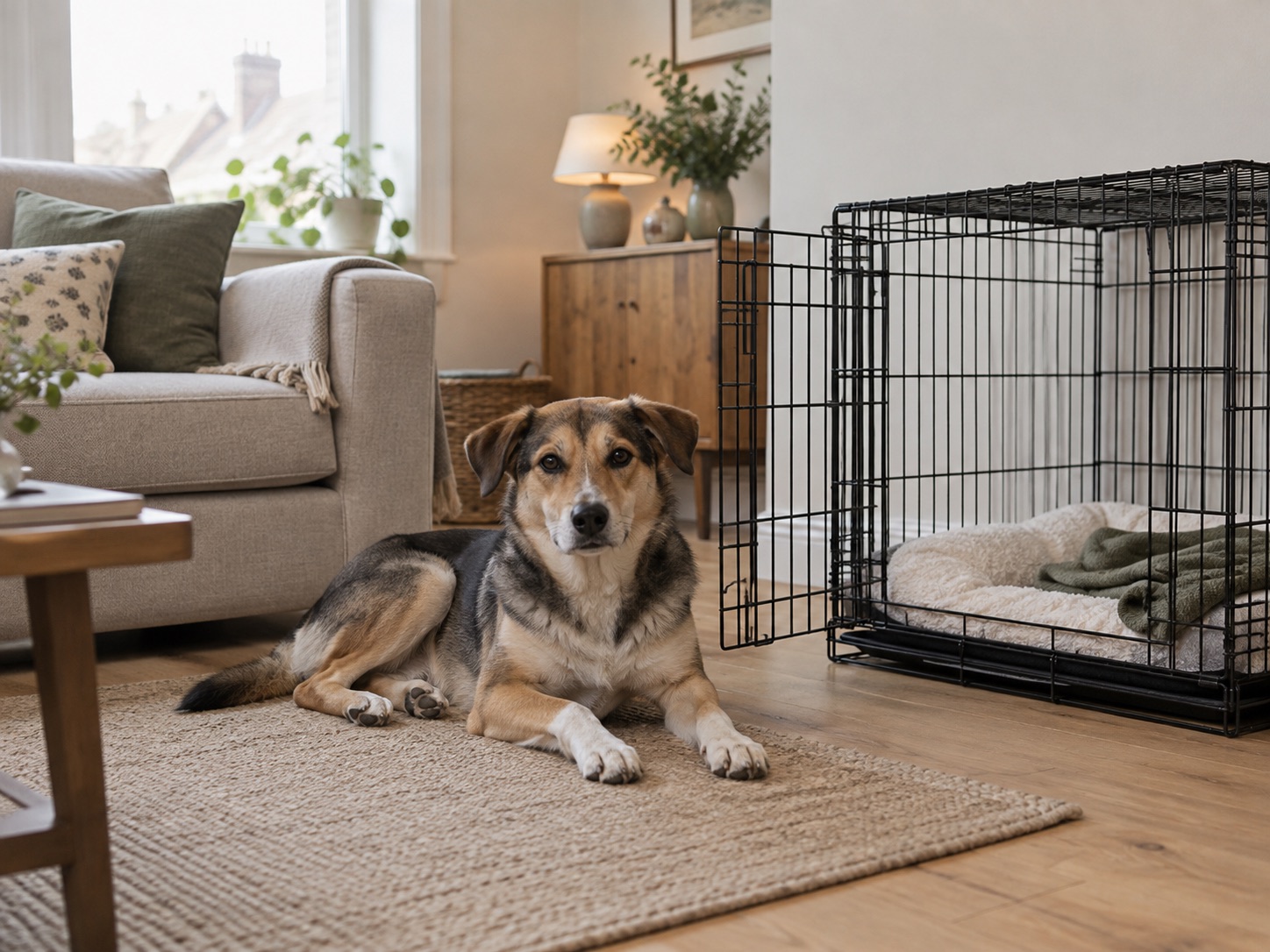
Our recommendations
Wire crates worth comparing
These options cover common 91cm, 106cm and 122cm footprints. Compare their published measurements with the dog's posture and the usable space available after bedding is added.

Ellie-Bo Deluxe 36-inch two-door crate
Best for: A folding wire crate supplied with a metal tray and bed mat
This 36-inch model combines two access points with a fold-flat frame, metal tray and bed mat. It is a practical household option when the measured dog suits the 91.4cm published length.
What stands out
- Two doors broaden placement options
- Folds flat for storage
- Metal tray and bed mat included
Keep in mind
- Published size is not labelled internal
- Included pad reduces usable height
- No crash-test claim for vehicle restraint
- 91.4 × 61 × 66cm
- Two doors
- Folding steel frame
- Metal tray and bed mat

MidWest iCrate 36-inch two-door crate
Best for: Households that want an included divider panel
The 36-inch iCrate adds a divider panel to the usual two-door, folding-wire layout. That makes the available area adjustable while a puppy grows, without treating a breed label as the final size decision.
What stands out
- Divider panel included
- Two doors
- Rounded corners and removable tray
Keep in mind
- Weight range is only a guide
- Published dimensions appear external
- Protective coating still needs regular inspection
- 92.7 × 59.7 × 62.9cm
- Two doors
- Divider panel
- Leak-resistant removable tray

Amazon Basics XXL 122cm double-door crate
Best for: A large dog needing a 122cm folding wire footprint
An XXL double-door wire crate with a divider, removable tray and fold-flat frame. The 122cm overall length is useful for room planning, but internal space still needs confirming.
What stands out
- Two doors
- Divider included
- Folds flat
Keep in mind
- Substantial floor area
- Internal dimensions not published
- Heavy to move once positioned
- 122 × 76.2 × 82.5cm
- Double door
- Divider
- Removable tray

Feandrea PPD48H 122cm wire crate
Best for: A large fold-flat setup that may be stored between uses
A 122cm two-door wire crate with double locks, two carrying handles and a removable tray. Its fold-flat construction helps storage, although the assembled footprint is substantial.
What stands out
- Two doors
- Two handles
- Double locks and removable tray
Keep in mind
- Large and heavy to manoeuvre
- Internal dimensions not stated
- Requires generous tray-removal clearance
- 122 × 74.5 × 80.5cm
- Two doors
- Double locks
- Two handles

PawHut 106cm folding two-door crate
Best for: A longer folding footprint with published folded depth
At 106cm long, this steel crate fills the gap between common 91cm and 122cm listings. Two doors, a removable tray and a 6.5cm folded depth make room and storage planning easier.
What stands out
- Useful 106cm length
- Folded depth is published
- Two lockable doors and tray
Keep in mind
- Internal dimensions not stated
- No divider listed
- Transport wording does not prove crash performance
- 106 × 68 × 76cm
- Folded: 106 × 71 × 6.5cm
- Two doors
- Removable tray
Scroll horizontally to see all columns →
| Model | Published size | Doors | Divider | Best for |
|---|---|---|---|---|
| Ellie-Bo Deluxe 36 | 91.4 × 61 × 66cm | Two | No | Starter set with mat |
| MidWest iCrate 36 | 92.7 × 59.7 × 62.9cm | Two | Yes | Growing puppy |
| PawHut 106cm | 106 × 68 × 76cm | Two | No | Mid-size step-up |
| Amazon Basics XXL | 122 × 76.2 × 82.5cm | Two | Yes | Straightforward XXL layout |
| Feandrea PPD48H | 122 × 74.5 × 80.5cm | Two | No | XXL crate with two handles |
What makes a good wire dog crate?
A good wire crate is large enough for the dog to stand and sit without touching the top, turn around easily, lie in a natural position and stretch out. That test matters more than the inch label on the box. A stocky dog and a long-legged dog can need different usable dimensions even if their weight is similar.
Wire is popular because it combines airflow, visibility and a frame that normally folds flat. It is also easy to see whether bedding, bowls or a cover have shifted. The trade-off is a more exposed feel, possible rattling on hard floors and a tray that needs enough clearance to slide out.
Before ordering, follow our step-by-step dog measuring method and understand the difference between internal and external crate dimensions. Published product dimensions are often overall measurements, so the dog's usable interior may be smaller.
Our same-label crate comparison puts three 36-inch two-door models side by side: matching inch labels still leave differences in listed width, height and length × width rectangle.
How we would narrow the shortlist
Start with length and sitting height
Measure from the nose to the base of the tail while the dog stands naturally. Measure from the floor to the highest point of the head or ears in a normal sit. Then watch how the dog sleeps: a dog that stretches flat needs more uninterrupted floor length than one that curls naturally.
Allow for bedding without sacrificing headroom. PDSA says too big is better than too small, and a puppy needs either a crate sized for adult growth or a well-managed divider.
Choose the door around the room
A front door suits a clear approach at the short end. A side door can be better beside a sofa or in an alcove. Two doors do not create more space for the dog, but they can prevent a crate being positioned with its only exit facing furniture or a busy walkway.
Tape the full external footprint and door swing onto the floor. Leave room for the tray to come out, nearby doors and drawers to open, and people to pass without brushing the frame.
Inspect the parts that receive daily wear
Look at latch alignment, wire joins, tray edges, divider attachment and the points where the folded frame locks open. Recheck them regularly. Remove collars and leads before the dog enters so tags and fittings cannot catch on the wire.
The wire crates in detail
Ellie-Bo Deluxe 36-inch: useful when you want the basics together
The Ellie-Bo combines a 91.4 × 61 × 66cm published size with two doors, a metal tray and an included bed mat. That makes it convenient for a first setup. The mat also reduces the usable height, so calculate fit with it in place rather than from the empty frame.
MidWest iCrate 36-inch: the more adaptable puppy option
The MidWest's divider is its main advantage. It lets you alter the available area while a puppy grows, provided the dog can still perform every essential movement comfortably. Its 92.7 × 59.7 × 62.9cm listed dimensions are close to other 36-inch crates, but small differences in width and height can matter.
Amazon Basics XXL: a straightforward 122cm frame
The Amazon Basics XXL model publishes a 122 × 76.2 × 82.5cm overall size and includes two doors, a divider and removable tray. It needs a large permanent floor area even if it can fold away. Measure the delivery route and storage location as well as the finished position.
Feandrea PPD48H: an alternative 122cm layout
At 122 × 74.5 × 80.5cm, the Feandrea is slightly narrower and lower on its published figures than the Amazon Basics XXL. Two doors, double locks, two handles and a removable tray make the physical layout clear, but only the dog's measurements can establish whether the usable interior is right.
PawHut 106cm: the useful size between common formats
The PawHut's 106 × 68 × 76cm published size bridges the jump from roughly 91cm to 122cm crates. Its folded depth is listed as 6.5cm, helpful when storage matters. It does not list a divider, so it is less adjustable for a puppy than the MidWest or Amazon Basics options.
Set up the crate as a calm resting place
Place the crate out of direct sun, draughts and intense household traffic, but do not isolate a social dog. Secure the door open at first and let the dog investigate voluntarily. Use treats, meals and calm repetition to build a positive association, then increase closed-door time gradually.
Keep suitable bedding and water available. PDSA advises that a dog should not be left in a crate for more than three hours, and some dogs cope with much less; puppies need more frequent toilet breaks. Panting, cowering, frantic escape attempts, persistent barking or injury mean the plan needs to stop and be reassessed.
When wire is the wrong material
A wire crate is not the answer to separation distress or repeated escape behaviour. If a dog bends bars, injures teeth or paws, or panics, stop using that setup and speak to a vet or suitably qualified behaviour professional. A gated, puppy-proofed room or configurable pen may offer safer management with more freedom.
For a calmer dog that needs a lightweight destination space, compare soft dog crates. For a fixed living-room installation, see furniture dog crates.
Common questions
Frequently asked questions
Are wire dog crates better than plastic crates?
Wire usually offers more airflow, visibility and fold-flat storage. Plastic can feel more enclosed and may be easier to wipe around solid sides. Neither is automatically better; choose according to the dog's behaviour, the room and the job the crate must do.
Should a wire crate have one door or two?
Two doors give more freedom to position the crate without blocking access. One door can work well when the crate has a clear, permanent approach. Mark each door swing on the floor before buying.
Can I cover a wire dog crate?
A partial, breathable cover can reduce visual stimulation for some dogs, but it must not restrict airflow, create excess heat or hang where it can be pulled through the bars. Observe the dog and keep water accessible.
How do I stop a wire crate rattling on a hard floor?
Check that the frame is fully assembled and level, inspect clips and tray alignment, and place it on a stable non-slip surface that does not block the tray. Do not improvise in a way that creates loose chewable parts.
Is a folding wire crate safe in a car?
A foldable household crate is not automatically a crash-tested vehicle restraint. Use equipment designed for the vehicle and dog, follow its installation instructions and comply with Highway Code Rule 57.
Sources
- PDSA — crate training your dog — crate types, sizing, location and positive introduction
- RSPCA — dog crate guidance — usable space, water, bedding and safe-haven guidance
- Amazon UK product pages linked from the product cards