
Dog and baby gate comparison
Dog gate vs baby gate
Compare dog gates and baby gates by intended use, height, bar spacing, pet flaps, fitting and stair suitability before choosing a household boundary.
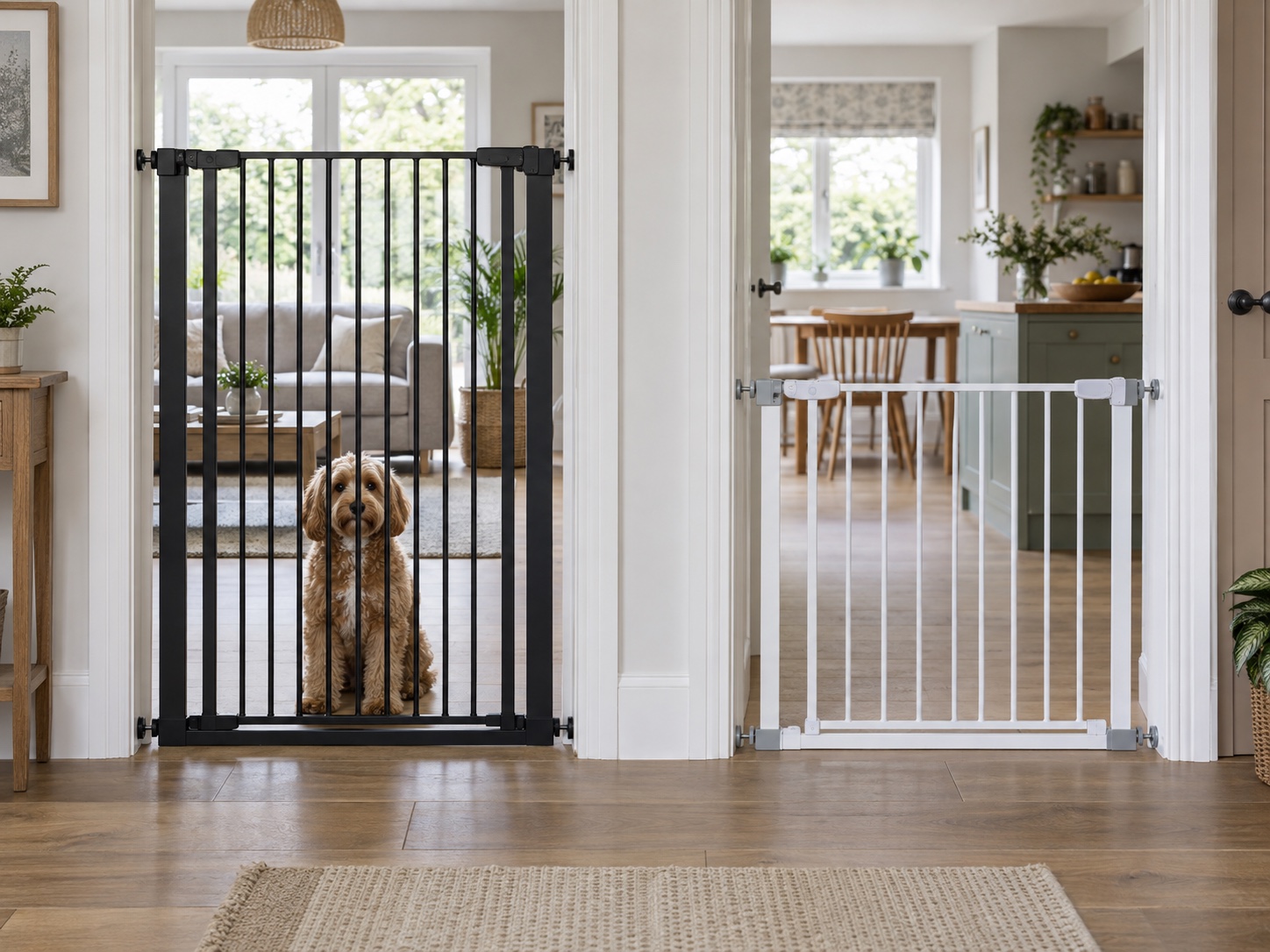
Intended use matters more than appearance; never assume a pet-only product is child safety equipment.
Extra height and cat flaps can help pet management but may introduce different gaps and moving parts.
At stairs, follow the exact product's approved position, mounting and swing instructions.
The names describe intended users
“Dog gate” is a broad retail label covering fixed, pressure-fit, retractable and freestanding pet barriers. “Baby gate” or safety barrier describes equipment intended to restrict a young child's access under defined instructions. Products can overlap, but the labels are not interchangeable proof.
PDSA suggests baby gates for dogs because they preserve sightlines while setting room boundaries. That can work well when the gate also matches the dog's height, strength and body size. The reverse assumption is unsafe: a pet-only gate should not be used for child safety without the required documentation and instructions.
Scroll horizontally to see all columns →
| Feature | Dog gate | Baby gate | Why it matters |
|---|---|---|---|
| Primary purpose | Pet access management | Child safety barrier | Use the exact intended-use instructions |
| Height | Standard or extra tall | Often standard doorway height | Dog jumping changes the requirement |
| Small opening | May include a cat flap | Normally no pet flap | A flap can defeat child or small-dog containment |
| Fitting | Pressure, wall or freestanding | Pressure or wall mounted | Location controls the safe method |
| Stairs | Not every pet gate is suitable | Exact-model instructions apply | Top landings need structural and trip-risk care |
Height and jumping
Standard child gates may be high enough for a small or boundary-respecting dog. Pet ranges often add 90–110cm options for taller or athletic dogs. The requirement comes from the individual animal's standing reach, jump and climbing behaviour—not weight.
PawHut's selected pet gate is 104cm high and includes a cat flap. That combination addresses a multi-pet household but is not automatically appropriate where a child must also be contained.
Bar spacing and small openings
Check whether the smallest dog's head, shoulders or body can pass through the bars or beneath the installed gate. Puppies grow, but an unsafe gap matters now. Do not attach loose mesh or panels unless the manufacturer approves the modification.
A cat flap is useful only if the restricted dog cannot squeeze through. In a home with a young child, an extra opening can undermine the barrier's purpose and should not be assumed acceptable.
Pressure fit, wall mounted and freestanding
Pressure-fit gates brace across an opening and normally retain a full-width floor bar. They can be convenient between rooms but need the correct tension and compatible surfaces. Wall-mounted gates use mechanical fixings and can avoid the threshold.
The Safety 1st Wall Fix example spans 62–102cm, has no bottom pressure frame and allows controlled opening direction. It is sold as a child safety gate and can also create a dog boundary when the height and spacing suit the dog.
Freestanding pet gates are another category. They can work as a visual boundary for a calm trained dog, but they are easy to push and should not guard a stair edge, exterior door or serious household hazard.
Stairs change the answer
At the top landing, choose only an exact product approved for the location. Secure wall mounting, a no-trip-bar design and opening away from the stair flight are central. A generic extra-tall pressure gate is not made top-of-stairs equipment by its height.
At the bottom, follow the gate instructions about placement near the lowest tread. Read our complete dog gates for stairs guide before buying.
Homes with dogs and children
Choose for the most vulnerable user and the most demanding location. If the gate must protect a child at stairs and contain an athletic dog, it needs documented child-safety suitability for the location plus enough height and spacing for the dog. You may need a different room plan if no single product satisfies both.
Keep pet food, toys and beds away from the gate so a child cannot reach through and a dog does not guard the threshold. Teach adults and older children to close and check the latch every time.
How to choose
- Define who and what the gate must contain.
- Identify whether the opening is level, at the top of stairs or at the bottom.
- Measure the opening at several heights and inspect the fixing surfaces.
- Measure the dog and assess jumping, climbing and squeezing.
- Read the exact model instructions before purchase.
- Install every specified component and test the complete gate.
For pet-focused doorway options, compare our best indoor dog gates and extra-tall dog gates.
Common questions
Frequently asked questions
Can I use a baby gate for a dog?
Often, if its width, height, spacing and installation contain the individual dog and you follow all instructions. PDSA specifically notes baby gates as useful dog boundaries.
Can I use a dog gate for a baby?
Not unless the exact product is sold and documented as a child safety barrier for the intended location. Pet-only height or strength claims do not establish child-safety compliance.
Are dog gates taller than baby gates?
Many pet gates are offered in extra-tall versions for jumping dogs, but ranges overlap. Compare the exact published height rather than relying on the category name.
Why do dog gates have cat flaps?
A small flap can preserve access for a cat while restricting a larger dog. It is only useful when the dog cannot fit through and when no child-safety requirement rules out the opening.
Which gate is best for stairs?
A product explicitly approved for the exact top or bottom position, fitted according to its instructions. At the top, a securely wall-mounted gate without a pressure-frame trip bar is the conservative choice.
Sources
- PDSA — making your home dog friendly — baby gates as visible boundaries for dogs
- BabyDan — safety gate types — pressure and wall-mounted gate distinctions
- BabyDan — gate manuals — exact-model width, mounting and safety instructions
- Amazon UK example products linked in the guide