
Puppy crate sizing guide
Puppy crate sizing as your dog grows
Choose and resize a puppy crate with measured posture, a compatible divider and regular fit checks instead of relying on breed charts alone.
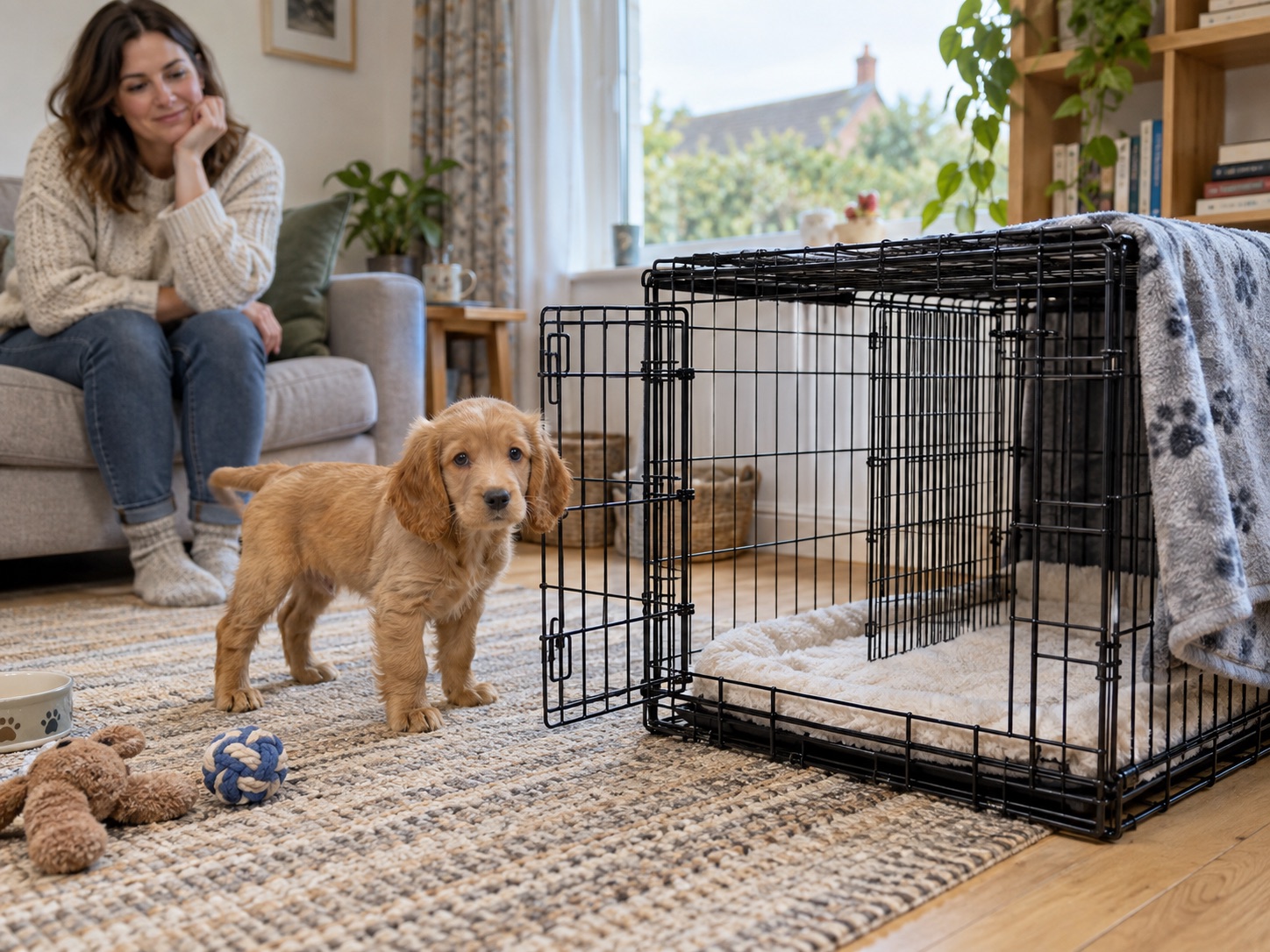
Record the puppy's current body and resting measurements before buying.
Estimate adult size cautiously; breed and parent size are only guides.
Recheck the furnished crate and move the divider before it becomes restrictive.
Start with the puppy in front of you
A breed estimate helps plan, but today's puppy needs today's usable space. Measure nose to tail base, natural sitting height, shoulder width and longest relaxed lie. Watch the puppy stand, turn and stretch. Then check those movements in the crate with its tray, bedding and water in place. Our dog measuring guide gives the sequence.
Puppies grow unevenly: legs may lengthen before body width, ears may change how sitting clearance looks, and sleep posture changes. No single nominal crate length will remain appropriate without rechecking.
Scroll horizontally to see all columns →
| Approach | Advantage | Limit | Best check |
|---|---|---|---|
| Small crate now | Compact initial footprint | Can be outgrown quickly | Measure every growth stage |
| Adult-size crate with divider | Potentially one long-term purchase | Adult estimate may change | Secure panel and current fit |
| Larger crate without divider | More space for movement | May complicate some toilet routines | Safe layout and supervision |
Small crate now or larger crate with a divider?
A small crate can suit a tiny puppy in a compact home, but it may be a short-lived purchase. The MidWest 18-inch example is a genuine small wire crate with a divider and removable tray. Its approximately 47cm outside length should prompt careful measurement rather than an assumption that every “small puppy” fits.
An adult-size model with a matching divider may offer longer service. The MidWest 36-inch example provides a larger overall structure and a supplied divider. Whether it will fit adulthood depends on your dog's eventual dimensions, and whether it works today depends on the correctly arranged puppy section.
Do not buy a large crate purely from a guessed adult weight. Ask about internal dimensions, door clearance and the exact divider fittings. If adult size is especially uncertain, it may be sensible to reassess later rather than force a poor fit now.
Set up a safe usable section
Install the divider exactly as instructed and check there are no trapping gaps or projecting ends. The puppy should stand, sit, turn and lie naturally in front of it. Add the actual bed or mat before judging the remaining height. A bowl must be stable and accessible without blocking the movement route. Our labelled divider-position examples explain the geometry without prescribing a universal puppy-space minimum.
Avoid an overly deep bed that steals much of a puppy's headroom or a soft bolster that pushes the puppy against the divider. Check the space needed for bedding and bowls as a separate step.
Reassess during each growth stage
During rapid growth, inspect the fit at least weekly and whenever posture changes. Move the divider before the puppy starts pressing against it or shortening its sleep position. Recheck latch security and bowl height after each adjustment. When the full crate is in use, measure again rather than assuming the adult prediction was right.
Crate size is only one part of a good experience. Introduce the space gradually and positively, provide frequent toilet opportunities and respond if the puppy is distressed. When growth changes the footprint or the room no longer works, review when to move or resize the crate. See how to introduce a puppy to a crate and the first-night guide for practical routines.
Common questions
Frequently asked questions
What size crate should I buy for a puppy?
Buy a model that allows the puppy to stand, sit, turn and lie naturally now. If using an adult-size crate, confirm adult-size estimates and fit a compatible divider without restricting current posture.
Should a puppy crate be just big enough to turn around?
No. Turning is only one check. The puppy must also sit and stand without touching the roof and lie naturally with bedding and water arranged safely.
When should I remove the divider?
Move it as the puppy grows and remove it when the full crate is suitable and the manufacturer's instructions permit. Do not wait for obvious crowding.
Can a puppy use an adult-size crate immediately?
Often yes if the puppy has a safe, suitable usable area and a positive introduction. A compatible divider may help with space management; the whole setup and toilet routine still need attention.
Is a weight-based breed chart enough?
No. Weight does not reveal body length, sitting height or sleeping posture. Measure your individual puppy and check the actual interior of the selected model.
Sources
- PDSA — crate training and fit
- RSPCA — dog crates and puppy playpens
- Amazon UK example products linked in the guide