
Pressure-fit dog gate safety guide
Choosing a pressure-fit dog gate
Choose a pressure-fit dog gate for a suitable UK doorway, checking the opening, wall strength, extension kit, floor bar and dog behaviour.
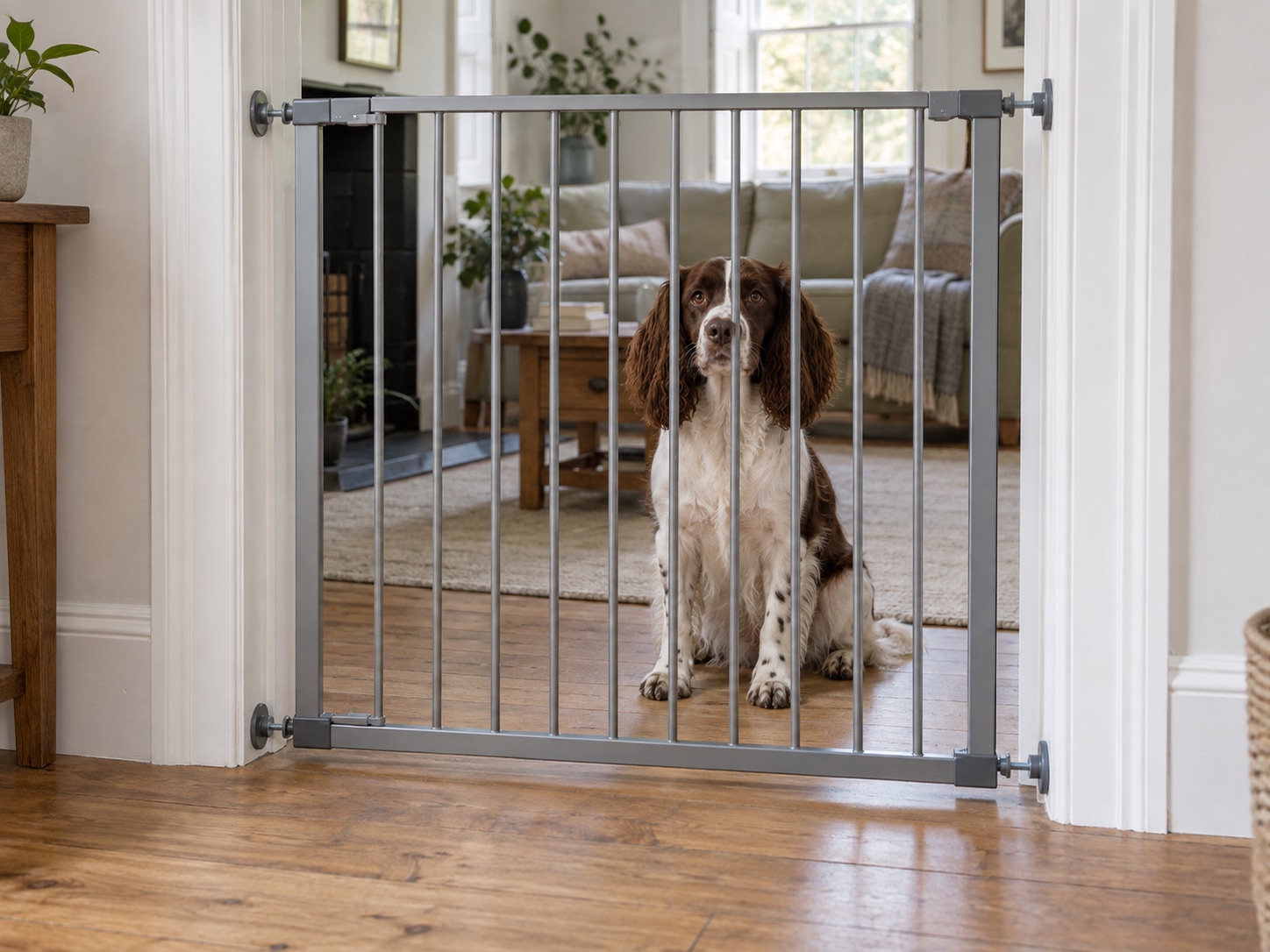
Our recommendations
Pressure-fit formats to compare
Height varies more than base width across these examples. Decide the location and fit first, then choose enough height for the individual dog.

Safety 1st Easy Close Extra Tall gate
Best for: A standard ground-floor doorway needing a 91cm gate
A pressure-fit metal walk-through gate listed at 91cm high and 73–80cm wide, extendable to 94cm with the appropriate extensions.
What stands out
- 91cm height
- Walk-through door
- Extensions available for wider openings
Keep in mind
- Floor bar creates a trip point
- Pressure must be installed and rechecked correctly
- Too low for some jumping dogs
- 91cm high
- Fits 73–80cm as supplied
- Up to 94cm with extensions
- Pressure fit

PawHut 104cm extra-tall dog gate with cat flap
Best for: A ground-floor doorway where a dog is restricted but a cat needs separate access
A 104cm-high pressure-fit metal gate with an integrated small-pet flap. The selected version is listed for 74–80cm openings.
What stands out
- 104cm overall height
- Integrated cat flap
- Walk-through main gate
Keep in mind
- Small-pet opening may not suit every household
- Pressure fit creates a floor bar
- Narrow listed width range
- 104cm high
- Fits 74–80cm openings
- Cat flap
- Pressure-fit metal frame

Venture Q-Fix 110cm extra-tall gate
Best for: A tall or athletic dog in a compatible ground-floor opening
At a listed 110cm high, this pressure-fit metal gate is taller than most child gates. It includes an auto-close walk-through door and is sized for 73–80cm openings before compatible extensions.
What stands out
- 110cm listed height
- Auto-close walk-through door
- Two-way opening for ordinary doorways
Keep in mind
- Pressure fit and floor bar
- Base width must match exactly
- Not our top-of-stairs format
- 110cm high
- Fits 73–80cm
- Auto close
- Pressure fit
Scroll horizontally to see all columns →
| Gate | Listed base width | Height | Particular check |
|---|---|---|---|
| Safety 1st Extra Tall | 73–80cm | 91cm | Compatible extensions only |
| PawHut with pet flap | 74–80cm | 104cm | Small flap may defeat boundary |
| Venture Q-Fix | 73–80cm | 110cm | High frame still has floor bar |
Check the opening before choosing a height
A pressure-fit frame pushes four pads against the sides of an opening. That can avoid drilling in a straightforward ground-floor doorway, but it cannot create sound walls or make an irregular opening square. Record the width at floor, middle and top, and note skirting, wallpaper, hollow partitions or curved banisters. The selected kit's range must include the installed position, not merely one centre measurement.
The dog-gate measuring guide includes a manufacturer-documented Premier extension table and an illustrated skirting example. Its ranges belong to that named manual, not to the other gates below; use the exact supplied instructions for your chosen model.
The continuous frame leaves a bar at floor level. Walk the route as you normally use it, carrying laundry or moving between rooms, and decide whether that step-over point is acceptable. At the top of stairs, RoSPA's safety-gate evaluation favours a fixed design without a trip bar. Read our gate-for-stairs guide before any stair purchase.
The pressure-fit examples in detail
Safety 1st Extra Tall: 91cm standard-width choice
This metal walk-through model is listed at 91cm high for a 73–80cm base opening, with compatible extensions for some wider arrangements. It gives more height than many basic child gates without requiring a very tall frame.
Check the exact extension and wall-cup instructions if your doorway is beyond its base range. Do not treat the headline extended width as permission to bridge a soft or uneven wall.
PawHut 104cm: taller, with a pet flap
PawHut's 104cm gate is listed for 74–80cm openings before any compatible expansion. Its small-pet flap may be useful in a dog-and-cat household, but only if the restricted dog cannot fit through it. Measure the dog's head and shoulders against the actual flap.
The main gate still has the pressure-frame base bar. Test both latches independently and make sure the cat flap cannot be nudged open by the dog.
Venture Q-Fix: 110cm height
The Venture has a listed 110cm height and 73–80cm base width. It offers the tallest frame here for a level doorway where a dog has been stepping over lower gates. Height does not solve climbing from furniture or distress-driven pushing.
If the dog is jumping, remove nearby take-off points and assess the behaviour. A gate should manage access, not become an obstacle the dog repeatedly collides with.
Fit and retest the complete frame
Read the instructions before removing packaging. Place pads at the specified heights, tighten evenly, and use any maker-provided tension or alignment indicator. Some pressure gates appear bowed before installation; the instructions explain how the final frame should align. Never assume an open latch gap is a defect or safe final state without checking the manual.
Operate the door repeatedly. It should close and latch without the frame moving. Apply gentle pressure at the top and lower corners from both sides. If the frame rocks, the latch misses or a pad sits partly on skirting, stop and select another arrangement. Our skirting-board guide covers the geometry.
Recheck tension and latch action regularly and after impacts. If a child also uses the space, choose a model approved for child safety and install it exactly for that purpose; a pet label alone is not enough.
Common questions
Frequently asked questions
Is a pressure-fit dog gate safe at the top of stairs?
We would not select one as the default. A pressure frame usually has a trip bar and its hold depends on sustained tension. Use a model expressly approved for that position and follow its complete instructions; fixed, no-trip designs are the safer starting point.
Do pressure-fit gates damage walls?
Pads can mark weak paint or plaster and overtightening can damage a surface. Wall cups or protectors must be compatible with the exact model and position; they cannot compensate for a weak fixing surface.
How tight should a pressure gate be?
Use the maker's alignment and tension indicators and tighten evenly as directed. A gate that shifts, racks or cannot latch correctly needs refitting, not more force at one corner.
Can I use any extension kit?
No. Extensions change the gate's geometry and must be listed for the exact model, with all required cups and fixings. Never combine unrelated kits.
Why is there a bar across the floor?
The pressure frame forms a continuous structure around the walk-through door. Its lower rail creates a step-over point that must be considered in a busy route and near stairs.
Sources
- BabyDan — safety gate types
- RoSPA — fixed versus pressure gate rationale
- Amazon UK product listings linked from the guide