
Car boot crate buying guide
Choosing a dog crate for a car boot
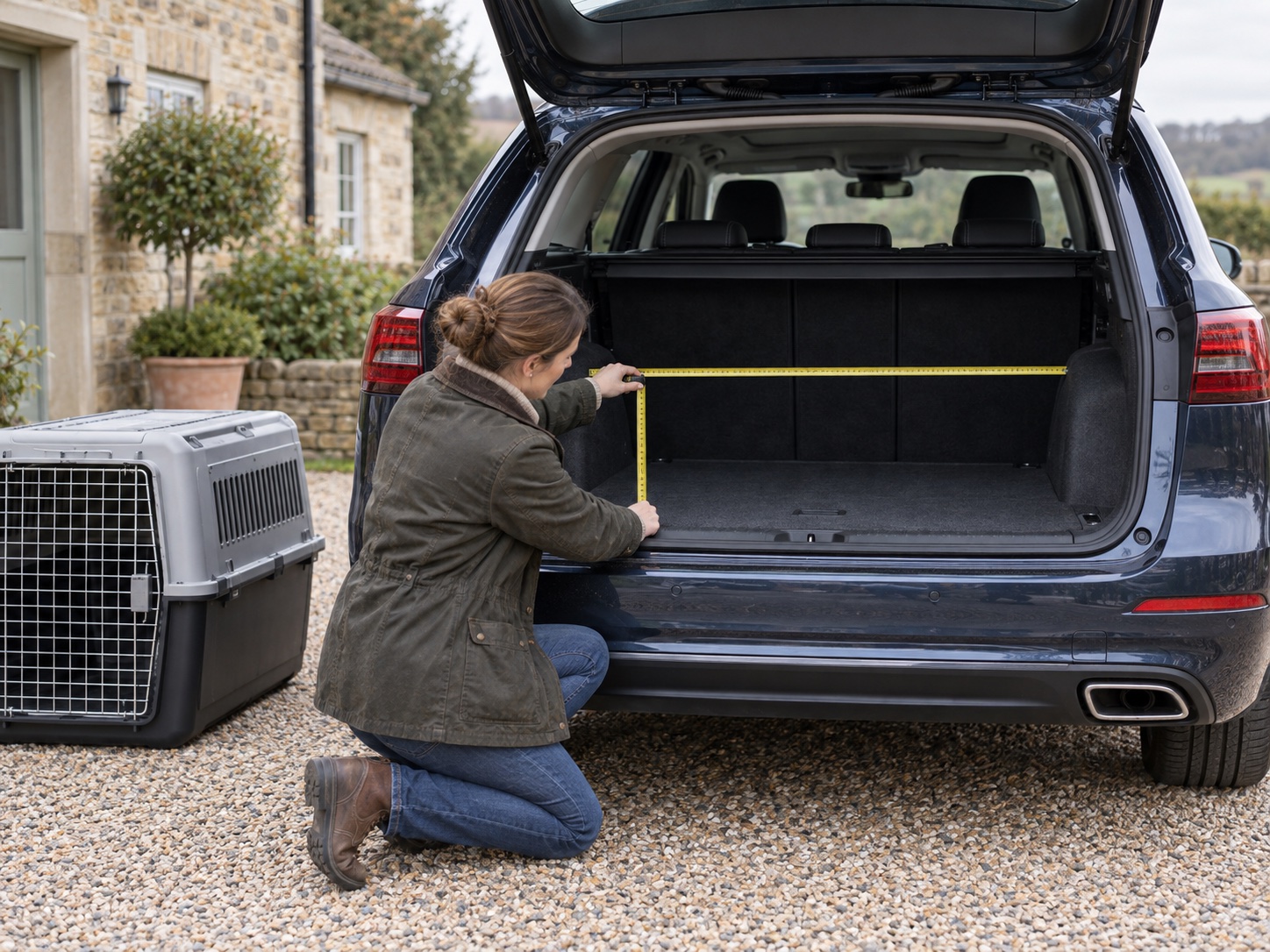
Measure your dog and car boot correctly, account for the tailgate and choose a dog crate that fits, opens and secures as its manufacturer intends.
Our recommendations
Car-boot crate formats to compare
These options cover moulded plastic, compact aluminium, an evidence-led adjustable system and a wide divided format. Published dimensions are only a screening step; complete the physical fit checks below.

Ferplast Atlas Car 80 Scenic
Best for: A medium dog and compatible boot needing broad ventilation and a sliding door
A thermoplastic boot carrier with a two-way sliding door, front and rear grids, side ventilation and a removable draining mat.
What stands out
- Sliding door saves swing space
- Removable draining mat
- Official dimensions published
Keep in mind
- Not presented as crash tested
- Boot and dog must both be measured
- 20kg is a load limit, not a fit test
- 82 × 51 × 61cm
- Maximum load 20kg
- Two-way sliding door
- Draining mat

CADOCA medium aluminium car crate
Best for: A measured small-to-medium dog and a boot needing a sloped rigid profile
A 70cm aluminium-frame transport crate with a trapezoidal profile, lockable door and ventilated sides.
What stands out
- Sloped boot profile
- Lockable door
- Light aluminium frame
Keep in mind
- No documented crash testing
- Interior dimensions not clearly published
- Generic fit claims require physical measurement
- 70 × 54 × 51cm
- Aluminium frame
- Trapezoidal profile
- Lockable door

Thule Allax car dog crate, small
Best for: A compatible car and dog where model-specific test documentation matters
An adjustable-depth aluminium car crate with a crumple zone, locking door and rear escape hatch. Thule describes front, rear and simulated roll-over testing for the Allax range.
What stands out
- TÜV SÜD reference published by Thule
- Adjustable depth
- Rear escape hatch
Keep in mind
- Premium price
- Heavy rigid installation
- Vehicle compatibility must be checked
- Small variant
- Adjustable depth
- Crumple zone
- Built-in lock

Cozy Pet ACDC12 aluminium car crate
Best for: A wide compatible boot needing two doors and an optional divider
An approximately 89–90cm-wide aluminium car crate with angled back, double doors, removable divider, locks and all-round ventilation. The listing varies by 1cm on width.
What stands out
- Two doors
- Removable divider
- Angled back
Keep in mind
- Large footprint
- Flat-pack assembly
- No documented crash testing
- 89–90 × 69 × 60cm (listed width varies)
- Double doors
- Removable divider
- Pre-fitted locks
Scroll horizontally to see all columns →
| Model | Published external size | Shape | Door | Evidence note |
|---|---|---|---|---|
| Ferplast Atlas Car 80 Scenic | 82 × 51 × 61cm | Moulded rectangular shell | Two-way sliding | No crash-test claim on official page |
| CADOCA medium | 70 × 54 × 51cm | Sloped aluminium frame | Single lockable | No exact-model report supplied |
| Thule Allax S | Adjustable depth; use fit tool | Sloped adjustable frame | Front plus rear escape hatch | Documented testing and TÜV SÜD certificate |
| Cozy Pet ACDC12 | 89–90 × 69 × 60cm (listing varies) | Wide angled-back frame | Double front doors | No exact-model report supplied |
The three things that must fit
A useful car-crate decision sits at the overlap of three measurements: the dog, the route into the vehicle and the usable boot after the tailgate closes. Product photos cannot establish any of them.
The dog must have the posture and movement space required by the manufacturer. The assembled crate must pass through the real opening rather than merely fit the boot's advertised litres. Once inside, it must sit securely without obstructing doors, vents, straps or any designed deformation space.
Measure the dog first
Measure while the dog is standing naturally on a level floor. Record nose-to-tail-base length, floor-to-head or ear height in the tallest normal posture, shoulder width and the space used when lying comfortably. Repeat rather than stretching the dog into position.
The manufacturer's sizing method takes priority because different designs allow movement differently. A kilogram limit is structural guidance, not proof of fit: two dogs of the same weight can have very different heights and body lengths.
If the dog's required internal space exceeds the car's available space, change the vehicle position or restraint approach. Do not buy a smaller crate and ask the dog to adapt.
Measure the route into the boot
Open the tailgate fully on level ground and record:
- the narrowest width, often between trim, lights or latch housings;
- clear height from the highest part of the sill to the lowest roof trim;
- sill height and the lift needed to bring the crate in level;
- any lip, hooks or trim that reduce the opening; and
- the diagonal only if the assembled crate can safely be tilted and the instructions allow it.
A flat-pack crate may enter before assembly, but that does not solve future removal, emergency access or routine fastener checks. Plan for the complete lifecycle, not only the first installation.
Use the annotated boot diagrams and fit-planning worksheet to keep hatch access, floor depth, upper profile and installation allowances in separate fields. The worked example shows why a floor fit can fail at roof height.
Measure the usable space inside
Measure width between the wheel arches at floor level and again above them. Record depth along the floor from the seat backs to the tailgate, then repeat at the crate's proposed roof height. Seat backs and tailgates usually slope in opposite directions, making the usable upper section shorter.
Close the tailgate slowly over an empty cardboard profile or taped mock-up. Check the window, wiper housing, latch and internal trim. Leave room for door movement, tension straps and the clearance stated in the manual. Never put yourself inside the closed boot while measuring.
Four crate shapes and where they work
Ferplast Atlas Car 80 Scenic: sliding-door practicality
Ferplast publishes an external size of 82 × 51 × 61cm and a 20kg maximum. The two-way sliding door avoids a large outward swing, while the moulded shell and removable draining mat suit wet or muddy journeys.
The weight limit does not replace dog measurements, and Ferplast does not publish crash-test evidence on the official page checked. Compare its full height with the tailgate curve and make sure the broad ventilation grids remain exposed.
CADOCA medium: a compact sloped profile
The published 70 × 54 × 51cm exterior and trapezoidal frame can suit a smaller boot where straight-sided household crates collide with the rear seats. The trade-off is that the sloped roof reduces internal space at one end.
Measure the dog's sitting position against the usable interior, not the tallest external point. The Amazon listing does not provide an exact-model crash-test report, so do not infer one from the aluminium construction.
Thule Allax S: adjustable, documented installation
The Allax uses adjustable depth, a locking gas-damped front door, rear escape hatch and tension-band installation to the boot's cargo loops. Thule also specifies a crumple-zone allowance of 10–13cm and supplies a vehicle fit tool.
That rear gap is part of the design rather than wasted luggage space. Confirm that the car has suitable anchor points, that both exits remain usable and that the selected small variant fits the dog.
Cozy Pet ACDC12: width and two-door access
At approximately 89–90 × 69 × 60cm, this is the widest option in the group. The product title states 89cm width while a listing bullet states 90cm; confirm the assembled width before using it for a tight boot fit. Two front doors can make access easier across a broad boot, and the removable divider creates separate zones.
It needs a large aperture and clear floor between the arches. A divider does not establish that two dogs are compatible or suitably accommodated, and the listing does not provide crash-test documentation.
Check the car before choosing a model
Find the vehicle handbook's cargo-loop information and compare it with the crate instructions. Some rings are intended for light luggage management rather than the loads assumed by a restraint manufacturer. Do not route straps over sharp trim, through a door or around a ventilation bar unless the instructions show that method.
Consider visibility too. A tall crate can restrict the driver's rear view, and a wide crate can block access to a spare wheel or charging cable. Those practical conflicts are reasons to choose another setup rather than leave the crate unsecured for convenience.
Test the installation before the dog travels
Install the empty crate, attach it exactly as directed and close every door. Apply firm hand pressure from front, back and side; it should not slide, rock against the trim or interfere with the tailgate. Confirm that locks, straps and an emergency exit can still be reached.
Add only bedding that leaves the dog stable and does not obstruct drainage or hardware. Secure every other item in the boot. A suitcase beside the crate becomes part of the restraint problem if it can move.
Introduce the dog while the vehicle is parked and cool. Build from voluntary entry to short closed-door periods, then brief drives. Panting in cool weather, frantic scratching, repeated escape attempts or refusal of normally valued food can indicate distress and call for a slower plan or professional help.
For broader comparisons, see the best dog crates for car travel and our evidence-focused guide to crash-tested dog crates.
Common questions
Frequently asked questions
How do I know whether a dog crate will fit my car boot?
Compare the assembled external crate measurements with the narrowest boot opening, sill height, usable floor, roof-level depth and closed-tailgate curve. Make a full-size cardboard footprint and height profile if the fit is close, and confirm the manufacturer's vehicle compatibility information.
Should a car crate fill the whole boot?
Not necessarily. The crate needs the manufacturer's required clearance, ventilation and attachment space. Some tested designs also need a specified crumple-zone gap, so filling every centimetre can make the installation wrong.
Is a sloped dog crate better for a car?
A sloped back or front can follow the seat backs or tailgate and recover useful space, but it also changes the dog's usable headroom and floor area. Measure the internal shape as well as the external footprint.
Can I secure a dog crate with bungee cords?
Use only the attachment method and suitable hardware specified by the manufacturer. Elastic cords and improvised routes may allow movement and should not be treated as equivalent to a designed restraint system.
Can luggage sit beside a dog crate?
Only when it cannot block ventilation, doors or an emergency exit and is itself secured so it cannot strike the dog or crate. Keep any required crumple zone and strap access clear.
Sources
- GOV.UK — Highway Code Rule 57 — suitable restraint guidance for animals in vehicles
- Thule — Allax product and fit information — adjustable depth, installation and crumple-zone clearance
- Thule — Allax instructions — vehicle installation and attachment requirements
- Ferplast — Atlas Car 80 Scenic specifications — official size, load, construction and door details
- Amazon UK product pages linked from the product cards