
Evidence-led buying guide
Best dog car harnesses UK
Compare dog car harness evidence by exact version, tested sizes, dummy loads and belt attachment, with fit guidance and clear limits to manufacturer claims.
Our recommendations
Car harnesses with published evidence
These differ in attachment design and size range. Match the exact size and version offered to the manufacturer's current instructions and documentation.

Kurgo Enhanced Strength Tru-Fit harness, medium
Best for: A medium dog needing a vehicle harness with published dynamic test reports
A five-point adjustable harness with a broad padded chest plate, steel nesting buckles and an included seatbelt loop and carabiner.
What stands out
- Manufacturer publishes test methodology and reports
- Five adjustment points
- Steel nesting buckles
Keep in mind
- Correct version and size matter
- Tested direct carabiner route is not an extended tether
- Not interchangeable with an ordinary walking harness
- Medium
- Neck 40.5–63.5cm
- Chest 45.5–71cm
- Includes seatbelt tether

EzyDog Drive car harness, small
Best for: A small dog needing a purpose-built car harness without a separate tether
A padded step-in vehicle harness that integrates directly with the car seatbelt through its top handles and uses vehicle-tested seatbelt webbing.
What stands out
- Direct seatbelt integration
- Manufacturer states FMVSS 213 testing
- Padded moulded chest plate
Keep in mind
- Initial fitting takes care
- Selected small size has a broad girth range
- Purpose-built for car travel rather than general walking
- Small
- Girth 28–64cm
- Seatbelt-webbing construction
- Two-buckle closure
Scroll horizontally to see all columns →
| Harness | Vehicle connection | Fitting focus | Published evidence |
|---|---|---|---|
| Kurgo Enhanced Strength Tru-Fit | Direct carabiner route in the 2018 v3 report | Five adjustments and chest fit | Kurgo methodology and size-specific dynamic reports |
| EzyDog Drive | Vehicle belt through integrated handles | Padded chest plate and staged adjustment | EzyDog-described FMVSS 213-based method |
Start with the evidence boundary
Highway Code Rule 57 says a dog should be suitably restrained so it cannot distract the driver or injure itself or people during a sudden stop. A seatbelt harness is one example, but the rule does not validate every harness sold for cars.
“Crash tested” is only useful when you can identify the product version, size or test mass, method, conditions and result. FMVSS 213 is a US child-restraint framework adapted in some pet-product testing; invoking the name does not make a dog harness a certified child seat. The result does not transfer to a different harness from the same brand.
Harness evidence by version, size and attachment
This uses the same approach as our crash-tested crate evidence comparison: identify the actual evidence object, then preserve its method and installation boundary. A full laboratory report and a manufacturer summary are different forms of evidence; the rows are not a safety ranking.
Scroll horizontally to see all columns →
| Exact evidence object | Size / source-labelled test load | Method / record | Attachment scope | Reported result / boundary |
|---|---|---|---|---|
| Kurgo Enhanced Strength Tru-Fit v.3 · 01256 | Small · 25lb | Calspan 4762-18-01 · 001B · 30mph | Lap + shoulder belt through carabiner; no tether in run | Pass; 26in head excursion; no post-test issues. |
| Kurgo Enhanced Strength Tru-Fit v.3 · 01257 | Medium · 50lb | Same report · 002A · 29.6mph | Same direct carabiner configuration | Pass; 28.7in excursion; slight carabiner deformation. |
| Kurgo Enhanced Strength Tru-Fit v.3 · 01258 | Large · 75lb | Same report · data row 004B · 29.8mph | Same direct carabiner configuration | 32.9in excursion; slight connector bend. Pass list names 1A instead: run labels differ. |
| EzyDog Drive · no numbered version identified in summary | Small 28lb / 12.5kg; Medium 50lb / 22.5kg; Large 75lb / 34kg | Maker's ASE Australia summary / videos; child-seat-based method | Published fitting route: vehicle belt through both top handles; not a full lab setup record | Manufacturer conformance claim; report ID, per-run speed and excursion not supplied in this summary. |
Reading the Kurgo report: the manufacturer reports passing v3 sizes, but a pass is not an undamaged result. The medium and large records note deformation. Its large data row and pass list also use different run labels, so do not silently equate them. The report describes indicator testing, not assurance of passing a government standard.
Reading the EzyDog summary: the paired pound/kilogram loads above preserve the manufacturer's rounded labels. Its Drive retail name is not a numbered version identifier. The published instructions establish the intended belt route, but the summary is not a complete laboratory configuration report. A claim about a testing facility's child-seat recognition is not government certification of a dog harness.
A tested size is not the whole retail size range
Kurgo's cited v3 evidence covers small, medium and large at 25, 50 and 75lb. Its retail chart also offers extra-small and extra-large. Those extra sizes are not established by these runs. Even within a tested size, a chart's suggested dog-weight range is not a test result for every weight in that range: the current large chart extends to 80lb, which should not be substituted for the documented 75lb load.
EzyDog's UK girth ranges are 28–64cm small, 38–86cm medium and 49–106cm large. Girth is a fit measurement, not a test load. A small harness fitting a broad-chested dog does not make its small-test summary equivalent to the large-load evidence. Check body fit, the relevant evidence and the exact vehicle connection independently.
Product naming, buckle appearance and a generic crash-tested badge are not sufficient version identification. Match the supplied model information and instructions to the record you rely on. If a listing or supplied item does not establish that match, do not treat historical evidence as an automatic endorsement of the item in hand.
The attachment is part of the evidence
The presence of a tether in a package does not mean a test used it to bridge the dog to the belt. For the cited Kurgo v3 configuration, both belt sections pass through the carabiner and the report records no tether in the run. Kurgo's fitting instructions put the carabiner through the specified back strap, leave the tether loose, and exclude walking leash attachments from vehicle securing. Follow the exact instructions rather than treating all supplied pieces as interchangeable restraint routes.
Drive's manufacturer instructions route the vehicle belt through both top handles, without an added seatbelt restraint. A separate buckle-ended lead, longer tether, bungee, walking D-ring connection or attachment to a collar is a different configuration. Extra freedom is not necessarily equivalent evidence, and a correct harness size cannot correct the wrong load path.
Before buying, record: exact family/version; size; source-labelled load; method/report identity; result and post-run damage; required connection; vehicle-seat/belt compatibility. That short evidence record is more useful than counting crash-tested logos. Recheck the instructions on the item supplied and replace damaged restraint equipment as the maker directs.
The harnesses in detail
Kurgo Enhanced Strength Tru-Fit: published dynamic reports
The selected medium product belongs to the Enhanced Strength Tru-Fit family, with five adjustment points and steel nesting buckles. Verify its exact version against the v3 evidence above rather than assuming every Tru-Fit-labelled harness is the same object. Its included tether is not a reason to ignore the direct carabiner configuration; match the supplied instructions and the applicable report before relying on the evidence.
EzyDog Drive: direct seatbelt routing
EzyDog's Drive places a padded chest plate against the body and routes the vehicle belt through integrated handles. Its UK page supplies fitting guidance; the manufacturer's US product page explicitly names FMVSS 213. The selected variant here is small. Body shape and adjustment still matter within its girth range: the chest plate should sit as instructed, and both belt sections must follow the maker's route without an added tether.
Measure, fit and install in that order
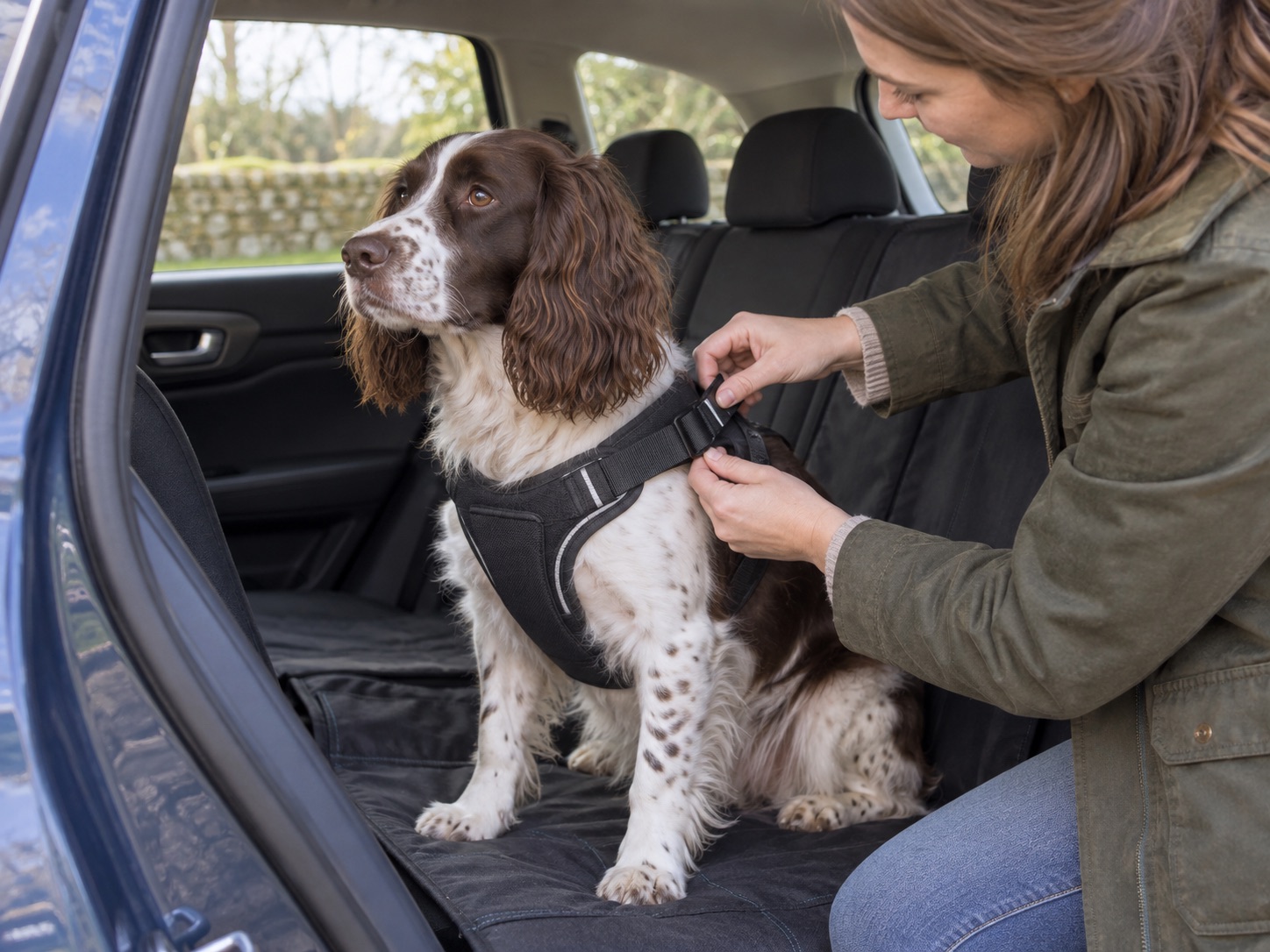
Measure around the widest part of the ribcage immediately behind the front legs while the dog stands, and check any neck and weight requirements in the current size chart. Our harness-measuring guide covers the checkpoints. A harness too loose can rotate or allow escape; one too tight can restrict shoulder movement or breathing.
Fit the harness away from traffic, then practise in a stationary, cool car. Place the dog on the seat specified by the maker and route the vehicle belt or supplied tether precisely as instructed. Keep the dog from reaching the front seats or window controls. Recheck strap position after a short journey; a correct standing fit can shift when the dog lies down.
If a harness cannot be fitted securely to the dog's shape, compare a purpose-built vehicle crate rather than improvising with a walking harness. Medical or mobility concerns may warrant veterinary advice before selecting a restraint.
Common questions
Frequently asked questions
Is any dog walking harness suitable for car travel?
No. A walking harness may lack the load path, attachment and evidence intended for a sudden stop. Use a product designed for vehicle restraint and follow its exact instructions.
Does crash tested mean a harness is guaranteed safe?
No test covers every crash, dog or vehicle. Read the tested version, size or load, method, pass criteria and installation conditions; correct fit remains essential.
Should I clip the seatbelt tether to a collar?
No. Follow the harness maker's specified connection. A collar concentrates force at the neck and is not a substitute for an approved car-harness route.
Can I add a longer tether for comfort?
Only if the manufacturer approves it for that exact harness. Extra slack lets the dog travel farther before the restraint loads and can undermine the tested setup.
How tight should a dog car harness be?
It should sit securely where the maker specifies without pressing the throat, rubbing the armpits or limiting normal movement. Use the maker's fit check and remeasure after growth or weight change.
Does a size chart's upper weight equal the crash-test load?
No. A retail fit range and a particular dummy load answer different questions. Kurgo's cited v3 records cover small, medium and large at 25, 50 and 75lb; do not extend those runs to extra-small, extra-large or a heavier dog merely because a chart lists them.
Sources
- GOV.UK — Highway Code Rule 57
- Kurgo — dog-harness crash-testing methodology
- Kurgo — Enhanced Strength Tru-Fit product information
- Calspan — Kurgo report 4762-18-01, published by the manufacturer — Printed pages 3-1 to 3-3; exact v3 runs, attachment and post-run observations. Large run labels differ between data and pass list.
- Kurgo — product-linked fitting instructions
- EzyDog UK — Drive car harness
- EzyDog — size-labelled vehicle-harness testing summary
- EzyDog — Drive attachment and FMVSS 213 claim
- Amazon UK product pages linked from the product cards