
Stair gate safety guide
Choosing a dog gate for stairs
Choose and fit a dog gate for stairs with separate guidance for top and bottom positions, wall mounting, trip bars, swing direction and banisters.
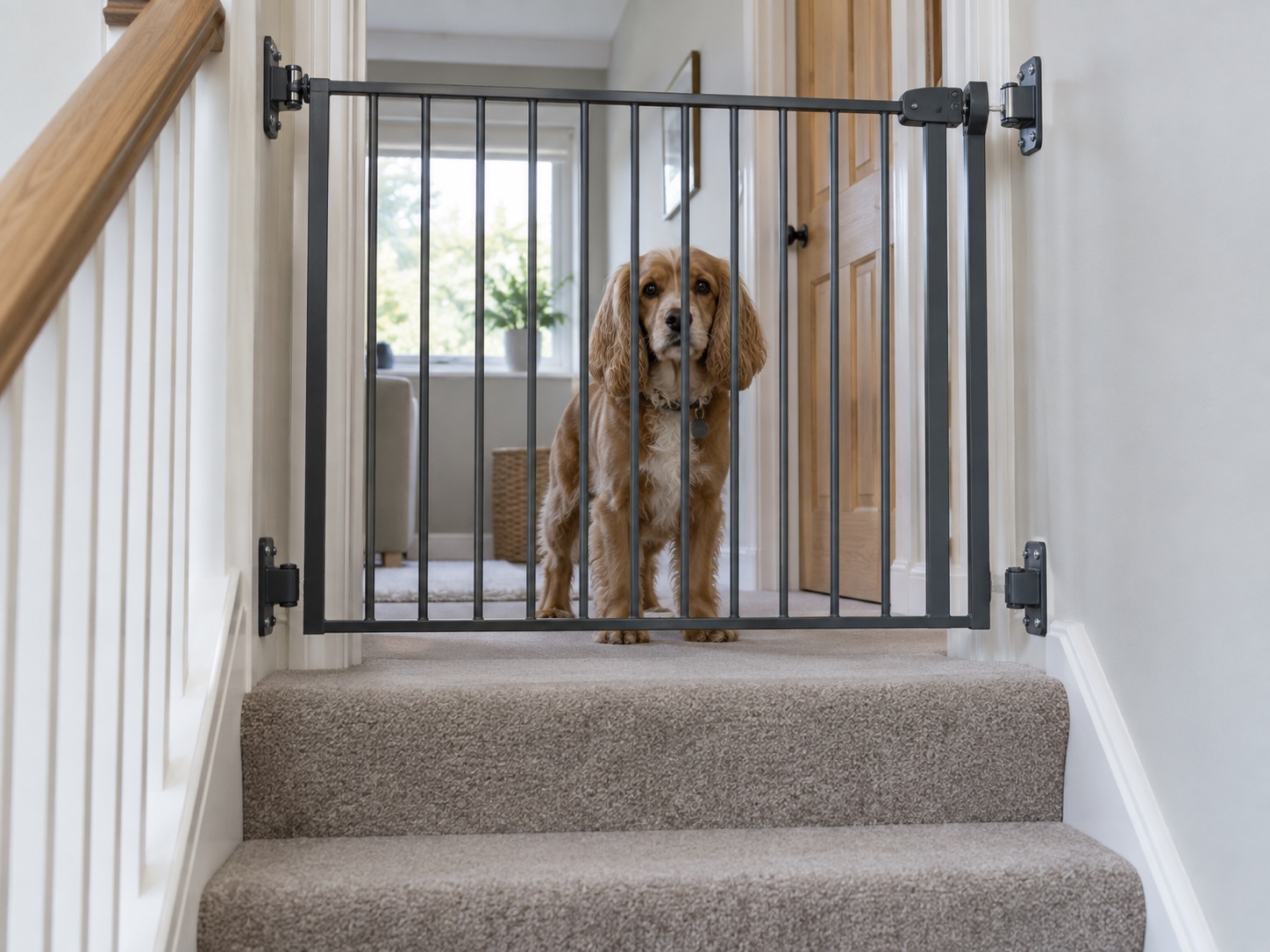
Use the exact gate instructions to confirm top- or bottom-of-stairs suitability before buying.
Measure at several heights and identify wall, post, skirting and handrail constraints.
A dog gate does not make open stairs safe for children unless the exact product is a compliant child safety barrier used as instructed.
Why the top landing needs a separate decision
A doorway gate manages access between level rooms. A top-of-stairs gate stands beside a fall edge, so frame movement, a missed latch or a trip over the threshold can have greater consequences. Select from products whose instructions explicitly cover that position.
BabyDan recommends a wall-mounted gate at the top of stairs. Its AdjustPro instructions also specify placing the barrier at the top level, using a one-way stop and making it open away from the top tread. RoSPA's evaluation describes fixed attachment and no trip bar as reasons a gate was suitable for the top of stairs.
Top-of-stairs checklist
Identify structurally sound fixing points on both sides. Plasterboard, masonry, timber posts and metal balusters need different hardware or adapters. The gate should sit at the landing level rather than partway down the flight, and its open door must not swing over the steps.
Avoid a full-width bottom bar. The user is already changing direction near an edge, so a step-over frame introduces a trip point. Check that the open gate provides enough clear width for normal passage and emergencies.
The Safety 1st Wall Fix extends across 62–102cm and has no pressure frame across the floor. Its one- or two-direction opening needs configuring for the position.
The BabyDan No Trip is a narrower 72–78.5cm wall-mounted option. It removes the threshold but must fit the opening without improvised spacers.
Bottom-of-stairs checklist
At the bottom, the objective is to prevent access to climbable treads. Manufacturer guidance commonly positions the barrier at the front of the lowest tread. A large gap before the gate can leave one or more steps accessible as platforms.
Pressure fit may be permitted for some bottom positions, but the threshold remains a trip point and the exact instructions control. Consider the direction of travel through the hall, door collisions and whether someone carrying laundry can operate the latch reliably.
Uneven walls and banisters
Measure at floor, latch and upper-rail height. Skirting can make the lower opening narrower; a handrail can restrict the upper fixing; a rounded newel post may not accept a flat bracket.
The BabyDan FlexiFit uses wall-mounted flexible fittings and covers 67–105.5cm, which can help with an angled or offset opening. Flexibility is not permission to attach to a weak surface—use the specified parts and suitable structure.
Do not wedge timber scraps behind pressure pads, attach with cable ties or rely on adhesive alone when the instructions call for mechanical fixing. Use an approved banister adapter where available or ask a competent installer to assess the structure.
Match the gate to the dog
Stair suitability does not guarantee pet containment. Check gate height, bar spacing and climbing features against the individual dog. A low no-trip gate can be the right structural format but insufficient for a jumping dog.
Remove nearby furniture, boxes and stair baskets that offer a launch point. If a very small dog can pass between bars or beneath a gap, choose another suitable model rather than adding unapproved mesh.
Install, test and maintain
Read the complete instructions before drilling. Confirm hinge and latch sides, direction stop and final height. Use the fixing type required for the wall or post and install every supplied safety component.
After installation, operate the gate repeatedly and apply controlled pressure at upper and lower corners. Confirm it cannot open towards the flight at the top. Everyone in the household should practise using the latch while keeping one hand free for the handrail.
Check fixings, alignment and latch action regularly and after any impact. Never climb over the gate. If the setup becomes loose, damaged or difficult to close, stop using it until corrected.
For room-only boundaries, see our best indoor dog gates. Once a stair gate is fitted, use the installation checklist to inspect fixings and the latch regularly. If children also use the space, select and install the exact gate for child safety as well as dog management.
Common questions
Frequently asked questions
What type of dog gate is best for the top of stairs?
A manufacturer-approved wall-mounted gate with secure structural fixings, no bottom trip bar and a way to prevent opening towards the stairs. Confirm the exact model and installation position in its instructions.
Can I use a pressure-fit dog gate at the top of stairs?
We would not choose it as the default. Pressure frames usually add a floor bar and can lose tension; BabyDan and RoSPA guidance support fixed, no-trip-bar designs for top landings.
Where should a gate go at the bottom of stairs?
Follow the product instructions. BabyDan guidance places it at the front of the lowest tread where possible, reducing access to climbable steps below the barrier.
Can I attach a dog gate to a banister?
Only with a compatible manufacturer-approved adapter or a properly designed structural solution. Do not drill or tie into a decorative post without confirming its strength and the gate instructions.
How often should I check a stair gate?
Check latch operation and stability before routine use, and inspect fixings regularly and after any impact. Stop using it immediately if the frame shifts, screws loosen or a component is damaged.
Sources
- BabyDan — safety gate types — wall-mounted recommendation for the top of stairs
- BabyDan — AdjustPro instructions — top and bottom placement and opening direction
- RoSPA — home safety equipment evaluation — fixed gate and no-trip-bar rationale
- Amazon UK example products linked in the guide