
Practical crate cover guide
Should you cover a dog crate?
Learn when a partial crate cover can help, how to introduce it safely and when a dog's behaviour means the cover should come off.
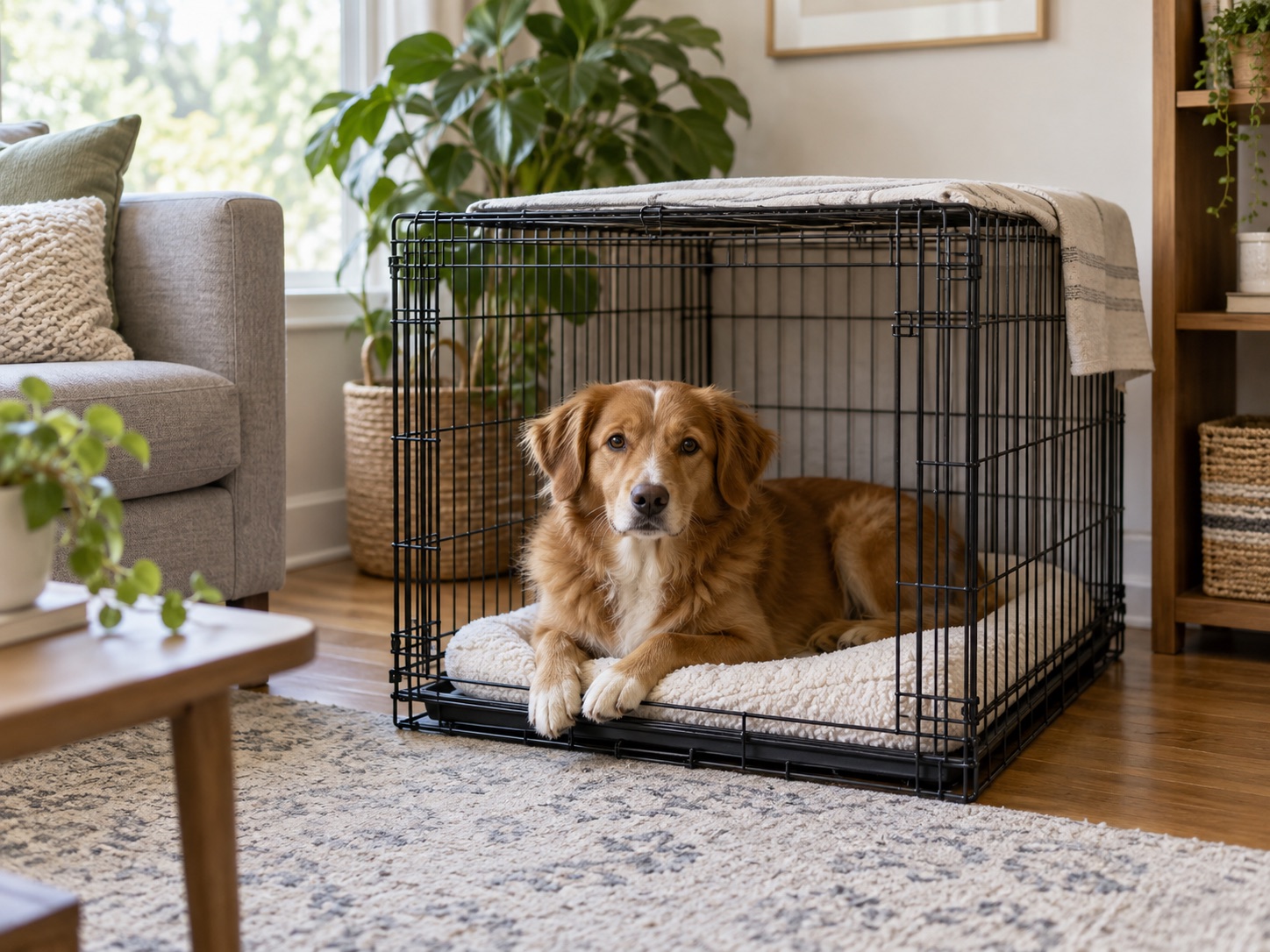
Start with the top and back, keeping the entrance uncovered.
Check the air and temperature inside the crate, especially in warm weather.
Treat distress as a welfare signal; a cover does not treat separation anxiety.
What a cover can and cannot do
PDSA and RSPCA both describe a partial cover as a possible way to make a crate feel quieter for some dogs. Blocking a view of constant hallway movement may help a dog who already likes the crate settle. The same fabric can make another dog feel trapped or hotter. The dog gets the deciding vote.
A cover is not a training shortcut. If the dog cries, scrabbles, drools, freezes or repeatedly tries to escape, shutting out the view may conceal a problem rather than solve it. Follow the signs of crate distress and separation anxiety guides if those behaviours appear.
Try it with the door open
Set up the crate in a quiet, draught-free room away from direct sun and radiators. Lay a light cover over the roof and back, leaving the entrance and at least one broad side clear. Secure the fabric so it cannot sag into the crate or be pulled between bars. Let the dog choose to enter and leave; reward calm investigation without trapping them inside.
Observe several ordinary rest periods before covering more. A dog who relaxes, changes position normally and chooses the space may benefit. A dog who pants, moves away, paws at the cover or refuses to enter is giving a clear reason to remove it.
Airflow, water and fabric safety
The room can feel comfortable while air beneath a heavy cover becomes warm and still. Check the covered space directly, especially in summer. Never block ventilation panels, the usual exit or an attached water bowl. Do not drape fabric over a heater, plug or electrical cable.
A fitted cover such as the Explore Land has roll-up panels and a mesh window. Those features make gradual adjustment easier, but the exact external crate measurements still matter. Stop using any cover if the dog drags a corner inside, chews straps or tangles in it.
Water should remain reachable without the dog having to push through bedding. A secure clip-on bowl, such as the MidWest Snap’y Fit, may reduce spills in a covered crate. Check bracket fit and mounting height; keep the cover clear of the bowl so the fabric stays dry.
Night-time and puppies
A cover can reduce light, but a puppy's first nights still involve toilet breaks and reassurance. Keep the crate close enough to hear the puppy and respond to waking. Do not use darkness to extend closed-door time beyond what the puppy can comfortably manage. Our first-night guide sets out a calmer routine.
The practical rule is simple: use the smallest amount of cover that helps the individual dog rest, and reassess it when the season, room or dog changes.
Common questions
Frequently asked questions
Should I cover my puppy's crate at night?
You can try a light partial cover if the puppy remains relaxed and can access water. Keep the crate near you at first, plan toilet breaks and respond to distress; darkness should not be used to ignore a puppy's needs.
How much of a dog crate should I cover?
Begin with the roof and perhaps one side or back, leaving the door and ventilation clear. There is no required percentage; the dog's response and room conditions decide whether any cover is useful.
Can a crate cover make a dog too hot?
Yes. Fabric reduces airflow, especially near radiators, windows or in hot weather. Check the air inside and remove the cover if the dog pants, seeks cooler areas or seems uncomfortable.
Will covering the crate stop barking?
It may reduce some visual triggers, but barking can reflect fear, pain, needing the toilet or isolation distress. Investigate the cause rather than closing more flaps.
Is a blanket as good as a fitted cover?
A secured light blanket can work if it does not block airflow, sag into the crate or touch heat sources. A fitted cover may offer controlled openings and a more secure fit.
Sources
- PDSA — crate training — partial top-and-side cover, water and avoiding separation distress
- RSPCA — dog crates and puppy playpens — partial cover can help some nervous dogs
- Blue Cross — indoor dog kennels — cover top, back and sides while retaining comfort and water