
Home-management comparison guide
Alternatives to a dog crate
Compare puppy pens, dog gates, dog-safe rooms and open rest areas when a crate is too restrictive, unsuitable or not working for the dog.
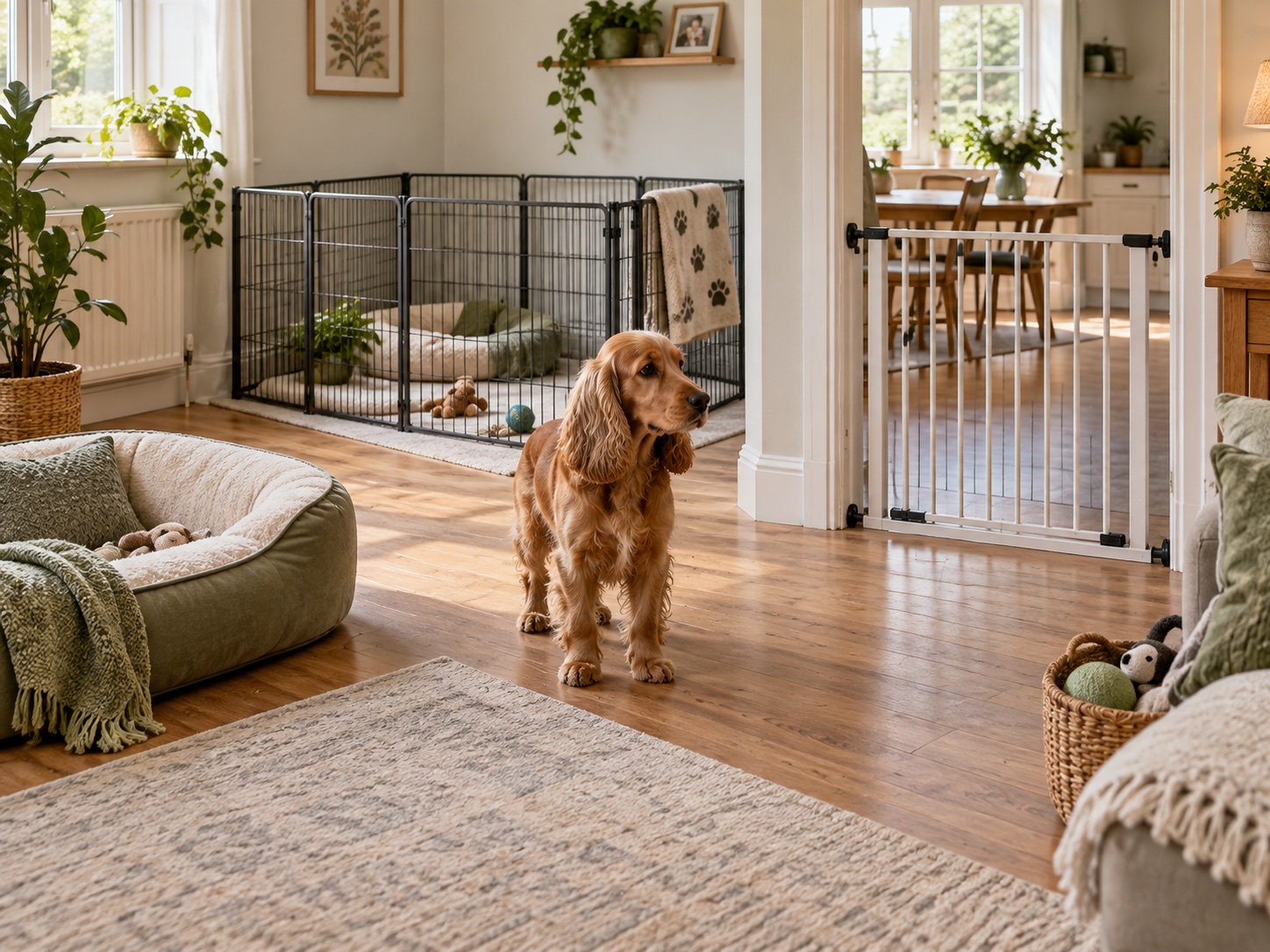
Use a pen when separate sleep, water and activity zones are needed.
Use a gate only after measuring the opening and checking climbing, jumping and bar spacing.
A dog showing panic or separation-related distress needs professional guidance, not tighter confinement.
Why look beyond a crate?
A crate is one form of household management, not a requirement for every dog. The usable space may be too restrictive for the task, the correct size may not fit the room, or the dog may be unable to relax when enclosed. Older dogs and dogs with mobility needs may also find turning through a crate doorway difficult.
Begin with the problem you are trying to solve: preventing access to stairs, keeping a puppy clear of cooking, supporting toilet training, creating uninterrupted rest or managing time alone. Different jobs need different boundaries.
Puppy pen: more room and separate zones
A secure pen can hold a bed, water and a separate activity area. It gives the dog more freedom to change position than a crate and can be reconfigured as the room changes.
Measure the usable floor area after everything is inside. Check panel height, gaps, connectors and whether nearby furniture creates a climbing step. Put the pen on a stable non-slip surface and supervise early use. A pen is not a substitute for toilet breaks, exercise, social contact or gradual training.
Dog gate: manage the room, not the dog
A gate can keep a dog out of a kitchen, protect a front-door zone or make one dog-safe room available. Measure the opening at the top, middle and bottom, and follow the specific fixing instructions. Pressure-fit and screw-fit designs are not interchangeable in every location.
Check that the dog cannot squeeze through, reach dangerous objects through the bars, climb using horizontal elements or clear the top. At stairs, use only a product approved by its manufacturer for that exact position.
Our pens and gates guide covers the room checks in more detail.
Dog-safe room: the largest practical option
A utility room, kitchen section or spare room can work if it is comfortable and genuinely safe. Remove medicines, cleaning products, bins, food, cables, plants, sharp objects and anything the dog might pull down. Block inaccessible gaps behind appliances and preserve ventilation.
Provide water, several resting surfaces and safe enrichment appropriate to the individual dog. Use a camera during gradual alone-time practice so quiet freezing or pacing is not missed.
Open bed or mat: a resting cue without a boundary
For dogs that do not need physical management, an open bed can become a reliable place to settle. Reward voluntary use, keep children and visitors from disturbing the dog there, and offer more than one resting position around the home.
An open crate can serve the same purpose when the dog already chooses it. The distinction is control: the dog can leave freely.
Compare the real space, not the label
Even when considering alternatives, a physical crate can help illustrate the floor area involved. The Hzuaneri 81cm furniture model is compact for a measured small dog, but it still creates one fixed enclosed zone. A pen using similar floor space may offer a different shape and more movement.
A 91.4cm wire crate such as the Amazon Basics double-door model can fold away, whereas a gate leaves the floor open. Compare those practical differences only after deciding which environment lets the dog relax.
When distress changes the decision
Do not use a smaller or stronger enclosure simply because a dog tries to escape. Dogs Trust warns that confinement can increase fear and create serious injury risk for some dogs with separation anxiety. If the dog pants, drools, freezes, vocalises continuously, eliminates, damages exits or refuses food when alone, record what happens and seek professional help.
Read signs of distress in a crate and crates and separation anxiety before changing the boundary.
Choose the least restrictive safe setup
The aim is not maximum containment. It is a safe, understandable environment that gives the dog enough room, predictable access to rest and water, and an introduction paced to their behaviour. Review the setup as puppies grow, mobility changes and household routines evolve.
Common questions
Frequently asked questions
Is a puppy pen better than a crate?
A pen gives more room for movement and separate zones, while a crate offers a smaller enclosed rest space. The better option depends on the puppy, the reason for management and whether the setup is secure, comfortable and introduced positively.
Can I use a baby gate instead of a dog crate?
A correctly fitted gate can manage access to a dog-safe room, but check manufacturer instructions, bar spacing, height and the dog's ability to climb or jump. Stair locations need particular care.
Can a dog sleep loose in a safe room?
Yes, if the room is genuinely dog-safe, comfortable and the dog settles there. Remove cables, toxic substances, chew hazards and unstable objects, and provide water and suitable resting choices.
What is the best alternative for a dog with separation anxiety?
There is no universal piece of equipment. Dogs Trust says confinement can worsen distress for some dogs. Record behaviour, avoid repeated panic where possible and seek advice from a vet or qualified behaviour professional.
Do I need to get rid of a crate if I stop closing the door?
Not necessarily. A dog that chooses an open crate can continue using it as one resting option, provided it is safe, comfortable and never used to trap a distressed dog.
Sources
- PDSA — crate training your dog — puppy-proof rooms, resting choices and separation-anxiety caution
- Dogs Trust — separation anxiety — confinement, monitoring and professional support
- Amazon UK product pages linked above