
Plastic dog crate buying guide
Best plastic dog crates for UK homes and travel
Compare rigid plastic dog crates and carriers by real space, ventilation, door design and cleaning. See where a travel kennel differs from a home crate.
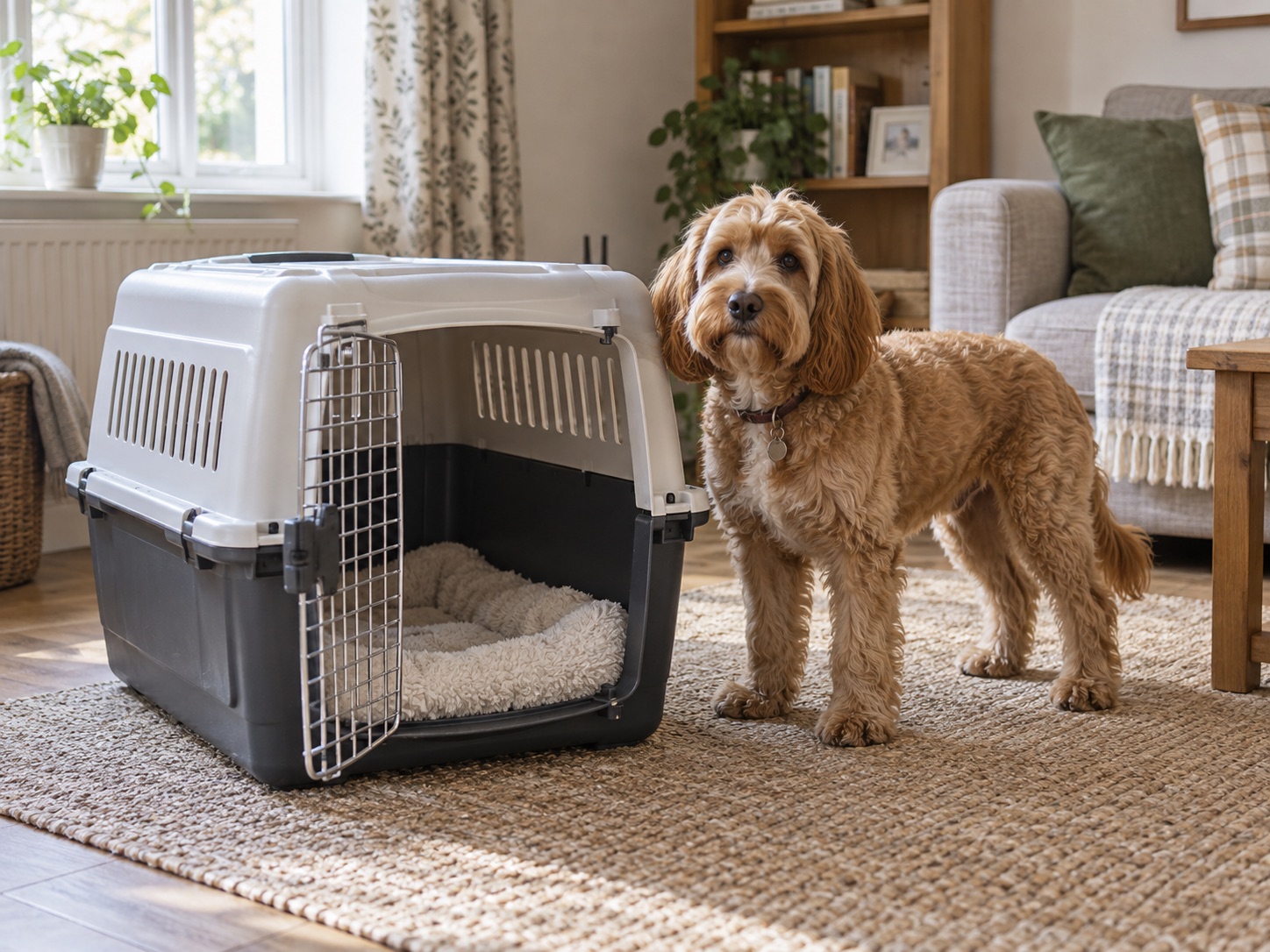
Our recommendations
Rigid plastic options to compare
These are transport-shaped products, not interchangeable substitutes for a roomy household wire crate or a crash-tested vehicle restraint.

Ferplast Atlas 30 plastic carrier
Best for: A small dog that fits a short, rigid, easy-clean carrier
A 60 × 40 × 38cm recycled-plastic shell with side ventilation, a roof handle and a four-point metal door. It separates for cleaning.
What stands out
- Published outside size
- Rigid wipe-clean shell
- Roof handle and ventilated sides
Keep in mind
- Short internal floor
- Less all-round view than wire
- Transport form differs from a home crate
- 60 × 40 × 38cm external
- Recycled plastic
- Four-point door

Amazon Basics 58cm two-door hard-sided carrier
Best for: A very small dog that benefits from a rigid top and front opening
A 58 × 38 × 33cm hard-sided carrier with a front grille, top opening, side ventilation and screw-secured shell halves.
What stands out
- Top and front access
- Ventilation on several sides
- Shell screws supplied
Keep in mind
- Low external height
- Small-dog use only
- Top loading still requires calm handling
- 58 × 38 × 33cm external
- Two openings
- Screw-secured shell

Ferplast Atlas 50 Professional
Best for: A measured dog needing a longer rigid plastic carrier
An approximately 81 × 55.5 × 59.5cm thermoplastic travel kennel with metal door, ventilated sides, roof handle and included bowl.
What stands out
- Longer published shell
- Four-point door closure
- Removable roof for cleaning
Keep in mind
- External figures are not usable interior
- Height wording varies
- Bulkier to lift and store
- About 81 × 55.5 × 59.5cm
- Thermoplastic shell
- Metal door

Henry Wag 90cm rigid travel kennel
Best for: A larger dog needing a 90cm transport-style shell
A 90 × 60 × 68cm plastic travel kennel with a steel door, ventilated sides, bowl and tie-down openings.
What stands out
- Published 90cm length
- Ventilated rigid shell
- Bowl and tie-down openings
Keep in mind
- Bulky for a home floor
- Airline acceptance is separate
- No published crash-test evidence
- 90 × 60 × 68cm external
- Plastic shell
- Steel door
Scroll horizontally to see all columns →
| Model | Outside dimensions | Door and access | Main caution |
|---|---|---|---|
| Ferplast Atlas 30 | 60 × 40 × 38cm | Front metal door | Short usable floor |
| Amazon Basics top-load | 58 × 38 × 33cm | Top and front | Low outer height |
| Ferplast Atlas 50 | About 81 × 55.5 × 59.5cm | Front metal door | Check conflicting height figures |
| Henry Wag large | 90 × 60 × 68cm | Front steel door | Airline acceptance is separate |
Plastic crate or plastic carrier: begin with the job
The same moulded shell may be sold as a dog crate, pet carrier or travel kennel. That wording does not tell you whether it is a comfortable everyday rest space. A home crate must work for the dog's normal postures and access to water; a transport carrier must also suit the particular journey and its restraint rules. A solid shell can shelter the dog from some visual activity, but it also blocks more airflow and sightlines than wire.
Start with the dog's measurements. Compare usable interior rather than the largest number in the listing. The door frame, rounded roof, wall thickness and bedding all reduce the available space. PDSA and RSPCA advise enough room to stand, turn, lie down and stretch. If you cannot confirm those movements, do not infer fit from a weight limit or breed suggestion.
Where a rigid shell helps—and where it does not
A removable roof can make cleaning corners easier. A firm base does not sag like some fabric carriers, and a front grille allows some airflow without exposing every side. Those are practical advantages for a suitable dog on an appropriate journey. But an enclosed crate can become hot in sun or poor airflow, and many models do not fold. Check the ventilation openings from inside, the stability of the assembled halves and whether the dog can enter without scraping the door frame.
Do not treat a rigid plastic crate as a shortcut around crate training. The dog still needs a gradual, positive introduction with the door held open. If the dog panics, paws frantically or tries to chew out, stop and address the distress rather than choosing a stronger latch.
The plastic options in detail
Ferplast Atlas 30: compact, easy-clean shell
At 60 × 40 × 38cm externally, this recycled-plastic carrier is one of the shorter options. It has a roof handle, ventilated sides and a metal door held at four points. The roof and base separate for cleaning, which is useful around the internal corners. The listed 15kg limit is not a promise that every dog below 15kg can fit: a long-backed or tall small dog may still be cramped.
Amazon Basics: top access for a very small dog
The Amazon Basics carrier has front and top openings, side ventilation and screws to secure its two shell halves. Its listed 58 × 38 × 33cm size is external, and the 33cm roof is a firm warning for dogs that sit tall. Top access can help with a calm dog who is comfortable being supported under the body, but it is not a reason to force a reluctant dog into the carrier.
Ferplast Atlas 50: more length, more bulk
The Atlas 50 Professional lists an approximately 81cm length and 55.5cm width, with a metal door, side ventilation, bowl and roof handle. Its title and bullets give slightly different height figures. Treat the model as a candidate only after you have confirmed the selected variant's interior height and checked that the handle, roof and bowl do not crowd the dog.
Henry Wag large: a 90cm travel-style kennel
The Henry Wag is listed at 90 × 60 × 68cm with a steel door, ventilation, a bowl and tie-down openings. It may suit a bigger dog that measures into its usable interior, but its size also makes it more awkward to lift and store. The retailer describes airline suitability; the operating airline must confirm acceptance for the exact flight. Tie-down openings do not establish crash-test performance in a car.
Check the shell before deciding
If the main job is hand-carrying rather than a home resting space, compare hard-sided dog carriers for lifting, handle support and journey checks. Similar shells can serve different purposes; choose around how the dog will actually use the equipment.
Measure the clear doorway as well as the floor. The dog should walk in without ducking continuously or climbing over an uncomfortable step. Make sure the shell halves meet evenly, every fastener is present, the door closes without catching fur and the crate sits level. Place the planned bed and bowl inside, then repeat the movement check.
At home, choose a calm, ventilated location out of direct sun and away from radiators. In a vehicle, consult our car-crate guide and the exact maker instructions; do not assume a portable plastic shell is a safe restraint just because it fits the boot. For a lighter fold-away alternative at a destination, see portable dog crates.
Common questions
Frequently asked questions
Is a plastic dog crate better than a wire crate?
Neither material is best for every dog. A plastic shell may be easier to wipe and offer more visual shelter, while wire usually provides more open ventilation and folding storage. Choose by the dog's comfortable internal space, the room and the intended journey.
Can a plastic travel carrier be a permanent home crate?
Only if the exact internal space, ventilation and access genuinely meet the dog's needs. Many carriers are designed for transport and have a short or low interior, so a larger home crate or open bed may be more appropriate for daily rest.
Are these crates approved for airline travel?
A product title is not airline approval. Ask the operating airline about the route, container specification and dog-and-container measurements before buying. Requirements can differ between carriers and journeys.
Can I use any plastic crate in a car boot?
No. A rigid shell is not automatically a tested vehicle restraint. Follow the product's installation instructions and the vehicle guidance, and do not treat a household or airline carrier as crash-tested without evidence for that exact model.
How should I measure a dog for a plastic crate?
Measure natural standing and sitting height, nose-to-tail-base length, turning width and resting posture. Compare those with usable internal dimensions, accounting for the roof curve, door opening, bedding and any fixed bowl.
Sources
- PDSA — crate training your dog — movement, bedding, water and location
- RSPCA — how to crate train a puppy — crate sizing and positive introduction
- Amazon UK product specification pages linked from the product cards