
Dog-crate welfare guide
How long can a dog stay in a crate?
Understand why crate time has no universal safe limit and how age, training, health, toilet needs and distress change the answer.
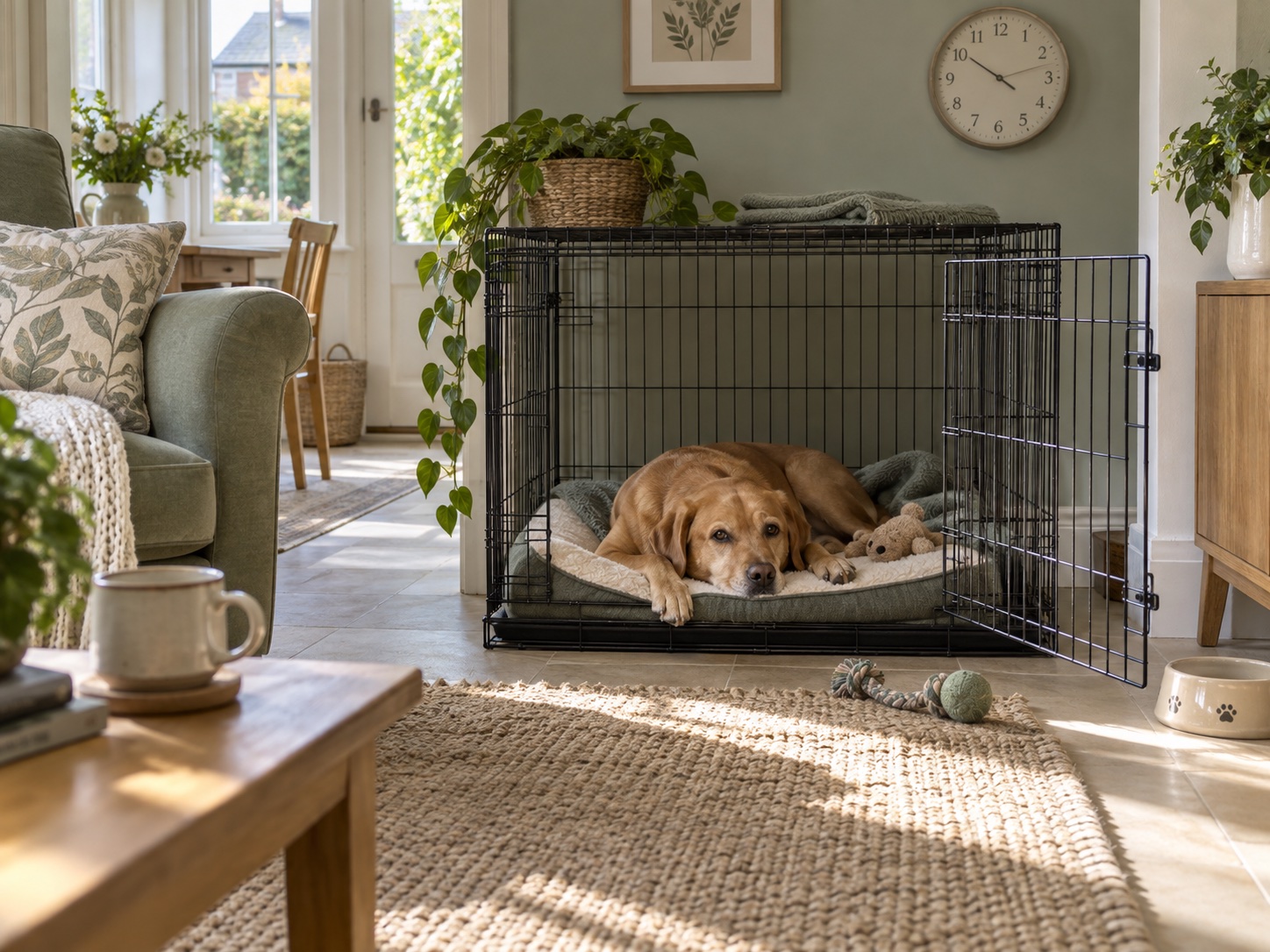
Count the whole continuous period, including travel and waiting before or after.
Puppies, older dogs and dogs with health or mobility needs require shorter, individual plans.
If the dog cannot relax, toilet comfortably or remain physically well, the period is already too long.
The three-hour guidance is not a target
PDSA says dogs should never be left in a crate for more than three hours and should spend less time if they are not accustomed to it. RSPCA guidance says a positively trained adult dog is normally okay for about three hours and emphasises that puppies need much shorter periods because they have less bladder and bowel control.
These figures are ceilings within a wider welfare plan, not a daily goal and not proof that every dog can cope for that long. A dog showing discomfort or distress at ten minutes has already reached their current limit.
What changes the answer?
Age matters, but it is not the only factor. Consider:
- current toilet pattern and recent food, water and exercise;
- previous gradual crate training;
- pain, medication, digestive issues or urinary concerns;
- mobility and how easily the dog can turn and settle;
- room temperature and airflow;
- whether the dog is sleeping or repeatedly monitoring the exit;
- the total amount of confinement across the whole day.
Ask your vet for an individual plan when health, recovery or medication is involved. Do not use an internet age formula as a substitute.
Count the complete period
The clock starts when the door closes, not when you leave the house. Include the time spent finding keys, travelling, waiting for a visitor and delaying release after you return. If the same crate is used in a car, count that separately within the dog's complete day and follow safe vehicle-restraint guidance.
Repeated shorter periods can also add up to a restrictive routine. Record a typical week: crate time, sleep, walks, toileting, play, training, company and freely chosen rest.
Correct size remains essential
The dog must be able to stand and sit without touching the roof, turn easily, lie naturally, wag and stretch with bedding and water in place. A larger crate does not justify a longer period, but an undersized crate is unsuitable at any duration.
The Amazon Basics 36-inch double-door model has a listed 91.4 × 58.4 × 63.5cm external size. Confirm the internal area against the measured dog rather than treating the label as a time recommendation.
Use our measurement guide before selecting any crate.
Puppies need a different plan
Young puppies need frequent toilet opportunities, company, sleep and gradual exposure to being alone. Crate training sessions may begin with seconds. Overnight, keep a new puppy near you and respond to waking rather than expecting a full night behind a closed door.
Read a puppy's first night with a crate and what to do about crate crying.
Older dogs and medical needs
An older dog may need to stretch, change surfaces or toilet more often. Arthritis can make a raised lip or tight turn painful. Dogs recovering from treatment should follow a veterinarian's specific movement plan; a generic crate limit does not override clinical advice.
Watch for stiffness on exit, reluctance to enter, repeated repositioning or accidents. Those are reasons to reassess promptly.
A permanent crate is still optional
A furniture crate can provide an attractive open resting place when the dog chooses it. The Hzuaneri 81cm model is an example for an appropriately measured small dog, but closing the door changes the experience from choice to confinement.
Where management needs last longer, a pen, gated room or dog-safe room can give more movement and separate water and rest zones. Compare alternatives to a crate.
Use behaviour as the deciding evidence
Relaxed sleep, normal breathing and voluntary return are different from shutdown. Panting when the room is cool, drooling, cowering, constant barking, escape attempts, repeated toileting or refusal of high-value food can indicate distress.
If these appear, end the session safely, meet immediate needs and return to an easier plan. Our guide to distress in a dog crate explains what to observe and when to seek help.
Common questions
Frequently asked questions
Can an adult dog stay in a crate for four hours?
UK welfare guidance from PDSA says never more than three hours, and RSPCA describes about three hours for a positively trained adult dog. Individual dogs may need far less, so four hours should not be treated as an acceptable routine.
How long can a puppy stay in a crate?
Puppies need much shorter periods because of toilet needs, development and limited training. There is no single age-to-hours formula that replaces watching the individual puppy and providing frequent breaks, company and gradual practice.
Can a dog sleep in a crate overnight?
A dog who is comfortable and can meet their physical needs may choose a suitable crate for sleep, but overnight use still needs individual planning. Puppies need toilet breaks and any distress means the setup or expectation must change.
Does a larger crate make longer confinement acceptable?
No. Correct size is essential, but it does not provide exercise, toileting, social contact or choice. A pen or dog-safe room may be more appropriate when more time or movement is needed.
Can I crate my dog while I am at work?
A normal working day is far beyond the guidance cited here. Arrange a less restrictive safe area, toilet and exercise breaks, and suitable human support rather than planning all-day crate confinement.
Sources
- PDSA — crate training your dog — three-hour maximum and shorter individual periods
- RSPCA — dog crate guidance — adult and puppy duration guidance
- Amazon UK product pages linked above