
Practical crate sizing guide
Allowing room for bedding and bowls in a dog crate
Calculate how crate bedding changes headroom and uncovered floor, with labelled bed-and-bowl diagrams, worked examples and a furnished-fit worksheet.
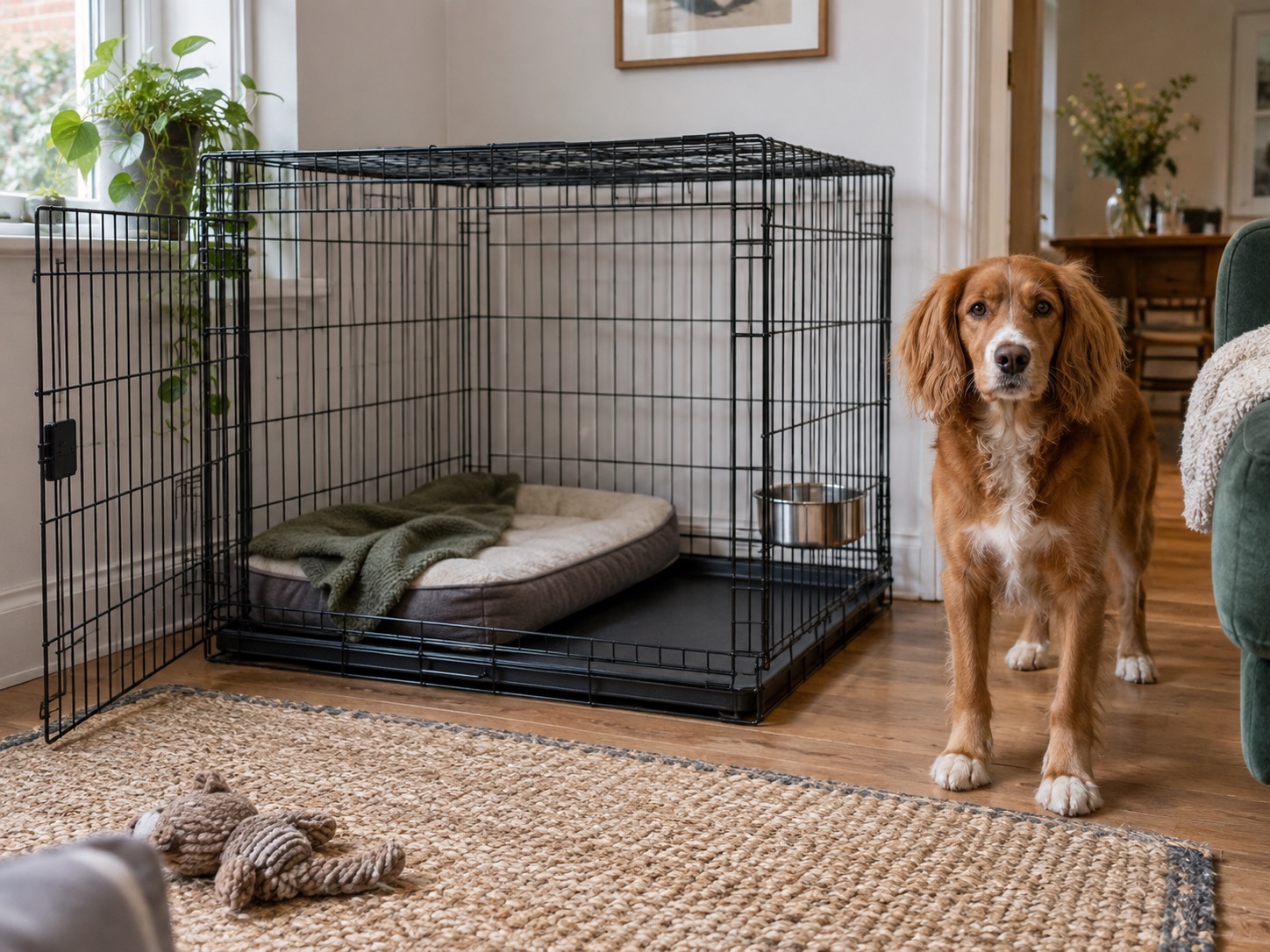
Compare bed footprint and compressed depth with the usable crate interior.
Keep a water bowl stable, reachable and away from the dog's head when lying.
Recheck the dog inside the fully arranged crate, not an empty display model.
An empty crate measurement is not the final measurement
The dog uses a furnished space. A deep bed raises the standing surface towards the roof; a bolster reduces the clear width; a water bowl occupies floor or projects from a wall. These changes can turn a barely adequate empty crate into one that restricts normal posture.
Start with the dog's measured height, length and resting shape. Record the crate's internal floor length and width, its interior height above the tray and the clear door opening. Do not subtract equipment from outside dimensions.
Work out the bed's real footprint
Compare the full bed dimensions with the clear tray, including corners and raised edges. A pad should lie flat without curling into the wall or rising over the doorway. If a bed has a thick rim, measure the usable flat middle separately; the dog may have less lying space than the overall product length suggests.
The selected Ellie-Bo 36-inch striped bed lists 87 × 57 × 10cm. The advertised 10cm depth is not a measured loaded thickness: compression under a particular dog is a separate input. Its 87 × 57cm footprint is not guaranteed to fit every crate called 36-inch. Compare the clear interior and then check the actual furnished arrangement.
A thin washable mat may preserve more space than a thick mattress. Thickness is not the only comfort factor, though: the dog needs a stable, non-slip surface suitable for its joints and temperature. Compare crate beds and crate mats for the trade-offs.
Position water without creating an obstacle
If a floor bowl takes up the only turning route, compare attached crate water bowls by bracket fit and cleaning access before deciding that water must be removed from the setup.
Water should be reachable without the dog having to stand in bedding or fold awkwardly around a bowl. A floor bowl needs a stable location outside the natural lying route. A clipped bowl uses less floor but protrudes into the interior and must be attached at an accessible height, clear of the dog's face when resting.
The MidWest Snap'y Fit example is a fixed-position bowl. Match its bracket to the crate bars and check the dog can approach it naturally. Verify the fit after moving a divider or changing a bed.
Worked example: floor space and height are different checks
Imagine a crate with a 110 × 75 × 70cm clear interior, an 87 × 57cm bed footprint and a separate 20 × 20cm bowl reservation. The interior and bowl zone are hypothetical, not specifications for a product. Only the bed footprint comes from the selected listing. This example explains the arithmetic; it is not a recommendation for a particular dog or crate.
Floor: distinguish uncovered area from resting space
The imagined floor is 110 × 75 ÷ 10,000 = 0.825m². The published bed footprint occupies 87 × 57 ÷ 10,000 = 0.4959m², leaving 0.3291m² of uncovered floor. Reserving a separate, non-overlapping 20 × 20cm bowl zone subtracts another 0.04m², leaving 0.2891m² uncovered.
That does not mean the dog has only 0.2891m² of usable space: the bed is a resting surface. Nor does it prove sufficient movement. In the illustrated corner arrangement, the uncovered floor is split into an 18cm side strip and a 23cm end strip, part of which contains the bowl zone. A generous-looking total can conceal an awkward approach or turn. Raised bolsters, tapered walls and rounded corners need separate checks.
Height: subtract loaded depth, not a catalogue assumption
Height above the bed = interior height above the tray − loaded bed thickness. In an imagined 70cm-high interior, assumed loaded depths of 3, 6 and 10cm leave 67, 64 and 60cm respectively. These depths are hypothetical examples, not compression measurements of the Ellie-Bo bed. A hypothetical 62cm sitting or standing posture produces the following arithmetic:
Scroll horizontally to see all columns →
| Assumed loaded bed depth | Height above the bed | Minus 62cm posture | Meaning in this example |
|---|---|---|---|
| 3cm | 67cm | 5cm | Numerical remainder only; not a guaranteed adequate allowance |
| 6cm | 64cm | 2cm | Numerical remainder only; not a guaranteed adequate allowance |
| 10cm | 60cm | -2cm | Numerical conflict with the imagined posture |
A negative result flags a numerical conflict. A positive remainder is not automatically enough: ears, posture, the actual roof profile and side-mounted equipment can change the fit. There is no universal clearance being prescribed here. Do not compress or restrain the dog to make a calculation work.
Bowls: reserve the projection as well as the footprint
A 950ml capacity says nothing about how far a bracket or rim sticks into the crate. For a clipped bowl, record inward projection and its height, then check the shoulder, head and drinking approach. The floor diagram's 20 × 20cm zone is simply an imagined floor reservation; it is not the Snap'y Fit bowl's documented dimensions. Relocating water may improve a route, but it must remain accessible and stable.
Your furnished-interior worksheet
Complete this with the actual crate, equipment and dog's natural postures. Keep the bed's overall dimensions separate from the flat centre and any raised edge. If you are replacing a pan, confirm the tray's inner platform and compatibility before assuming the same bedding will fit.
Scroll horizontally to see all columns →
| Record | Your dimensions / notes | Interpretation |
|---|---|---|
| Interior, not exterior | Clear floor L × W: ____; height above tray: ____ | Record roof slopes, bars and projections separately. |
| Bed and bolsters | Overall footprint: ____; flat centre: ____; loaded depth: ____ | Height above bed = interior height − loaded bed depth; nominal depth may differ. |
| Water position | Floor reservation or inward projection: ____; approach: ____ | Volume in millilitres does not describe clearance at shoulder or head height. |
| Natural postures | Standing / sitting / turning / full lie / drinking: ____ | Confirm with the actual dog and arrangement; arithmetic alone cannot establish comfort. |
| Door and maintenance | Clear entry: ____; access for cleaning: ____ | Recheck after washing, changing equipment or moving a divider. |
Check the furnished crate
Install the bed and bowl exactly as they will be used. Leave the door open and invite the dog in calmly. Observe a natural stand and sit, a complete turn, a full-length lie and an easy drink. If a bowl collides with shoulders or a bed forces the dog into a shortened posture, move the equipment or choose a more suitable crate.
Check after washing too. Pads can change shape or bunch, and a new cover can alter thickness. A growing puppy needs the whole check repeated as the divider moves; our divider sizing guide explains the sequence.
Common questions
Frequently asked questions
How much headroom does a crate bed remove?
Approximately the bed's loaded thickness, which may differ from its advertised uncompressed depth. Check the dog sitting and standing on the actual bed in the crate.
Can a crate bed be too large?
Yes. A bed that buckles up the sides, blocks the door or prevents a natural turn makes the space less usable. Measure the clear tray or floor, not only the crate's nominal length.
Should a dog have water in a crate?
Access to fresh water is important. Choose a stable bowl that the dog can reach naturally, following welfare guidance and the dog's individual needs; check it does not obstruct movement or spill into bedding.
Are clip-on bowls better than floor bowls?
A correctly fitted clip-on bowl can save floor space and reduce tipping, but it can protrude into shoulder or head space. A stable floor bowl may work better in some layouts. Check the dog using it.
Should I buy the bed before the crate?
Choose them together where possible. Confirm the crate's internal floor, the bed's actual footprint and the remaining height before buying either.
Is uncovered floor area the same as usable dog space?
No. The bed is still a resting surface, while the shape and position of the uncovered floor determine access and movement. A calculated leftover area cannot show that a dog can turn comfortably or reach water.
Sources
- PDSA — crate training and fit
- RSPCA — dog crates and puppy playpens
- Ellie-Bo — selected large striped bed dimensions — published 87 × 57 × 10cm; loaded thickness is a separate input
- MidWest — Snap'y Fit 950ml bowl — bracket and product context; capacity does not establish inward projection