
Car restraint comparison
Dog car harness vs crate
Compare a dog car harness with a boot crate by evidence, dog and vehicle fit, installation, space, access and everyday practicality.
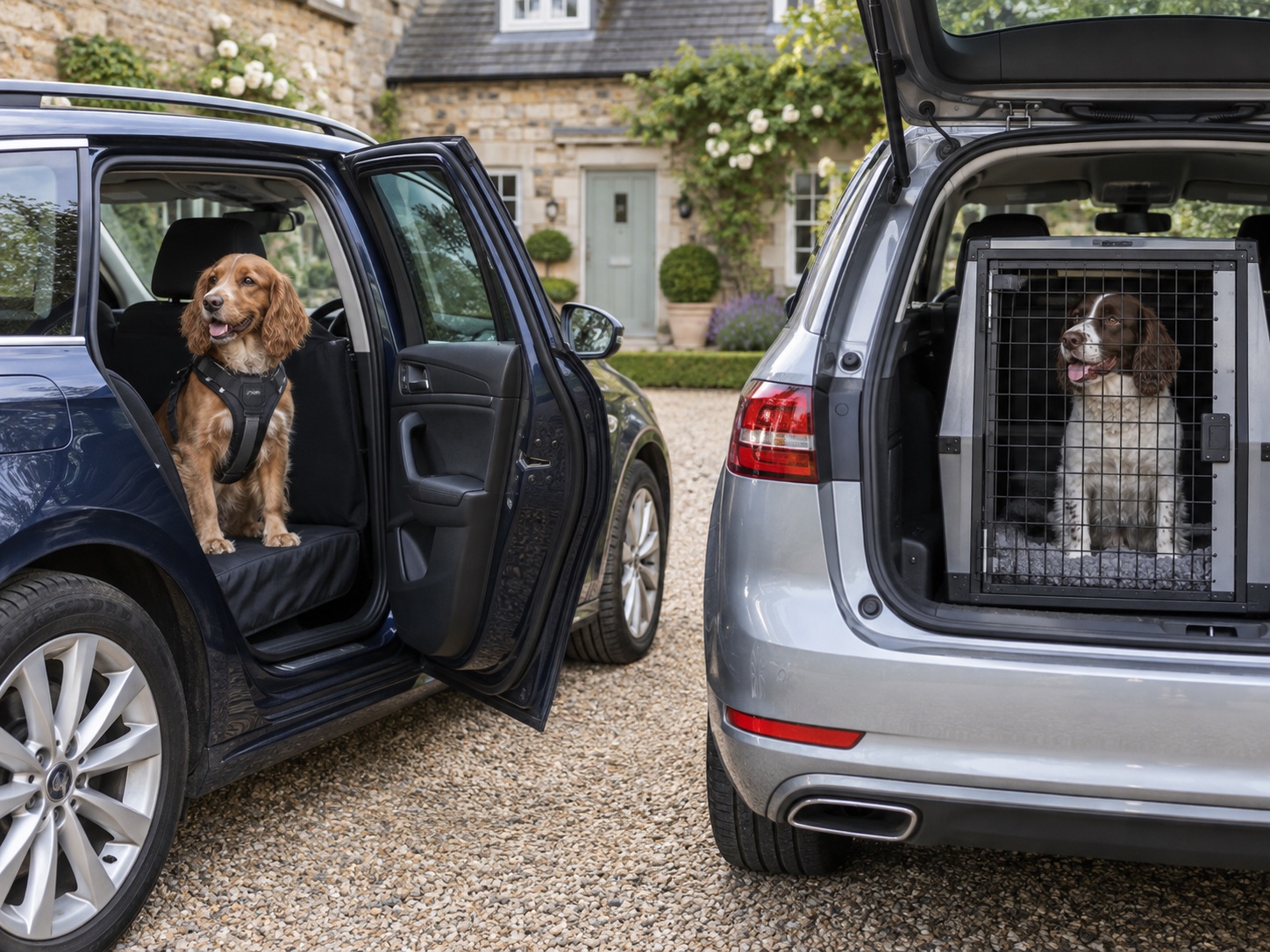
Highway Code Rule 57 lists a seatbelt harness, pet carrier, dog cage or dog guard as examples of suitable restraint.
Walking harnesses and household crates are not automatically vehicle restraint products.
Exact-product evidence, correct sizing and installation matter more than the general format.
What Rule 57 asks you to achieve
Highway Code Rule 57 says that when you are in a vehicle, dogs or other animals should be suitably restrained so they cannot distract you while driving or injure you—or themselves—if you stop quickly. It gives a seatbelt harness, pet carrier, dog cage or dog guard as examples.
That is an outcome, not an endorsement of every product using one of those names. The Highway Code introduction explains that advisory wording is not, by itself, a statement of a specific legal offence, but the Code may be used in evidence to establish liability. Treat restraint as a real driving-safety decision rather than a label to satisfy.
The comparison at a glance
Scroll horizontally to see all columns →
| Question | Car harness | Vehicle crate |
|---|---|---|
| Main location | Usually a rear passenger seat | Usually the boot or cargo area |
| Space used | One seating position | A measured section of the boot |
| Dog contact | Easier to observe from outside the car | More visually enclosed and separated |
| Fit work | Chest, neck and body shape | Dog dimensions plus boot and opening |
| Installation | Vehicle belt or supplied system | Specified cargo points, straps or brackets |
| Evidence to seek | Exact model, size/load, test method and result | Exact range, directions, test method, result and attachment |
| Common error | Clipping a walking harness to an improvised tether | Assuming a strong-looking crate is crash tested |
When a car harness makes sense
A harness can be practical when the boot is too small, already carries secured equipment, or must remain accessible. It is easier to move between compatible vehicles than a heavy crate and allows the dog to be loaded through a passenger door.
The fit is close to the body, so accuracy matters. The load-bearing chest area should lie as the instructions show without crossing the throat, restricting the shoulders or allowing the dog to back out. Recheck adjustment after grooming, weight change and growth.
Kurgo Enhanced Strength Tru-Fit
Kurgo publishes dynamic test methodology and reports for its Enhanced Strength harness range. The current medium Amazon listing gives a 40.5–63.5cm neck and 45.5–71cm chest, with five adjustment points, steel nesting buckles and an included seatbelt loop and carabiner.
Match the exact harness version and size to the relevant evidence. The cited v3 report uses lap and shoulder belts through the carabiner, without a tether bridging the restraint. Our version, load and attachment evidence matrix explains why included accessories are not automatically the tested configuration. Do not add tether length or replace components without maker approval.
EzyDog Drive
The EzyDog Drive routes the vehicle seatbelt through integrated handles instead of using a separate long tether. EzyDog states that the harness was tested using an FMVSS 213 method and uses seatbelt webbing with a moulded padded chest plate.
The selected Amazon variant is small, and EzyDog UK's current chart gives a broad 28–64cm girth range. Measure rather than inferring from breed, then follow the maker's staged fitting process so the chest plate sits correctly.
When a vehicle crate makes sense
A purpose-built crate separates the dog from passengers, limits access to doors and windows and can keep mud or loose hair within an easy-clean area. It may suit a dog that settles better in a familiar enclosure, provided confinement has been introduced positively.
It also asks more of the car. The dog needs sufficient internal space, the assembled crate must pass through the aperture, and the vehicle needs compatible attachment points. Door movement, ventilation, an emergency exit and required clearance all consume space beyond the external dimensions.
The Thule Allax is the documented example in this comparison. Thule publishes front, rear and simulated roll-over testing, identifies TÜV SÜD certification and specifies tension-band installation plus a 10–13cm crumple-zone allowance. That evidence belongs to the Allax range and cannot be transferred to other aluminium crates.
Evidence is not interchangeable
“Crash tested” needs context. Look for the exact model family, sizes or loads tested, direction and method, pass criteria, result and installation conditions. A test of a large harness does not necessarily cover a differently constructed small variant; a report for one crate does not validate every product from the brand.
FMVSS 213 is a US child-restraint test framework that some pet-product makers adapt for their test procedure. A maker's reference to it should not be read as formal approval of the dog product as a child seat. Read the report for what was actually done and what passed.
Likewise, a TÜV SÜD certificate is meaningful only when its scope can be connected to the product. No evidence removes the need for correct fit and installation, and no test guarantees an injury-free outcome in every collision.
Dog fit may decide before car fit
A harness may be unsuitable for a dog with a shape that cannot be securely fitted, a medical issue affected by chest loading, or a strong history of chewing restraint straps. Ask the dog's vet about relevant medical limitations rather than choosing a looser fit.
A crate may be unsuitable when the dog cannot adopt the required natural postures, becomes distressed in confinement or cannot safely be lifted or walked into the boot. Separation anxiety and travel fear need a behaviour plan; containing the symptoms more strongly is not treatment.
For two dogs, assess each animal separately. One may suit a harness while the other settles in a crate. Make sure neither can reach or interfere with the other's restraint.
Vehicle fit and everyday use
With a harness, check the vehicle handbook, belt geometry and whether the selected seat can remain free of unrestrained luggage. The dog should not be on the front seat where an active airbag creates a further hazard. Protect the belt from chewing without adding unauthorised hardware.
With a crate, measure the boot opening, wheel arches, floor and roof-level depth and tailgate curve. Locate approved cargo loops and preserve the manufacturer's clearance. Our car-boot crate guide covers the full measurement sequence.
Whichever route you choose, practise while parked before driving. Start with calm entry and very short periods, then build journey time. Check the full system before every trip and secure luggage separately.
How to make the final choice
- Rule out products that do not fit the dog's body, posture or welfare needs.
- Rule out products that cannot be installed exactly as instructed in the vehicle.
- Compare exact-model test documentation rather than category-level marketing.
- Consider loading, emergency access, temperature, luggage and other passengers.
- Introduce the selected restraint gradually and inspect it before each journey.
Continue with our plain-English explanation of Highway Code Rule 57, or compare dog car crates by fit, installation and product-specific evidence.
Helpful products
A documented boot-crate alternative
If a rear-seat harness is not practical, compare a purpose-built crate that fits the dog and vehicle and states its installation and test evidence.

Thule Allax car dog crate, small
Best for: A compatible car and dog where model-specific test documentation matters
An adjustable-depth aluminium car crate with a crumple zone, locking door and rear escape hatch. Thule describes front, rear and simulated roll-over testing for the Allax range.
What stands out
- TÜV SÜD reference published by Thule
- Adjustable depth
- Rear escape hatch
Keep in mind
- Premium price
- Heavy rigid installation
- Vehicle compatibility must be checked
- Small variant
- Adjustable depth
- Crumple zone
- Built-in lock
Common questions
Frequently asked questions
Is a dog harness safer than a crate in a car?
The format alone cannot answer that. Compare exact-product test evidence, fit and installation. A documented harness fitted badly or a tested crate installed without its required attachment and clearance may not perform as intended.
Is a normal walking harness suitable for car travel?
Do not assume so. Choose a product specifically designed for vehicle restraint with clear fitting and seatbelt instructions, and check whether the evidence applies to the exact model and size.
Can a dog travel in the boot without a crate?
Rule 57 says animals should be suitably restrained so they cannot distract or injure. A properly fitted dog guard may be one approach, but an open boot does not by itself provide suitable restraint or protect the dog from loose luggage.
Where should a dog car harness be attached?
Follow the exact manufacturer's instructions. Some route the vehicle belt through integrated loops; others use a supplied tether. Do not improvise attachment to a collar, child-seat point or unapproved extension.
Can two dogs share a car crate?
Do not assume a large box is suitable for sharing. Dogs can collide or redirect fear during sudden movement. Use a manufacturer-approved divider or separate restraint systems with suitable individual space and behaviour compatibility.
Sources
- GOV.UK — Highway Code Rule 57 — suitable restraint guidance and examples
- GOV.UK — Introduction to The Highway Code — meaning of advisory wording and possible evidential use
- Kurgo — car-harness crash-testing methodology — published test approach and report links
- Kurgo — Enhanced Strength Tru-Fit product information — fitting, materials and included restraint components
- EzyDog UK — Drive car harness — current sizes, design and stated test method
- Thule — Allax product and test information — vehicle-crate installation and evidence example
- Amazon UK product pages linked above