
Crate welfare guide
What to do when a dog refuses a crate
Help a dog who avoids a crate by checking discomfort, fit and past associations, rebuilding voluntary entry, and choosing safer alternatives when needed.
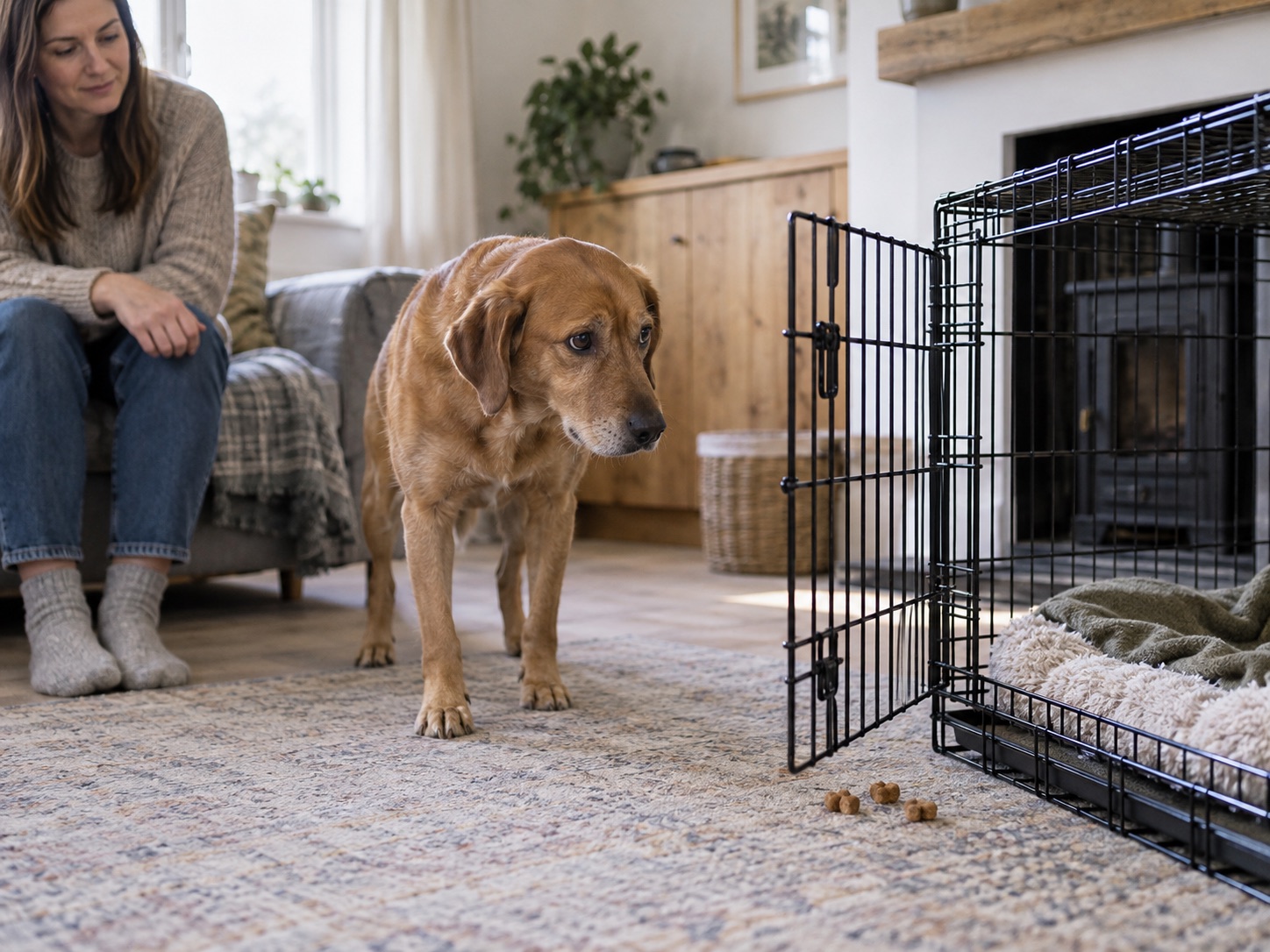
Leave the door secured open and reward calm investigation near, then inside, the crate.
Confirm the dog can stand, turn and lie naturally with bedding in place.
Seek veterinary or qualified behaviour help for persistent fear, panic or sudden refusal.
Refusal is a useful observation
A dog may stop at the entrance, stretch forward without moving hind feet, take a treat and immediately back out, or avoid the room containing the crate. That behaviour tells you the current step is difficult. Do not drag, push or repeatedly lure the dog inside before shutting the door. RSPCA and PDSA guidance both emphasise positive, gradual introduction and never using a crate as punishment.
If refusal appeared suddenly, check for pain or illness, a recent frightening sound, a trapped paw or fur incident, a moved crate, heat or an uncomfortable bed. Ask a vet about abrupt or persistent changes, especially when the dog also avoids movement elsewhere.
Check whether the equipment fits the dog
The dog should stand and sit without touching the roof, turn and lie naturally. Assess this with the actual bed and bowl in place. Measure the clear doorway as well as the floor; a high threshold or narrow entrance can be particularly difficult for a dog with limited mobility.
The MidWest 36-inch wire crate is an example with front and side doors. The second door may improve approach in one room, but it does not make the crate suitable unless its usable interior and opening fit the individual dog. Our crate door-opening guide gives the checks.
Check placement. A crate beside a radiator, busy passage or noisy appliance may be unpleasant even when correctly sized. Keep the door secured fully open during early practice so it cannot swing shut unexpectedly.
Rebuild entry in small voluntary steps
Begin by rewarding calm behaviour near the open crate. Place treats or a favourite toy beside the threshold, then just inside only when the dog is comfortable. Let the dog leave whenever they choose. Short sessions are more useful than a long standoff. Feed a meal near the crate if the dog finds that easier, gradually shifting the bowl only as confidence grows.
When the dog chooses to rest inside, practise moving the door a little, reward calmness and reopen it. Build the duration in tiny steps. If the dog freezes, pants, cowers, scratches frantically or tries to escape, you have moved too fast. Return to an easier step and seek veterinary or qualified behaviour advice when fear persists.
Give the dog another safe place meanwhile
Management does not have to wait for crate training to succeed. A measured pen can give a dog more room to move; the Yaheetech six-panel example is compact, so check its usable floor and height rather than assuming it suits every dog. A dog that panics in confinement may also struggle in a pen, so observe the response.
A properly puppy-proofed room behind a correctly installed gate can be another option. The BabyDan FlexiFit illustrates a wall-mounted gate for a measured opening; it does not make the room safe until cables, plants and other hazards are removed.
See alternatives to a dog crate for the wider comparison. If the dog shows separation-related distress, a different enclosure is not a treatment; read crates and separation anxiety and seek individual help.
Common questions
Frequently asked questions
Should I put my dog in the crate if they refuse?
No. Forcing entry can make fear worse and creates a struggle at the doorway. Make the space safe, leave the door open and rebuild a positive association at the dog's pace.
Why did my dog suddenly stop using the crate?
A sudden change may reflect pain, an awkward door, heat, noise, a frightening incident or another health or behaviour issue. Contact a vet if the change is unexplained or accompanied by other signs.
What if my dog enters for treats but panics when the door closes?
Return to voluntary entry with the door open. Practise tiny, positive door movements only when the dog is relaxed; stop and seek help if panic or escape attempts occur.
Does buying a different crate fix refusal?
Only when the problem is truly physical, such as an undersized interior or awkward entrance. A new model does not treat fear, separation distress or pain.
Is a crate essential for every dog?
No. A puppy-proofed room, suitable pen or gated area can provide safe management where a crate is inappropriate, provided the dog's needs and the space are addressed.
Sources
- PDSA — crate training
- RSPCA — crates and puppy playpens
- Blue Cross — crate training your puppy
- Amazon UK example products linked in the guide