
Dog crate comparison guide
Internal vs external dog crate dimensions
Compare internal and external dog crate dimensions with published-size calculations, a scale diagram and a practical worksheet for dog and room fit.
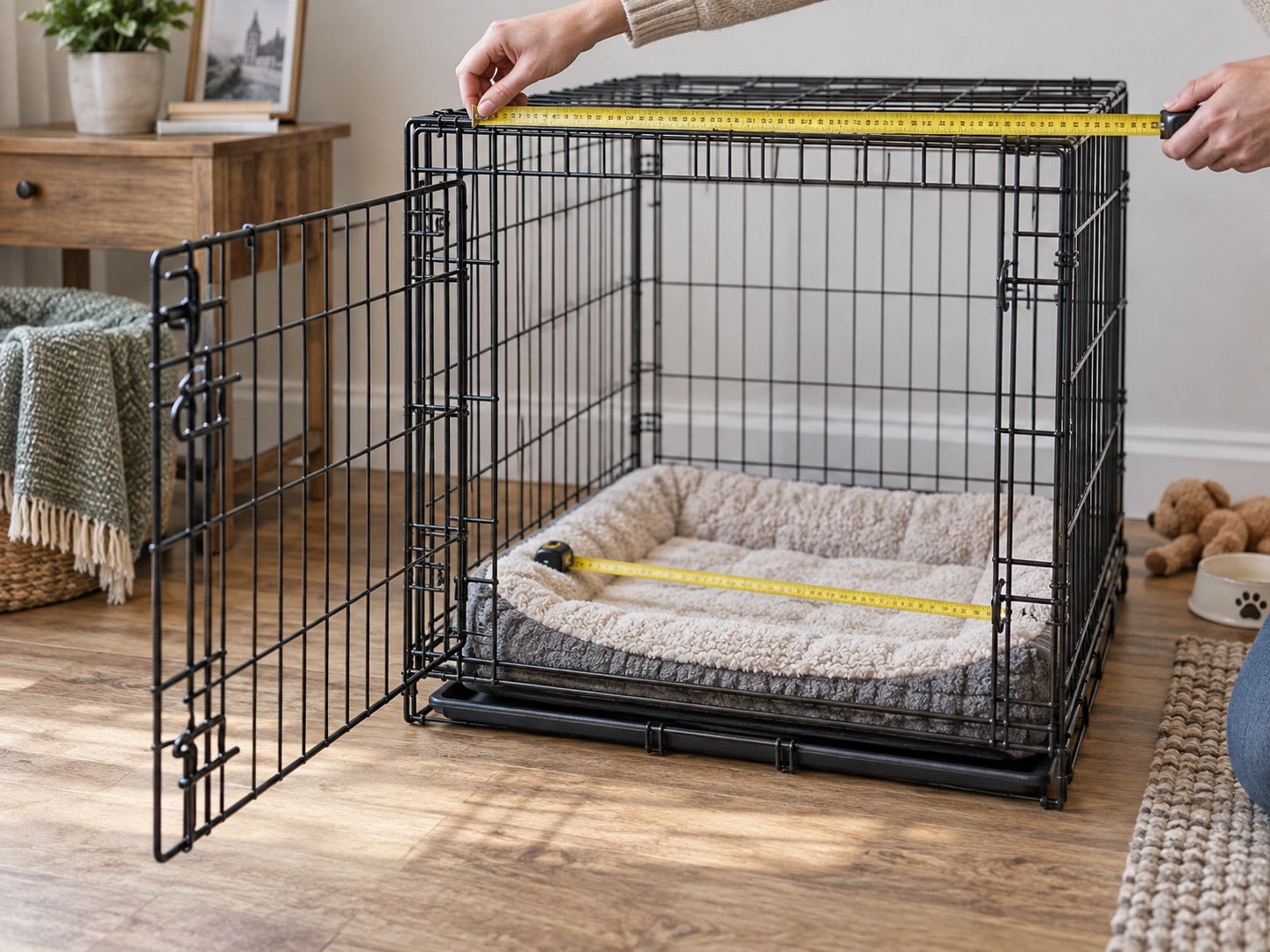
Frame thickness, tray lips, sloping walls, doors and bedding all reduce usable room.
Compare products in the same units and confirm whether measurements are internal or external.
If an interior is not published, ask the seller rather than subtracting a guessed allowance.
The simple distinction
External dimensions measure the outside of the assembled product. They help you plan floor area, delivery routes, doorways and storage. Internal dimensions measure the space the dog can actually occupy. They determine whether the crate is suitable.
Both matter, but they answer different questions. A crate can fit the dog yet block the room, or fit the room while restricting the dog. Choosing successfully means passing both tests independently.
What reduces usable space?
Wire frames and tray lips
Wire crates look visually open, but corner rails, folded panel hooks and the rim of the base tray take space. A divider adds another boundary. A quoted 91cm overall length cannot safely be treated as a 91cm bed platform.
Plastic shells that slope inward
Plastic carriers and crates often narrow towards the roof. The widest external point may be near the base while shoulder and head space are smaller. Interior height at the centre does not reveal height near sloping sides.
Furniture panels and tracks
Cabinet-style crates have thick side panels, a top, base, door tracks and sometimes central dividers. The Hzuaneri's 81cm product length corresponds to a published 75.4cm interior length. That 5.6cm difference shows why outer size is not enough.
Bedding, bowls and fittings
Even exact interior dimensions describe an empty crate. A deep bed reduces headroom, a clip-on water bowl occupies width and a bulky divider attachment can interrupt floor space. Plan the finished setup.
How to read a product listing
Look for the words internal, interior, inner or usable alongside a diagram. Confirm the order of dimensions—manufacturers alternate between length × width × height and width × depth × height. Convert inches to centimetres consistently: one inch is 2.54cm.
Check whether the selected variant changes the specification. Marketplace pages often combine several sizes, so the title, diagram, bullets and checkout selection may not update together. Save the exact variant details you rely on.
When internal measurements are missing, ask the manufacturer or seller. Avoid subtracting a fixed 2cm or 5cm from every side; construction varies too much for that shortcut.
Apply the dimensions to the dog
First measure the dog in natural standing and sitting positions and observe their longest relaxed sleep. Then compare against the interior. The dog must be able to stand, sit without touching the roof, turn, lie naturally, wag and stretch fully. If the measurements sit between two labelled sizes, use the between-sizes decision guide rather than rounding down.
Repeat the check with bedding and water in place. For a puppy, allow for growth or use a correctly positioned divider in a crate that will suit adult size. PDSA advises that too big is better than too small.
Apply the dimensions to the room
Tape the external rectangle onto the floor. Add the complete door swing, the space required to slide the tray out and a clear route around the setup. Mark height against a wall if the crate will sit under a counter or window.
Look beyond a perfect rectangle. Skirting boards, plugs and radiator pipes may push the crate forward. Hinges and handles may project. Soft-crate frames can bulge, while furniture crates may need assembly clearance.
Published dimensions: what the difference looks like
The Hzuaneri DFC83614B provides a worked example because its detailed specification labels both outside and interior measurements. We have normalised the figures to length × width × height in centimetres, then calculated the differences below. These are calculations from published specifications, not a universal deduction for furniture crates.
Scroll horizontally to see all columns →
| Axis | Outside | Inside | Difference | Difference / outside |
|---|---|---|---|---|
| Length | 81cm | 75.4cm | 5.6cm | 6.9% |
| Width | 55cm | 48.5cm | 6.5cm | 11.8% |
| Height | 67.5cm | 57.5cm | 10.0cm | 14.8% |
The detailed outside specification gives a height of 67.5cm; the size-selection label rounds it to 68cm. We use the detailed figure consistently here. Each difference is across the whole axis: a 5.6cm length difference does not establish that each end panel is 2.8cm thick. Panels, tracks and other components can contribute differently.
The floor rectangle is about 82.1% of the outside rectangle
The outside length × width gives 0.446m² after rounding. The published inside length × width gives 0.366m². That makes the internal rectangle about 82.1% of the outside one. This explains why allocating space for an 81 × 55cm cabinet does not give the dog an 81 × 55cm floor.
The ratio is useful for understanding the space taken up by the structure; it is not a score. A higher percentage does not make a crate more comfortable, stronger or safer. Length, width and height must each suit the dog's postures. An unusually long but narrow interior could have a generous area while still preventing a natural turn.
A larger furniture format: keep the tabletop separate
The FirFurd 120cm sliding-door variant publishes an interior of 115 × 53.5 × 79cm. Its internal length × width produces a rectangular area of 0.615m², before allowing for bowls, bedding or a divider. The separately described 120 × 60cm tabletop is not enough to establish the exterior floor footprint, so we do not calculate an inside-to-outside percentage for this example.
This is the distinction to carry into any comparison: a tabletop, maximum shell width and empty floor rectangle may describe different boundaries. Do not compare one product's inside width with another's outside width, even if their size names sound similar.
How we calculate the figures
All inputs belong to the exact variants named above; their specification sources are linked at the end of this guide. We retain the source precision for calculations and round displayed percentages to one decimal place and square metres to three. Rounding does not make the original specifications more precise.
- Axis difference: outside measurement − inside measurement. For the Hzuaneri length: 81 − 75.4 = 5.6cm.
- Axis difference percentage: difference ÷ outside measurement × 100. For that length: 5.6 ÷ 81 × 100 ≈ 6.9%.
- Internal rectangular area: inside length × inside width ÷ 10,000. Here: 75.4 × 48.5 ÷ 10,000 = 0.36569m², displayed as 0.366m².
- Inside/outside area percentage: (inside length × inside width) ÷ (outside length × outside width) × 100. Here: (75.4 × 48.5) ÷ (81 × 55) × 100 ≈ 82.1%.
These rectangular calculations do not describe usable volume, door clearance or the shape of a sloping shell. Nor do they subtract bowl intrusion or divider fittings unless that space is explicitly documented. Missing interior data cannot be filled in by assuming every frame takes the same allowance.
Your dog-and-room comparison worksheet
Use the worksheet below when comparing a shortlist. Copy it into your notes or print this guide and complete a separate set for each exact variant. Record missing information as unknown, not zero or an estimated deduction.
Scroll horizontally to see all columns →
| Record | Your notes | What to compare |
|---|---|---|
| Exact product and variant | Model / size: ______ | Use one variant's source-labelled figures, not a mix of sizes. |
| Dog in natural postures | Standing / sitting height: ____; relaxed lying length and width: ____ | Check internal space for standing, sitting, turning and stretching; do not use outside measurements. |
| Published interior | Length: ____; width: ____; height: ____ | Record narrow points, slopes, door opening and any divider separately. |
| Bedding and bowls | Bed thickness: ____; bed and bowl positions: ____ | Recheck headroom and uninterrupted lying space with the intended setup. |
| Room and access | Outside L × W × H: ____; door / tray clearance: ____ | Mark the whole setup, airflow and household route; floor area alone is not enough. |
The worksheet separates three decisions: whether the empty interior suits the dog, whether the equipped interior still works, and whether the assembled product works in the room. It cannot confirm suitability from dimensions alone. Follow the dog-measuring guide, the bedding-and-bowls sizing guide and the home placement guide for the checks behind each row.
Illustrative headroom calculation: a hypothetical interior 65cm high with a 6cm-thick bed leaves approximately 59cm above the bed surface, assuming a level floor and that bedding thickness. That is arithmetic, not a recommended clearance or proof that a particular dog fits. The dog must still stand and sit naturally without touching the roof, turn and stretch, with water accessible.
When measurements conflict
If the title, diagram and technical table disagree, do not choose the most generous figure. Contact the seller or manufacturer and keep a copy of the response. If clear internal data remains unavailable, a product with documented measurements is easier to assess.
After delivery, measure the assembled interior yourself before normal use. Add the planned bedding and observe the dog with the door secured open. Return or replace a crate that restricts posture rather than hoping the dog adapts.
Common questions
Frequently asked questions
Are dog crate sizes usually internal or external?
Many listings publish overall external dimensions without clearly labelling them. Read the specification wording and diagrams carefully. If it does not explicitly say internal, do not assume the full figure is usable by the dog.
How much smaller is a crate inside?
There is no standard deduction. Wire gauge, frame rails, tray edges, sloped carrier walls and furniture panels vary, so ask for the exact internal dimensions.
Do I include bedding when checking internal height?
Yes. Bedding raises the dog's body and reduces headroom. Check standing and sitting clearance with the intended mat or bed in place.
Which dimensions matter for placing a crate in a room?
Use external length, width and height, then add door swing, tray-removal clearance, airflow and a safe household route. Skirting boards and plugs can keep the frame farther from the wall than expected.
Can two crates with the same inch label have different interiors?
Yes. The inch label often rounds external length. Width, height, frame design and tray construction can all differ, so compare the full specification.
Does a higher internal floor-area percentage mean a better crate?
No. The percentage describes the relationship between two published rectangles, not comfort, quality or safety. A crate with a high ratio can still be too narrow or low for your dog, and bowls, bedding or dividers can reduce usable space.
Sources
- PDSA — crate training your dog — usable-space movement requirements
- RSPCA — dog crate guidance — sizing and growing-puppy guidance
- Hzuaneri DFC83614B — 81cm furniture crate specification — seller-published outside and interior dimensions for the white/brown variant
- FirFurd — 120cm sliding-door furniture crate specification — seller-published interior dimensions and separately labelled tabletop size