
Buying guide
Best wheeled dog carriers
Compare wheeled dog carriers by usable dog space, wheel stability, lift points, handle control and the difference between load rating and fit.
Our recommendations
Wheeled carrier formats
These are format examples for small dogs on suitable surfaces, not airport or vehicle approvals.

PawHut two-in-one dog carrier trolley
Best for: A very small dog needing both rolling and brief carried sections
A steel-frame soft carrier with two wheels, retractable handle, front and side mesh, and backpack straps. It changes mode without changing the dog's interior space.
What stands out
- Two carrying modes
- Front and side ventilation
- Stable standing legs
Keep in mind
- Tall narrow shape is not for every dog
- Two wheels need careful tilt control
- Not an airline or car restraint by default
- 42 × 25 × 55cm external
- Listed below 4kg
- Two PU wheels

COSTWAY foldable rolling pet carrier
Best for: A measured small dog on smooth level routes with some lift points
A 43 × 33 × 35cm soft-sided carrier with four swivel wheels, removable wheel assembly, telescopic handle, mesh openings and washable pad.
What stands out
- Four swivel wheels
- Removable wheel unit
- Multiple carrying handles
Keep in mind
- Compact usable interior
- Soft sides need supervision
- Wheels add height and can roll on slopes
- 43 × 33 × 35cm listed carrier
- Four removable wheels
- Listed load maximum 15kg
Scroll horizontally to see all columns →
| Carrier | Wheel design | Listed size | Main trade-off |
|---|---|---|---|
| PawHut backpack trolley | Two wheels and standing feet | 42 × 25 × 55cm | Tilted rolling position |
| COSTWAY rolling carrier | Four removable wheels | 43 × 33 × 35cm | Level rolling but compact interior |
A trolley is still a carrier
Start by measuring the dog standing, turning and lying relaxed. Subtract padding, frame and wheel-box intrusion from the published exterior; ask for internal dimensions when a listing gives only an outer size. The dog should not have to crouch through the whole trip. Our carrier measurement guide explains the posture check. A published kilogram limit is the structure's load ceiling, not a dog-sizing chart.
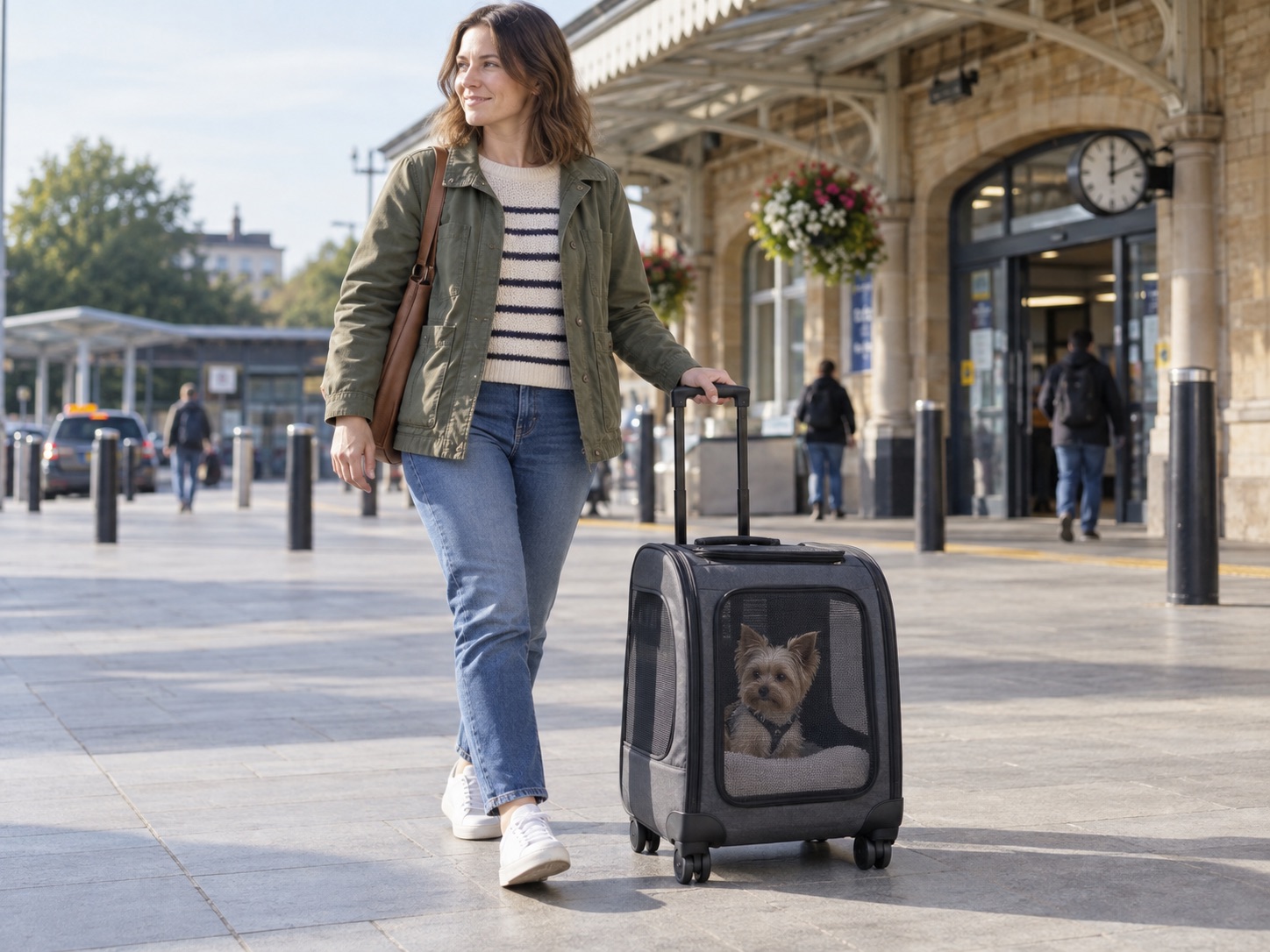
Examine the route too. A compact trolley can work across a smooth station floor, yet ruts, escalators, stairs and narrow pavements create different forces. Keep the carrier upright, maintain air around mesh panels and use lift handles at steps. Never leave a loaded trolley unattended or let it roll away on a slope.
The formats in detail
PawHut: a backpack-trolley hybrid
This model offers two wheels, a pull handle, standing legs and backpack straps. The published 42 × 25 × 55cm exterior is tall but narrow; verify the usable internal floor and how the dog sits while the unit is tilted. Its listed guidance is for dogs below 4kg. The backpack option can bridge short stair sections, but check your own carrying capacity and the dog's comfort when changing orientation.
COSTWAY: four-wheel, level-floor layout
The 43 × 33 × 35cm listed carrier uses four removable swivel wheels and a telescopic handle. Its 15kg maximum load is easy to misread: a 15kg dog is unlikely to fit naturally in this compact interior. Treat the number as a structural cap and size the dog separately. Check wheel attachment, brakes or holding control, and whether removal changes the listed height.
For this exact grey variant, our loaded-carrier calculation uses its published 1.8kg item weight and explains how to add the dog and extra contents without counting fitted components twice. A pet-load rating and a combined travel-weight limit answer different questions.
A short trial before a real journey
Let the dog explore the carrier stationary at home, then roll it empty and finally with the dog for a few metres on a quiet, level surface. Stop if it leans, braces, panics or struggles to turn. Check the mesh after every change of orientation: luggage piled next to a vent can block it. For a journey that includes an aircraft, read the airline carrier guide before buying; the wheels and route may make a seemingly compact model unsuitable.
Common questions
Frequently asked questions
Are wheeled carriers good for older dogs?
They may reduce the owner's lifting, but jolts, tilt and entry height can make them unsuitable for a dog with pain or poor balance. Ask a vet if mobility is limited and favour a stable, level interior.
Does a 15kg load limit fit a 15kg dog?
No. A structural rating says nothing about whether the dog can stand, turn and lie naturally inside the stated dimensions.
Can a wheeled carrier go on an aircraft?
Only when the operating airline and route accept the pet and the exact closed carrier meets their requirements. Wheels may count toward external height, and hold-carriage rules can require wheels to be removed or disabled.
What happens at stairs and kerbs?
Stop rolling and use the maker's specified lift handles. Plan for the full weight of dog, carrier, wheels and belongings; do not drag a loaded carrier up steps.
Are two-wheel and four-wheel carriers equally stable?
No. Two-wheel models are typically pulled at an angle; four-wheel models roll more level but may move on slopes or uneven floors. Test the unloaded motion before introducing the dog.
Sources
- IATA — traveller pet guidance
- IATA — container requirements, including wheels
- Amazon UK product pages linked from the product cards