
Topic guide
Dog playpens and gates
Plan safer, more flexible boundaries with puppy pens, room dividers and gates chosen for the opening and the dog.
Browse all guides ↓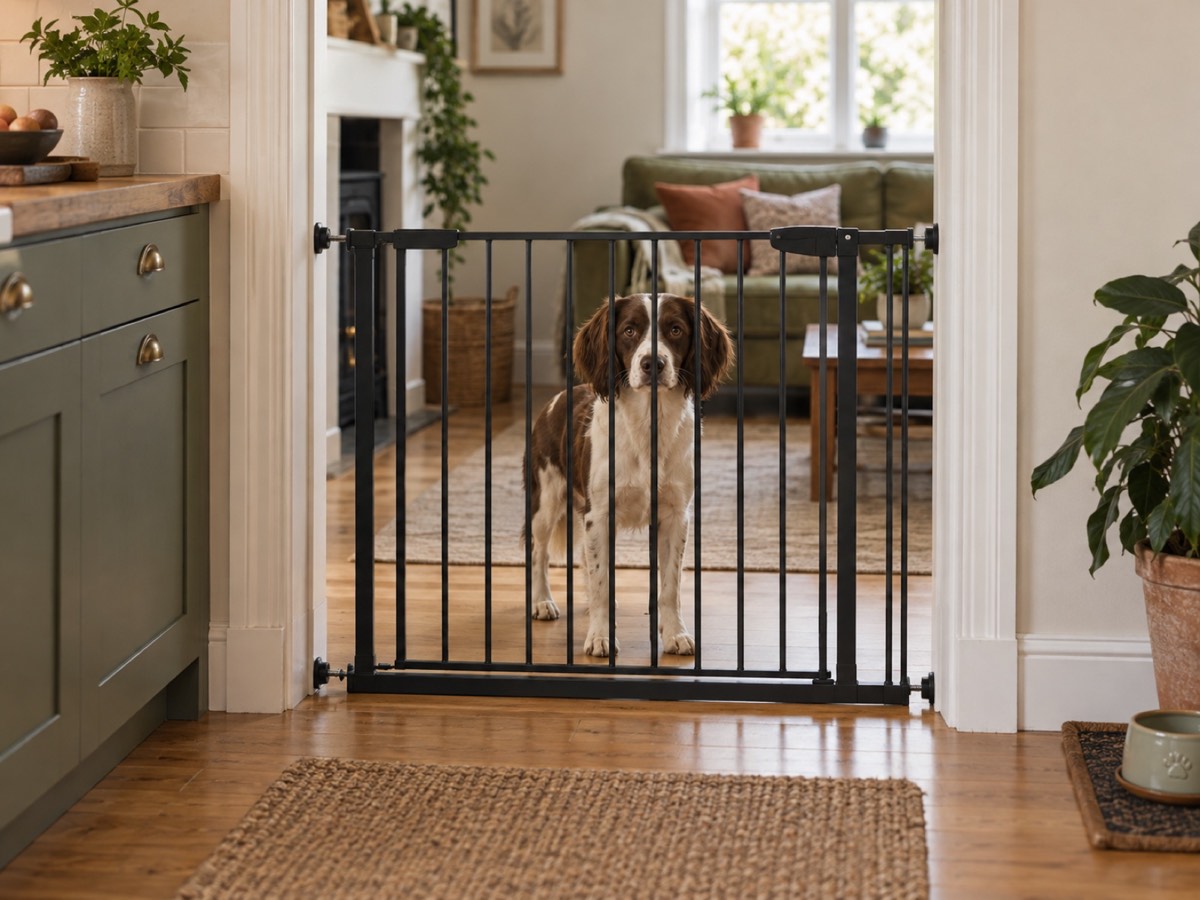
A playpen gives a puppy or dog more room to change position than a crate and can hold a bed, water and a separate activity area. A gate keeps a dog out of a whole room or stairway while preserving sightlines. Neither is automatically secure for every dog: height, bar spacing, fixing method and the surrounding furniture all affect the result. PDSA's dog-friendly home advice treats boundaries as part of a wider safe-room setup, not a substitute for supervision.
Choose the boundary by its job
For a puppy's supervised base, start with the playpen comparison and floor-area guide. If your home is compact, the flat-friendly puppy layout helps leave a clear route for people as well as space for the dog. A crate-and-pen combination gives rest and activity different places. Keep cables and sockets clear of the boundary; a panel is not proof that a puppy cannot reach through it.
For a doorway, compare everyday gate formats only after measuring the opening. A retractable gate and a freestanding divider make different compromises on fixing and resistance to a dog that pushes the barrier. Outdoor use is a separate decision: garden pens need suitable anchoring, shade, water and active supervision.
Start with the opening and the escape route
Measure the opening at the top, middle and bottom; older houses are rarely perfectly square. Note skirting boards, handrails and the direction a gate door can swing. Pressure-fit gates avoid drilling but use outward force and are not appropriate in every position. At the top of stairs, follow the gate manufacturer's location and fixing instructions exactly; BabyDan's gate-type guidance distinguishes pressure and wall-mounted designs. Use the stairs guide and installation checklist for that higher-risk location.
For pens, calculate the floor area after adding a bed and water—not just the panel diameter shown in a listing. Remove nearby chairs or boxes that could become steps. A dog that climbs, jumps, pushes panels or mouths fixings needs closer supervision and a different setup. The climbing response guide starts with injury prevention rather than simply buying taller panels.
A pen is not a long-term substitute for company
Managed spaces help during cooking, deliveries and short periods when direct supervision is difficult. They do not replace exercise, toilet breaks, social contact or gradual training. Keep sessions appropriate to the dog and review the setup as a puppy grows stronger and more coordinated.
Plan the room after the boundary
Keep routes to exterior doors and fire exits clear. Put water where it is less likely to be knocked over, use a non-slip surface and protect cables. In a multi-dog household, make sure one dog cannot guard the only exit or reach through bars to disturb another dog resting nearby.
Explore this topic
Useful guides and comparisons
Puppy pens and room zones
Give a puppy enough usable floor and a boundary that remains stable as behaviour changes.
Best puppy playpens UK
Compare compact, tall, clear-panel and soft pens by usable space, height and behaviour.
Read the guide →Buying guideBest indoor dog pens
Plan a stable indoor boundary around movement, rest, water and the actual room.
Read the guide →Safety-led buying guideBest outdoor dog pens UK
Compare panel heights and anchoring while planning shade, water and supervised garden use.
Read the guide →Buying guideBest folding puppy pens
Weigh fold-flat storage against floor space, stability and the dog's escape behaviour.
Read the guide →Sizing guidePuppy pen size guide
Work out usable floor area after the bed, water and activity zones are in place.
Read the guide →Sizing guideHow tall should a puppy pen be?
Choose panel height from standing reach, jumping, climbing and growth.
Read the guide →Practical guidePuppy pen flooring
Protect timber, laminate, tile or carpet with a flat, grippy and cleanable layer.
Read the guide →Comparison guidePuppy pen vs crate
Decide when a larger activity area or smaller den-like resting space fits the job.
Read the guide →Practical guideHow to set up an indoor puppy pen
Assemble a stable boundary, then add bedding and water without losing usable floor.
Read the guide →Problem-solving guideWhen a puppy climbs its pen
Prevent falls and assess height, footholds and distress before changing the boundary.
Read the guide →Puppy space setupCrate and playpen setup
Give the crate and pen different jobs in one workable room layout.
Read the guide →Room guidePuppy zones in an open-plan room
Keep the living-side puppy area clear of cooking routes and equipment.
Read the guide →Transition guideFrom pen to supervised room access
Expand into a puppy-proofed room in calm, observed stages.
Read the guide →Gates, openings and stair safety
Measure the installation plane and choose a fixing method for the exact location.
Best indoor dog gates UK
Compare wall-mounted, pressure-fit, extra-tall and flexible doorway gates.
Read the guide →Buying guideBest extra-tall dog gates
Compare 91cm to 110cm options for tall and athletic dogs in level openings.
Read the guide →Buying guideBest wide dog gates UK
Choose a fixed modular boundary for a wide opening without overlooking panel geometry.
Read the guide →Buying guideBest retractable dog gates
Compare mesh and folding barriers by fixing, tension, visibility and dog behaviour.
Read the guide →Buying guideBest freestanding dog gates
Understand when a supported movable divider is suitable and when it can be pushed aside.
Read the guide →Safety-led buying guidePressure-fit dog gates
Check the mounting surfaces, pad positions and use limitations before choosing a no-drill gate.
Read the guide →Sizing guideHow to measure for a dog gate
Record three widths, skirting, fixing surfaces and gate swing at the intended installation plane.
Read the guide →Fit guideGates for awkward openings
Plan angled layouts and asymmetric walls with compatible, manufacturer-approved systems.
Read the guide →Fit guideGates around skirting boards
Account for projecting trim without making unsound fixings or misaligning pressure pads.
Read the guide →Safety guideGate installation checklist
Verify the exact gate, hardware, latch, clearance and daily-use routine after fitting.
Read the guide →Safety-led guideDog gates for stairs
Plan top- and bottom-of-stairs positions, secure fixings and trip-free access.
Read the guide →Comparison guideDog gate vs baby gate
Compare intended use, height, spacing, pet flaps and stair suitability.
Read the guide →Related home guides
Compare rest spaces or suggest an awkward layout for a future guide.
Dog crates
Compare the smaller enclosed resting-space option and understand its welfare limits.
Read the guide →Related categoryBeds and home spaces
Give the managed area a comfortable, washable resting option and sensible placement.
Read the guide →ContactContact the editorial team
Tell us which awkward opening or layout you would like a guide to cover.
Read the guide →Common questions
Frequently asked questions
Should I use a puppy pen or a dog gate?
A pen makes a defined area within a room; a gate controls access through an opening. Choose the job first, then measure the usable floor or opening and assess the dog's climbing, jumping and pushing behaviour.
Is a taller gate or pen always more secure?
No. Fixings, stability, footholds, bar spacing and nearby furniture matter alongside height. A dog that climbs or pushes a boundary needs a reviewed setup and supervision rather than height alone.
Can I put any pressure-fit dog gate at the top of stairs?
No. Choose a gate explicitly suitable for that location and follow its exact fixing instructions. Wall-mounted designs are generally the appropriate starting point for top-of-stairs use; a pressure-fit frame and lower rail introduce different movement and trip risks.