
Dog backpack carrier buying guide
Best dog backpack carriers
Compare dog backpack carriers by usable interior, frame support, ventilation, closures and comfort for both dog and wearer.
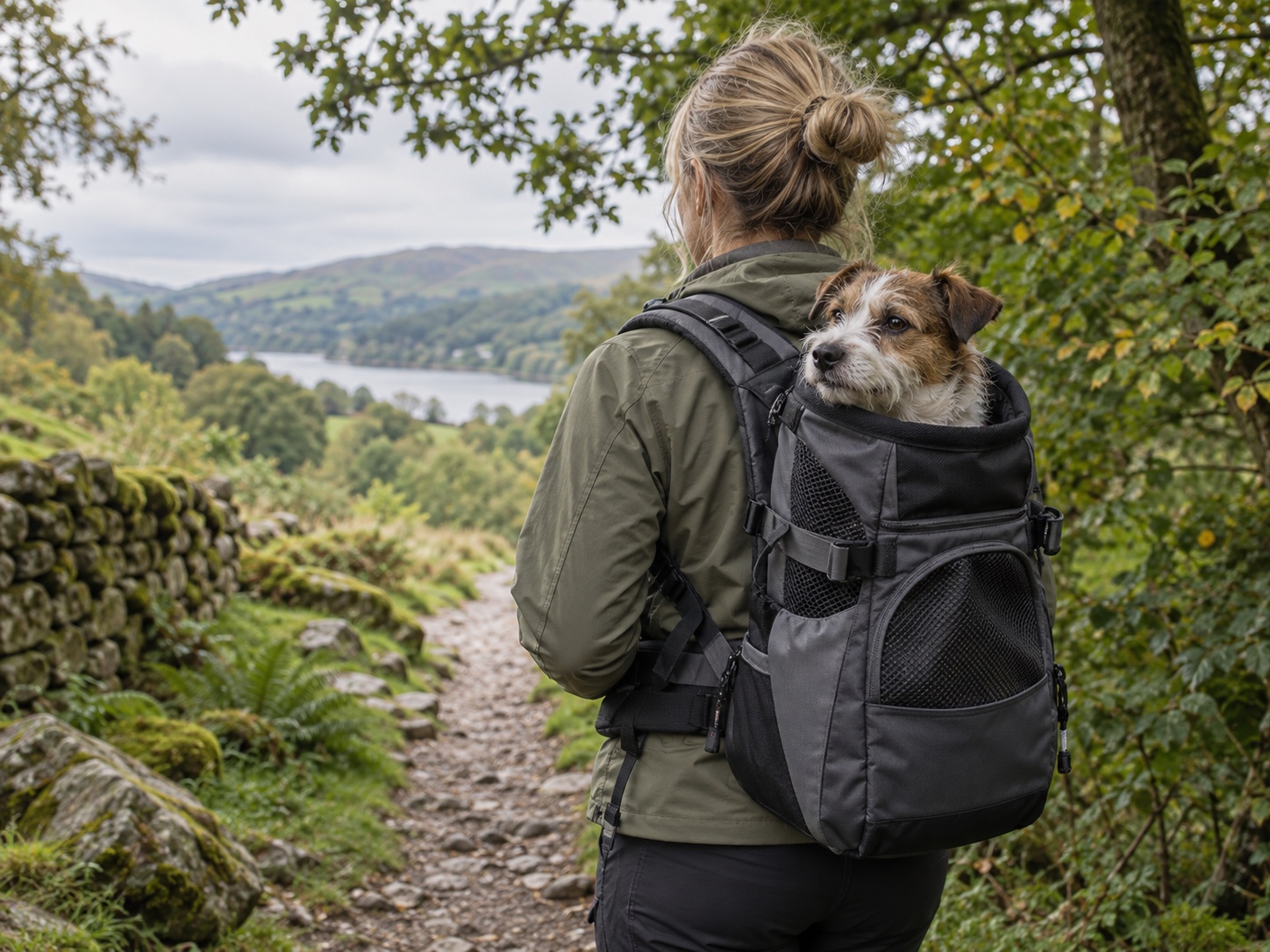
Our recommendations
Dog backpack carriers worth comparing
These are for small dogs that can sit and lie comfortably inside the selected dimensions. A backpack is not a substitute for walking, and no listed kilogram limit guarantees a humane fit.

Pecute ventilated dog backpack, L
Best for: A small dog whose sitting height fits the selected size
A structured backpack with four-sided mesh, locking zip buckles, a reversible pad and chest and waist straps to control movement on the wearer.
What stands out
- Four-sided ventilation
- Chest and waist straps
- Locking zip buckles
Keep in mind
- Variant dimensions differ
- Heat still needs active monitoring
- An internal tether must attach to a harness, not a collar
- L: 44 × 34 × 27cm
- Listed below 5kg
- Steel-wire frame
- Chest and waist straps

Pecute small-dog backpack carrier
Best for: A genuinely small dog needing a compact enclosed carrier
A 42cm structured backpack with a stable frame, breathable mesh, locking zip buckle, two-sided base pad and chest and waist straps.
What stands out
- Compact footprint
- Stable wire frame
- Chest and waist straps
Keep in mind
- Only for small measured dogs
- Harness attachment is safer than a collar tether
- Monitor heat and breathing continuously
- 34 × 30 × 42cm
- Listed maximum 6kg
- Sitting-height guide 38cm
- Locking zip buckle

Morpilot dog backpack carrier
Best for: Occasional walking transport for a measured small dog
A 42cm backpack with two-way entry, mesh windows, padded straps, waist support, a removable bed and folding bowl.
What stands out
- Two-way entry
- Padded back and straps
- Removable bed and bowl
Keep in mind
- Listed weight is not a fit test
- Tether should connect to a harness
- Not for long unsupported carrying
- 42 × 28 × 33cm
- Listed maximum 7kg
- 600D Oxford fabric
- Waist support

Apollo Walker expandable pet backpack
Best for: A small dog that needs a larger stationary rest area between carries
A carrier backpack with a rear expansion section, reinforced mesh, lockable zips, an internal tether and padded chest and waist straps.
What stands out
- Rear expansion section
- Lockable double zips
- Chest and waist straps
Keep in mind
- Expanded size is not a carrying mode
- Large profile on the wearer
- Fit still depends on sitting height and base area
- Closed: 32 × 29 × 43cm
- Expanded: 31.2 × 42.6 × 55.9cm
- 800D fabric
- Removable mat
Scroll horizontally to see all columns →
| Model | Published closed size | Listed maximum | Support | Best for |
|---|---|---|---|---|
| Pecute L | 44 × 34 × 27cm | Below 5kg | Wire frame, chest and waist straps | All-round structure |
| Pecute compact | 34 × 30 × 42cm | 6kg | Wire frame, chest and waist straps | Small upright dog |
| Morpilot | 42 × 28 × 33cm | 7kg | Padded back and waist support | Occasional trips |
| Apollo Walker | 32 × 29 × 43cm | Confirm live listing | Expandable rear, chest and waist straps | Stationary rest space |
When a dog backpack is appropriate
A backpack can help a small dog cover a short section they cannot walk safely: a crowded station, an elderly dog's route to the vet or part of a longer outing with planned ground breaks. It should not be used simply to avoid the dog's normal exercise or to carry an uncomfortable dog for hours.
Choose an enclosed design that supports the whole body. Legs-out carriers can concentrate pressure around limb openings and leave the dog exposed. A structured compartment with a level base makes posture easier to assess and gives the dog a defined resting surface.
Measure two bodies, not one
First use our dog carrier measuring method. Backpack dimensions can be published in different orders, so confirm which number is length, width and height. The dog needs sitting headroom, room to turn and a natural resting position.
Then fit the wearer. Shoulder straps should sit flat, the chest strap should stabilise without restricting breathing and the waist strap should transfer part of the load to the hips. Add the carrier, dog, mat, water and supplies to understand the real carried weight.
What separates a useful backpack from a novelty
A frame that preserves breathing space
The front, back and roof should not collapse into the dog when the wearer leans or climbs a step. A wire frame or reinforced structure helps, but inspect it regularly for distortion and exposed ends.
A base that cannot fold
The base should span the dog's whole resting area and remain horizontal. A removable pad can improve grip and cleaning, but a deep cushion may reduce headroom and increase heat.
Controlled movement on the wearer
Chest and waist straps reduce swinging. Tighten them enough to stabilise the pack, then check both the dog's space and your breathing. Sudden side-to-side movement is tiring for the wearer and destabilising for the dog.
Ventilation you can see
Mesh panels need open air around them. A jacket hood, long hair or another bag can block ventilation. Feel the inside temperature frequently and plan shorter sessions in warm or humid weather.
The backpack carriers in detail
Pecute L: the strongest all-round comparison
The selected L variant is listed as 44 × 34 × 27cm for pets below 5kg. Its steel-wire frame, four-sided mesh, locking zip buckles, reversible pad and chest and waist straps cover the most important fundamentals.
The proportions are important: Amazon's product page also shows other variants and dimension orders. Confirm the chosen size and compare the dog's actual sitting height before checkout.
Pecute compact: for a genuinely small upright dog
This 34 × 30 × 42cm model has more published vertical height and a stated 38cm sitting-height guide. It can make more sense for an upright small dog than a low, long-backed shape.
The 6kg maximum is still not permission to squeeze in a 6kg dog. Check shoulder width and lying posture, and attach the internal tether to a harness only.
Morpilot: a practical value option
Morpilot lists 42 × 28 × 33cm and a maximum 7kg. It includes mesh windows, two-way entry, padded back and straps, waist support, a removable bed and a folding bowl.
The listed maximum is relatively high for the footprint. Give dimensions priority and test the combined load at home. Stop if the pack pulls away from your body or the dog cannot reposition freely.
Apollo Walker: expansion for stationary breaks
The Apollo Walker is listed at 32 × 29 × 43cm closed and expands at the rear to provide a larger stationary compartment. That can be useful during a quiet wait, provided the pack is placed on a level floor.
Do not carry the backpack with the expansion panel open. The larger shape changes balance and is not the transport configuration. Confirm the current live weight guidance before choosing it.
Acclimatise on the floor first
Open the backpack on a stable floor and reward voluntary investigation. Practise entering, turning and settling before fastening anything. Then close it briefly while it remains on the floor, followed by a short lift with one hand supporting the base.
Build to a few calm indoor steps before going outside. The first outdoor sessions should be short and cool, with frequent checks. A dog that pants heavily, drools, claws, throws their body around or becomes unusually still needs to come out in a safe place.
Carrying checklist
Before leaving, inspect the frame, base, mesh, zip locks, strap stitching and buckles. Put the pack on before loading if the manufacturer's method allows, or have another adult support it. Keep the dog low and close to your centre of gravity.
Avoid steep scrambling, running, cycling and crowded situations where the pack can be struck. A backpack provides convenient containment; it is not protective sports equipment. For conventional handheld choices, compare our dog carrier guide.
Common questions
Frequently asked questions
Are dog backpack carriers safe?
A well-fitted enclosed carrier can be useful for a small dog on a short, monitored journey. Safety depends on usable space, base support, ventilation, secure closures, the wearer's balance and stopping immediately if the dog struggles or overheats.
How should a dog sit in a backpack carrier?
The dog should rest on a level supported base with the spine in a natural position and enough height to sit without persistent neck flexion. The carrier should not suspend the dog by the limbs or abdomen.
Can I carry a 10kg dog in a backpack?
Only if the exact carrier is rated for that load, the dog fits by posture and the wearer can carry the combined weight safely. Many products in this shortlist are intended for dogs below 5–7kg, so do not exceed the selected variant's limit.
Should the dog put its head through the top opening?
Use the carrier only as its instructions specify. An open top increases escape and impact risk; if permitted while stationary, attach an internal tether to a harness, never a collar, and close it before moving through hazards.
Can I cycle with a dog backpack carrier?
Walking suitability does not establish cycling safety. A fall changes the forces and exposes the dog to greater impact, so use only equipment explicitly designed and tested for that activity and follow its instructions.
Sources
- IATA — travelling with pets and container fit
- Amazon UK product pages linked from the product cards