
Dog crate sizing guide
Standard dog crate sizes explained
Convert standard dog crate sizes to centimetres and compare published dimensions of 36-inch models. See why identical inch labels do not mean identical fit.
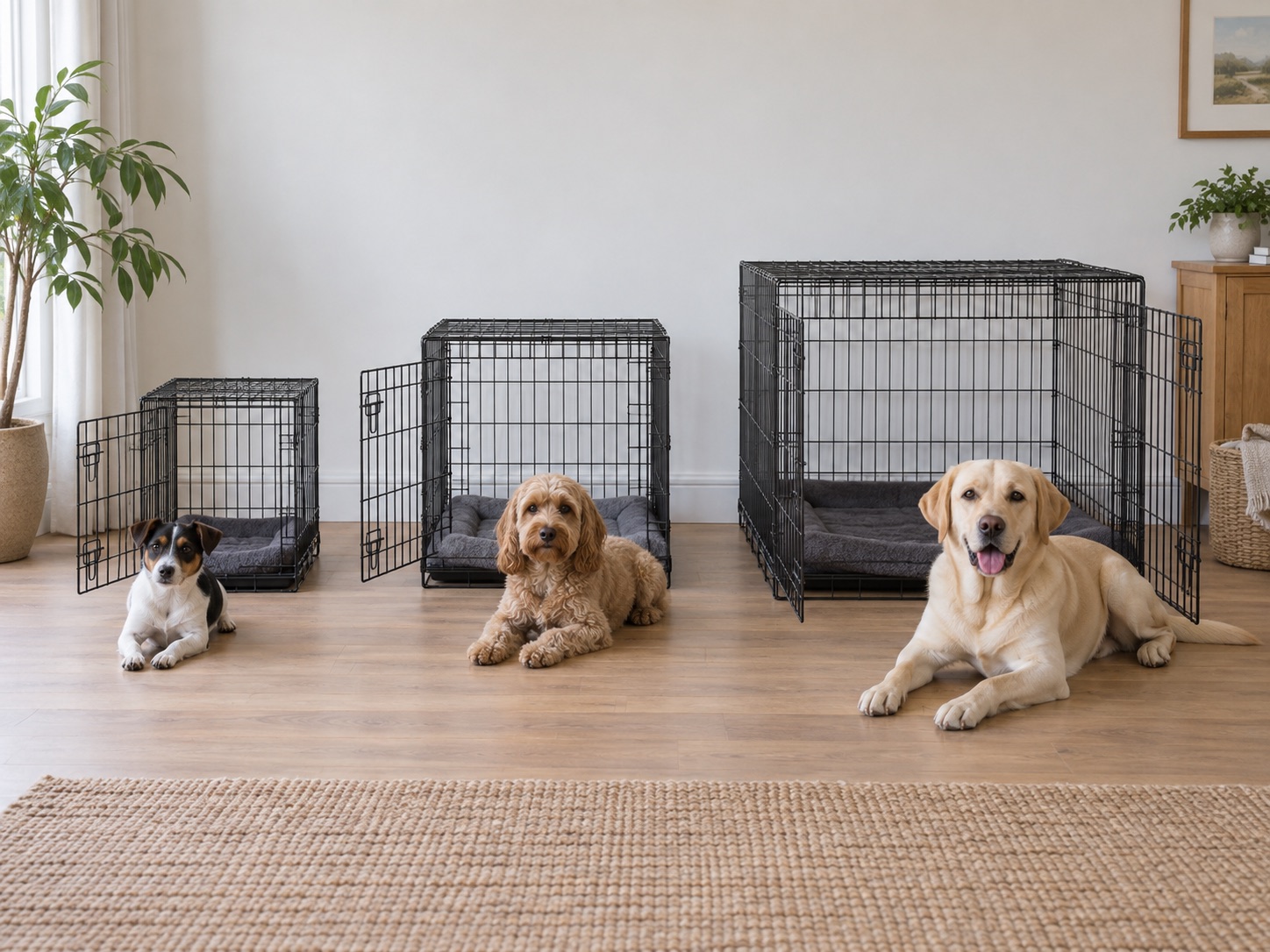
Convert inches to centimetres by multiplying by 2.54, but expect manufacturers to round.
Never choose from breed or weight charts alone; dogs of the same breed can differ substantially.
Confirm internal length, width and height with bedding in place before accepting the fit.
Common labels and their metric equivalents
Crate ranges are often organised by approximate external length. The conversions below are mathematical equivalents, not promises about a particular product's measurement or usable interior.
| Common label | Exact conversion | Typical listing shorthand |
|---|---|---|
| 18 inches | 45.72cm | About 46–47cm |
| 24 inches | 60.96cm | About 61cm |
| 30 inches | 76.20cm | About 76cm |
| 36 inches | 91.44cm | About 91–93cm |
| 42 inches | 106.68cm | About 106–108cm |
| 48 inches | 121.92cm | About 122cm |
Manufacturers round differently and may include projecting handles, feet or frame rails. An inch conversion is a reference point, not a substitute for the selected variant's specification.
Compare actual dimensions within the 36-inch band
These three two-door wire crates share a 36-inch label, but their published centimetre dimensions differ. The comparison uses the named variants, not a mixture of single-door, standard and deluxe models. The source listings do not identify these figures as usable internal dimensions. Confirm the measurement boundaries and any projections before planning the room, then obtain separate interior figures for dog fit.
Scroll horizontally to see all columns →
| Exact model / variant | Length (cm) | Width (cm) | Height (cm) | Listed L × W rectangle (m²) |
|---|---|---|---|---|
| Ellie-Bo Deluxe, 36-inch, two-door | 91.4 | 61 | 66 | 0.558 |
| MidWest iCrate, 36-inch, two-door | 92.7 | 59.7 | 62.9 | 0.553 |
| Amazon Basics 9001N-36B, double-door | 91.4 | 58.4 | 63.5 | 0.534 |
Within this small comparison, listed length spans 1.3cm, width 2.6cm and height 3.1cm. That is why swapping one 36-inch model for another can change whether it suits a narrow alcove or a taller dog's posture. Interior headroom remains a separate, unconfirmed measurement; the published height alone cannot establish it.
What the area calculation adds
We calculate each listed length × width rectangle as length in centimetres × width in centimetres ÷ 10,000. Ellie-Bo's figures give 91.4 × 61 ÷ 10,000 = 0.558m², rounded to three decimal places. The largest rectangle in the table is 4.5% larger than the smallest, calculated from the unrounded areas.
This is a comparison of published rectangles, not usable floor area, a dog-space allowance or a complete installation footprint. Door swing, tray removal and projecting parts can require extra room. The sample demonstrates variation within one label; it does not describe every 36-inch crate on sale. Sources for each exact variant are listed at the end of this guide.
Before choosing, use the crate door-opening guide and internal versus external dimensions analysis to complete the missing fit checks.
Why there is no universal size chart
The label standardises only a rough length band. A 36-inch crate can be taller, wider or differently shaped than another 36-inch crate. Furniture crates have thick panels; plastic carriers may slope inward; soft crates lose shape under pressure; wire crates include tray rims and frame hooks.
Dogs also vary beyond weight. Two dogs at 20kg may have very different back lengths, shoulder widths and sitting heights. Breed charts overlook individuals, mixed breeds, upright ears, long bodies, deep chests, age and mobility.
Use a chart to find likely products, never to make the final decision.
What each size label really tells you
18 to 24 inches
These are genuinely compact formats. An 18-inch crate may suit only a very small dog or young puppy, and it can be outgrown quickly. Check adult-size planning before buying for a puppy.
30 to 36 inches
This broad middle of the market contains many wire crates and some soft models. Door layout, width and height diverge even when lengths look close. A divider can add growth flexibility, but it must preserve comfortable movement.
42 inches
Often listed around 106–108cm, this band can bridge the jump between 36-inch and XXL frames. Our PawHut example is 106cm long; the MidWest large model is published at 108cm despite being sold around the same category.
48 inches and XXL
Usually around 122cm external length, these crates require significant floor, carrying and storage space. They are not automatically right for every large dog, and some tall or broad dogs may still need a different shape.
The correct sizing process
Follow the full dog crate measuring guide. Record nose-to-tail-base length, natural sitting height and body width, then observe the longest relaxed sleep. The dog needs to stand, sit, turn, lie naturally, wag and stretch.
Next compare those needs with internal measurements. If the manufacturer only publishes an outside size, ask for interior figures. Our internal versus external dimensions comparison shows a calculated example, a scale diagram and a worksheet for separating dog fit from room fit.
Finally, map the external crate in the room. Include the door swing, tray clearance and a clear household route. A larger suitable crate is not useful if the only possible position is in direct sun or blocks a doorway; choose a different layout or room.
Puppies and standard sizes
Do not repeatedly buy the tightest crate as a puppy grows. Estimate adult size with help from a vet, breeder or rescue, then consider a suitable adult crate with a purpose-made divider. Adjust the divider frequently and remove it once no longer needed.
Re-measure during growth. If a puppy's ears touch, turning becomes awkward or the sleeping posture is constrained, the available space must increase immediately.
Size labels are for shopping, movement is for deciding
The value of inch labels is speed: they help you filter a long product list. Their danger is false certainty. Use the label to assemble a shortlist, exact dimensions to compare it, and the dog's real movement in the finished setup to approve it.
If you are comparing current options, our wire crate guide includes products from compact to 122cm, and our large dog crate guide focuses on 106–122cm footprints.
Common questions
Frequently asked questions
What are the standard dog crate sizes?
Common labels include 18, 24, 30, 36, 42 and 48 inches, usually referring to approximate outside length. They are retail conventions rather than a universal standard, so exact width, height and interior vary.
What size is a 36-inch dog crate in centimetres?
Thirty-six inches equals 91.44cm, so listings often round it to 91 or 92cm. That is usually the external length, not guaranteed internal floor space.
What size is a 48-inch dog crate in centimetres?
Forty-eight inches equals 121.92cm, commonly marketed as 122cm. Compare the model's width, height and internal dimensions too.
Can I choose a crate from my dog's weight?
Weight can help navigate a product range but cannot show body length, sitting height or sleeping posture. Measure the dog and use the movement test before choosing.
Should I size up between two crates?
If the smaller interior restricts any essential movement, choose the larger suitable option. PDSA says too big is better than too small, provided the crate remains safely set up and a puppy divider is managed correctly.
Do all 36-inch crates have the same width and height?
No. The three exact variants compared here list widths from 58.4 to 61cm and heights from 62.9 to 66cm. The inch label groups approximate lengths; it does not define a standard interior or guarantee the same room footprint.
Sources
- PDSA — crate training your dog — individual fit, puppy growth and too-big guidance
- RSPCA — dog crate guidance — movement requirements and puppy sizing
- Ellie-Bo Deluxe 36-inch two-door — published product dimensions
- MidWest iCrate 36-inch two-door — published product dimensions
- Amazon Basics 9001N-36B double-door — published product dimensions