
Wide dog gate buying guide
Best wide dog gates in the UK
Compare wide dog gates for UK homes by real opening width, wall fixings, panel geometry, walk-through door and dog height.
Our recommendations
Wide modular gates worth comparing
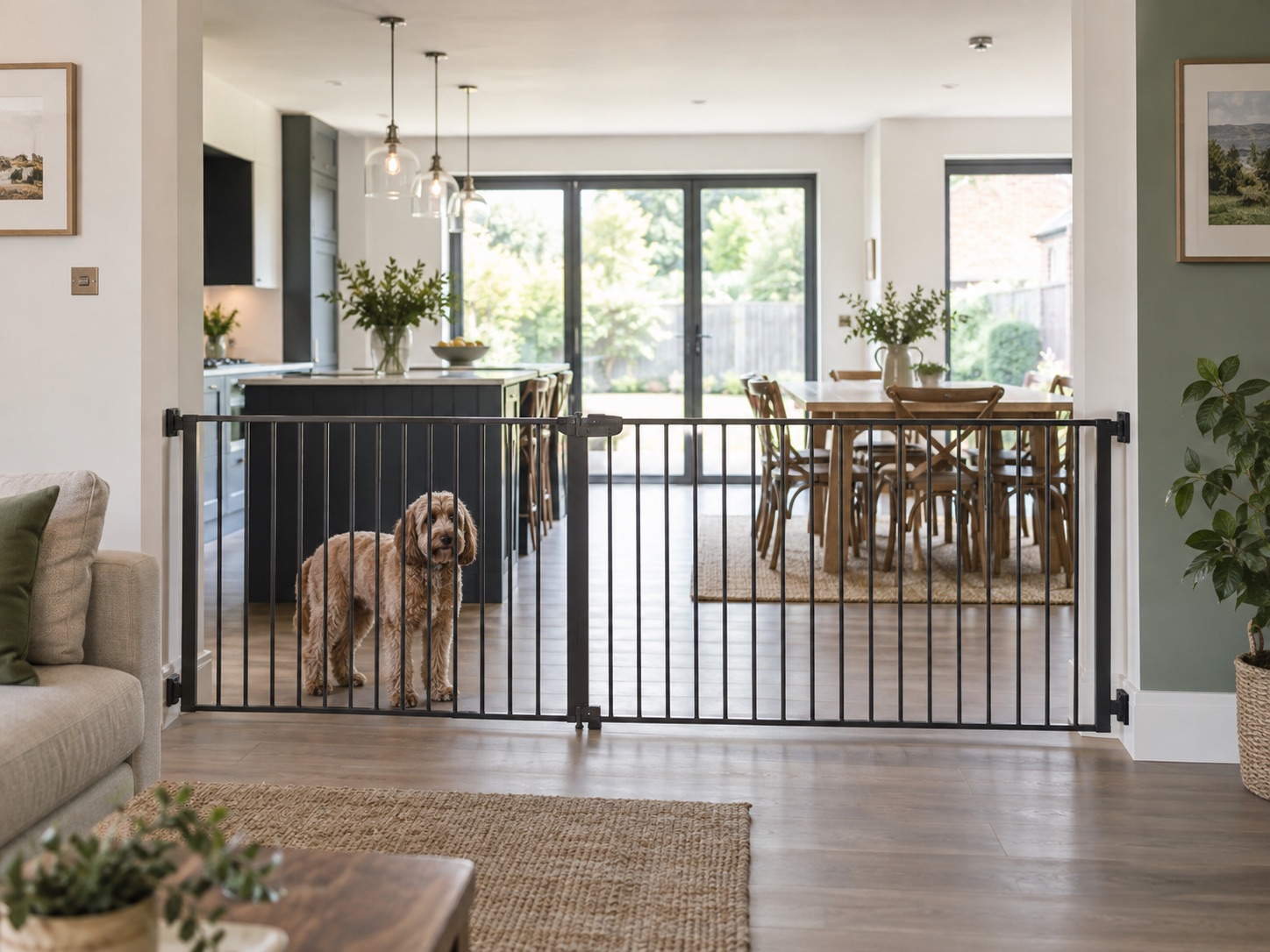
These two formats illustrate when an opening is beyond an ordinary doorway. Measure the full route and the dog, then verify the exact panel kit and fixing points.

BabyDan Flex L wall-mounted room divider
Best for: A wide or angled room opening with sound wall fixings
A wall-mounted modular gate for listed openings of 90–223cm, with linked metal sections and a walk-through door.
What stands out
- 90–223cm published range
- Modular angled layout
- Walk-through door
Keep in mind
- Wall fixing required
- Not extra tall
- Exact sections affect fit
- 90–223cm range
- About 70.5cm high
- Wall mounted

BabyDan Flex XL wall-mounted room divider
Best for: A very broad opening that needs a planned, fixed panel layout
The larger wall-mounted Flex configuration covers listed openings of 90–278cm with linked sections and a walk-through door.
What stands out
- 90–278cm range
- Configurable sections
- Walk-through door
Keep in mind
- Substantial footprint
- Requires sound fixing points
- Standard height may not contain jumpers
- 90–278cm range
- Modular panels
- Wall mounted
Scroll horizontally to see all columns →
| Gate | Listed opening | Fixing | Main limitation |
|---|---|---|---|
| BabyDan Flex L | 90–223cm | Wall mounted | About 70.5cm high |
| BabyDan Flex XL | 90–278cm | Wall mounted | Larger panel footprint |
A width number is only the beginning
Open-plan rooms rarely offer two perfect opposing walls. One side may be a short return, the other a tall cabinet or a door leaf. A gate needs approved mounting surfaces at both ends; furniture is not a structural fixing point. Sketch the opening from above and identify the wall bracket positions, any turn in the panel run and the direction the walk-through door can swing.
Measure the clear route at floor, latch and upper-rail height. Include skirting projection and any angle between the sides. Our gate measuring guide gives a record sheet to copy. A headline 223cm range does not mean every shape within that width can be built from the supplied panels.
The wide gates in detail
BabyDan Flex L: broad but manageable
Flex L is listed for 90–223cm configurations. Its modular wall-mounted panels can form an angled run, while a walk-through section provides everyday access. That is useful between a kitchen and living area where a straight doorway gate would end before the wall.
The maker lists a height around 70.5cm for the safety-gate format. A dog that clears a standard gate will not be contained merely because the new one is wider. Check the panel and door locations against furniture, radiators and the dog's route.
BabyDan Flex XL: a larger configuration
The XL kit extends the listed range to 278cm, making it relevant when L cannot reach. It is not simply a stretched bar: extra panels occupy floor depth, and the layout may need an angle to stand as designed.
Before buying the larger kit, draw each supplied section to scale. Confirm where the latch will land and whether an adult can pass through with ordinary household items. A panel resting against a dining chair is not a safe way to make up missing reach.
Fixing and height matter as much as reach
Use the specified wall brackets and hardware appropriate to the actual structure. Hollow plasterboard, masonry, timber and rounded posts do not accept the same fixings. If you cannot establish a sound mounting point, change the position or seek a competent installer. Never rely on adhesive, cable ties or unapproved timber offcuts to hold a broad barrier.
Check the individual dog's head and shoulder height, jumping ability and bar spacing. Move sofas and console tables away from the boundary. A transparent line of sight can help some dogs settle, but another may repeatedly slam into a visible barrier; a taller or longer gate is not a training remedy.
When a different gate is better
A narrower straight opening may suit the indoor dog gate guide instead. For an irregular corner or banister, see awkward-opening gate planning. At stairs, apply the stricter stair gate criteria rather than assuming a room divider's width claim makes it suitable beside a fall edge.
After installation, use the gate repeatedly and check every bracket, hinge and latch for movement. The wider the run, the more important it is to inspect all connections rather than only the door.
Common questions
Frequently asked questions
What counts as a wide dog gate?
It is a gate for an opening wider than the ordinary doorway range, often a broad hallway or open-plan transition. The practical test is the exact measured route, not a generic wide label.
Can I add extensions to any dog gate?
No. Only use sections and fittings approved for the exact model and configuration. Extensions alter span, support and often the safe mounting range.
Is a wide pressure-fit gate stable?
It depends on the product, permitted extension combination and strength of both surfaces. A very broad or angled opening often calls for a fixed modular arrangement instead of an improvised pressure span.
Can a wide gate turn a corner?
Some modular systems are designed for angled panel runs. Draw the corner, locate the wall brackets and verify the maker's approved panel geometry before ordering.
Does a wide gate suit a tall dog?
Not automatically. The BabyDan examples here are broad but standard height, so check standing reach, jumping, bar spacing and nearby launch points for the individual dog.
Sources
- BabyDan — Flex L product specifications
- BabyDan — gate manuals and configuration ranges
- RoSPA — safety gate fixing rationale
- Amazon UK product listings linked from the guide