
Cabin sizing guide
Measuring a dog and carrier for cabin travel
Measure a dog's natural posture, the closed carrier's usable inside and outside dimensions, and combined travel weight against an airline's exact route rules.
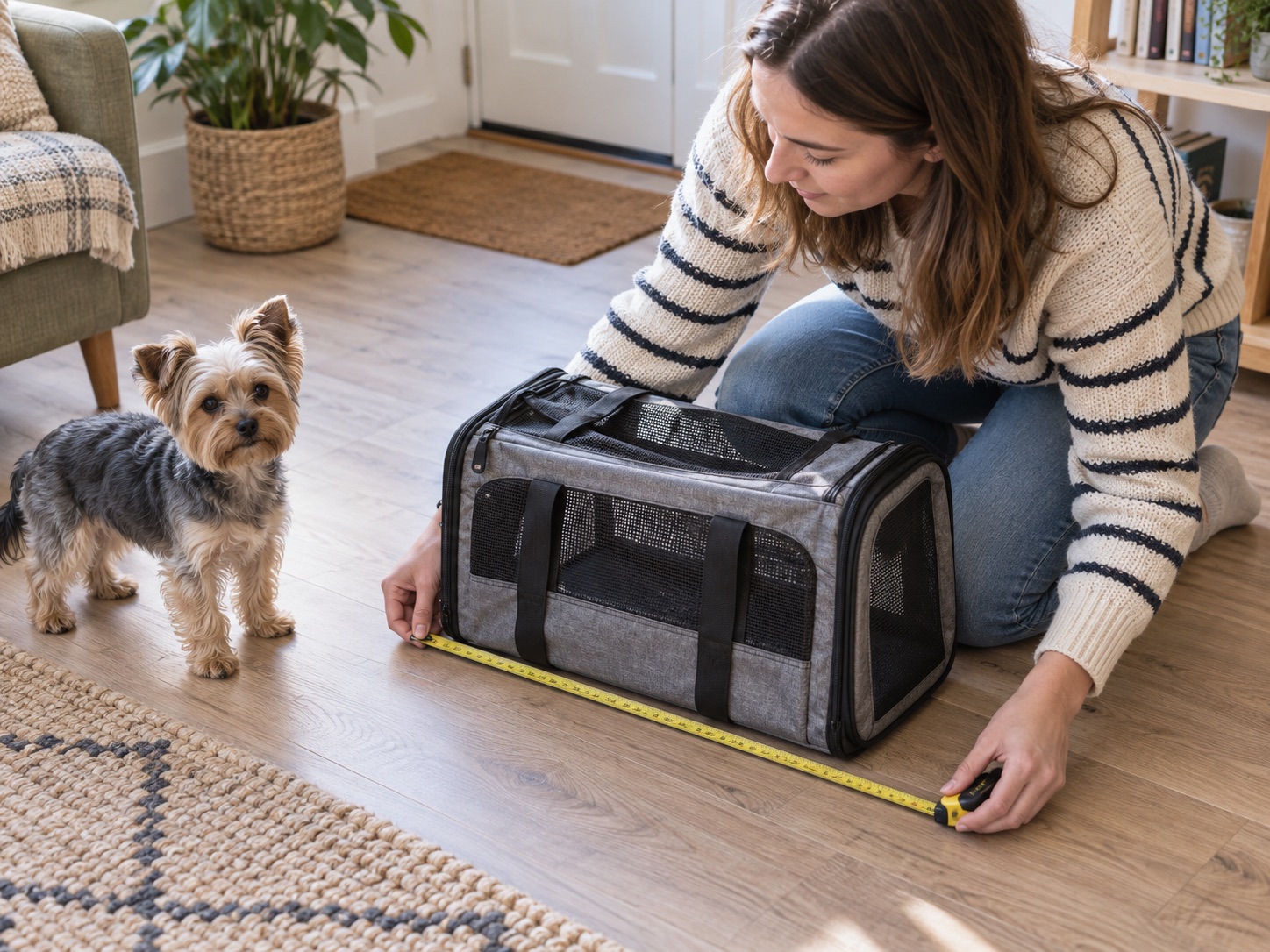
Take dog length, width and standing height in natural posture.
Include handles, pockets and base in the closed external carrier dimensions.
Weigh dog, carrier, bedding and permitted contents together.
Step 1: check whether cabin carriage exists on this route
Write down the flight's operating airline, origin, destination, connections and return direction. Confirm that an ordinary pet dog is accepted in the cabin on every leg; recognised assistance dogs use a separate process. Then obtain the carrier-size and weight rules for the booked cabin and aircraft. A perfect measurement cannot overcome a prohibited route. The airline-carrier guide covers UK direction traps; the IATA container explainer separates this cabin check from hold requirements.
Step 2: measure the dog in natural positions
With the dog standing calmly, measure nose to tail base (A), floor to elbow (B), widest shoulders or body (C), and floor to highest head or ears (D). IATA's general container formula begins with internal length A + half B, width twice C and height D plus bedding. Also watch the dog turn and settle lying down; real posture can reveal a fit issue that a formula misses. The dog should not have to lower its head for the whole trip.
Step 3: measure the carrier twice
Close all zips and flaps as they would be during the flight. Measure the full external length, width and height, including rigid base, protruding seams, handles that do not fold and any wheel assembly. Compare each number with the operating airline's current limit—do not rotate dimensions unless it explicitly permits that orientation. Then measure the usable internal floor and headroom with the actual pad installed. Keep mesh open and test that the dog can stand, turn and lie in this closed state.
The Sherpa Original Deluxe small publishes an exterior around 38 × 25 × 22cm. That may be numerically compact but its low roof is suitable only for a very small dog whose posture fits. The seller's airline claim does not establish acceptance on your flight.
The Petskd publishes 43 × 28 × 24cm closed externally, but its listed internal height conflicts with that outer height. Ask for reliable usable measurements or assess the actual carrier before relying on it. Do not count the expanded roof as extra in-flight room without express airline permission.
Step 4: weigh and document the result
Add the dog, empty carrier, bedding and any permitted contents. Compare the total with the airline's combined-weight cap, if one applies. KLM, for example, publishes 8kg for its eligible cabin-pet service and a 46 × 28 × 24cm closed-carrier limit; its UK-direction restrictions still need a separate check. Save the airline's current confirmation and your measurements with the booking, and remeasure before departure if the dog grows or the carrier changes.
Common questions
Frequently asked questions
Do airlines measure the inside or outside of a carrier?
Published size limits normally describe the closed external carrier. The inside is separately needed to establish the animal's welfare and natural posture; ask the operating airline if wording is unclear.
Can I squeeze a soft carrier to pass a height limit?
A carrier must not be compressed in a way that presses on the dog or blocks ventilation. Check the airline's actual policy and choose a design with enough room at the required closed height.
Are ears included when measuring the dog's height?
IATA's animal measurement D runs from floor to the top of the head or ears in natural position. Do not force ears or posture down to manufacture a smaller number.
Does the combined weight include the carrier?
Where an airline sets a combined pet-and-carrier maximum, yes. Read its current policy for what else counts and weigh the whole travel setup.
What if my dog fits but the return flight does not accept cabin pets?
Do not book on the assumption that outbound permission applies both ways. Check each operating flight and direction before making travel plans or buying a carrier.
Sources
- IATA — pet measurements and minimum container space
- IATA — cabin passenger guidance
- KLM — current example of cabin size and combined weight
- Amazon UK product pages linked from the product cards