
Home and car crate comparison
Can you use a home crate in a car?
Understand why a household wire or fabric crate is not automatically a vehicle restraint, and what to check before using any crate in a car.
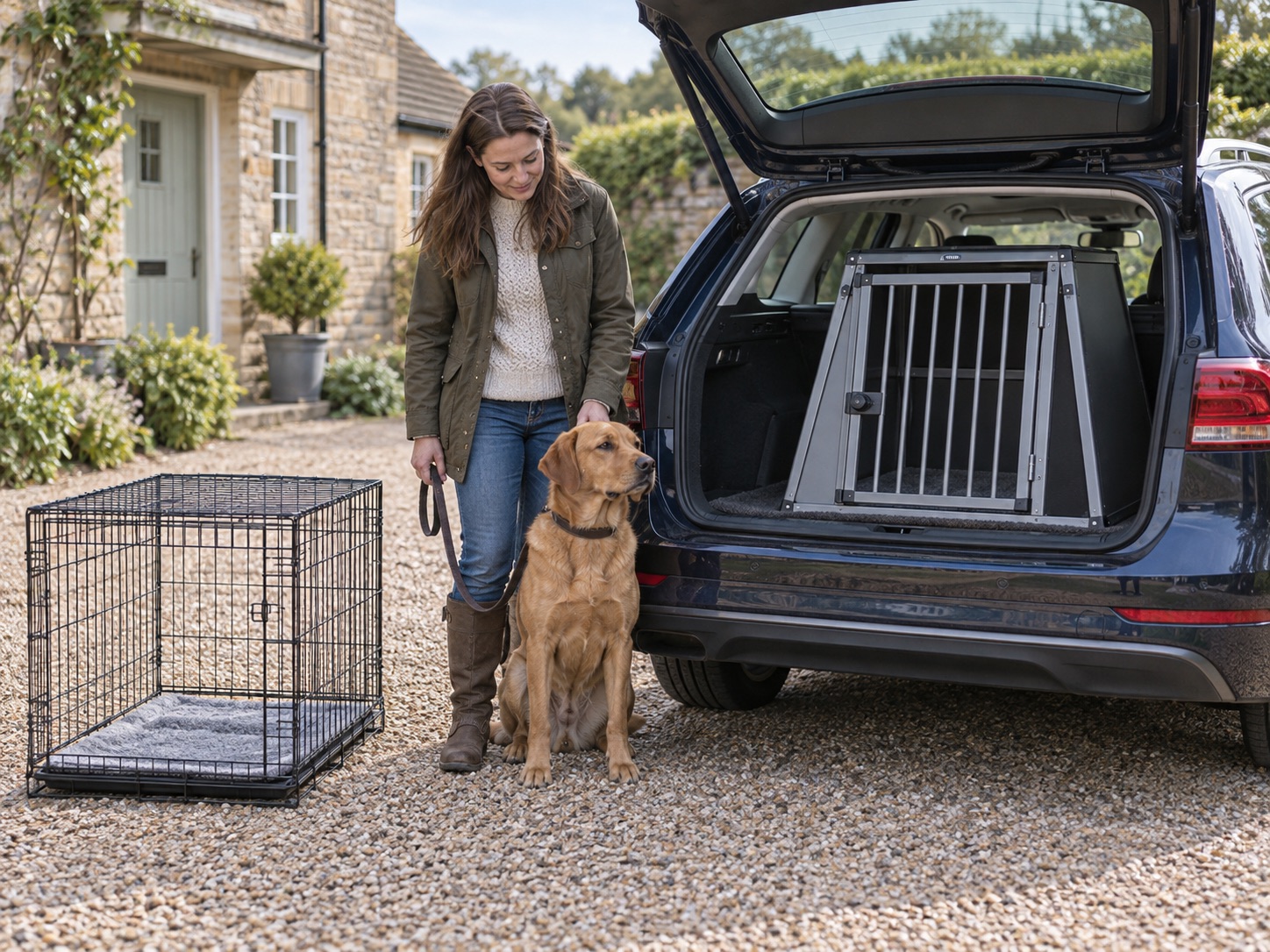
A label such as travel or heavy duty is not proof of collision testing.
A crate that fits the boot floor may not pass the opening or anchor correctly.
A car-specific crate or fitted harness can be a better route, depending on the dog and vehicle.
Similar names, different jobs
A home crate is a resting and management space. It may fold flat, have a removable tray and provide a familiar bed at a holiday cottage. A vehicle crate is designed to fit and attach in a car; some makers also publish test information for specific ranges. “Travel crate” on a listing can describe portability rather than restraint, so read the actual instructions.
Highway Code Rule 57 says dogs should be suitably restrained so they cannot distract or injure on a sudden stop. It names cages among possible methods, but not every cage is suitable. The Code's advisory wording is not itself a blanket product approval.
The comparison at a glance
Scroll horizontally to see all columns →
| Question | Household crate | Purpose-built car crate |
|---|---|---|
| Primary design | Resting and containment at home | Vehicle fit and installation |
| Typical structure | Folding wire or fabric panels | Vehicle-shaped rigid construction |
| Attachment | Often no car-specific route | Specified straps or brackets |
| Evidence to seek | Exact-model vehicle-use instructions if claimed | Exact-range test and installation documentation |
| Destination use | Often suitable when dog is settled | May be less convenient outside the car |
Why a familiar home crate may be the wrong car product
A folding wire crate is convenient in a room, but its panels, latches and folding joints may not be designed for vehicle forces. It may lack approved anchor points. Its square profile may also block the tailgate or sit against glass. The Amazon Basics wire model below illustrates a practical household crate; it is not presented as a documented collision-tested car restraint.
Fabric destination crates have a different limitation: soft panels may not contain a dog or luggage during sudden movement, and straps for carrying are not necessarily vehicle attachments. Do not convert either design with a homemade belt route or unapproved straps.
What a vehicle-specific crate adds
A purpose-built format can account for a sloping boot, loading access, emergency exit and specified anchor points. Thule publishes front, rear and simulated roll-over test information for the Allax range and states how to install it. That is specific evidence, not a guarantee in every collision. Choose the correct size and preserve required rear clearance.
Before buying, measure the dog and boot, then follow the installation checklist. If a boot crate will not fit or the dog finds enclosure distressing, consider a properly fitted car harness instead.
Keep the familiar part without confusing the function
Introduce the new restraint gradually while the car is parked and cool. A familiar mat may help if it does not reduce usable space or block vents, but remove loose accessories the maker prohibits. Build up to short journeys. At the destination, the household crate can still serve its original job as a calm resting place.
Common questions
Frequently asked questions
Is a metal home crate safe in a car?
Metal is not proof of collision performance. Check whether the exact crate is approved for vehicle use, how it attaches and whether there is relevant test evidence.
Can I strap a folding wire crate into the boot?
Do not invent a strap route. If the maker does not specify a compatible vehicle installation, generic luggage straps do not validate the crate as a restraint.
Is a soft crate suitable for car travel?
A soft crate may be useful at a destination for a settled dog, but it should not be treated as a crash-protective vehicle crate without exact-product evidence and instructions.
What if my dog only settles in the familiar home crate?
Introduce a suitable car restraint gradually while parked, using familiar bedding if permitted. Do not sacrifice installation or ventilation for familiarity; ask a qualified behaviour professional if travel distress persists.
Does Rule 57 require a crash-tested crate?
Rule 57 says the dog should be suitably restrained and lists several possible methods. It does not specify one product category or a universal crash-test standard, but evidence, fit and installation remain important.
Sources
- GOV.UK — Highway Code Rule 57
- GOV.UK — Highway Code introduction
- Thule — Allax product and test information
- Thule — Allax installation instructions
- Amazon UK product pages linked from the product cards