
Practical guide
Dog weight vs total carrying weight
Calculate dog plus carrier plus accessories with sourced item-weight examples. Separate pet-weight limits, total carrying weight and airline combined-load rules.
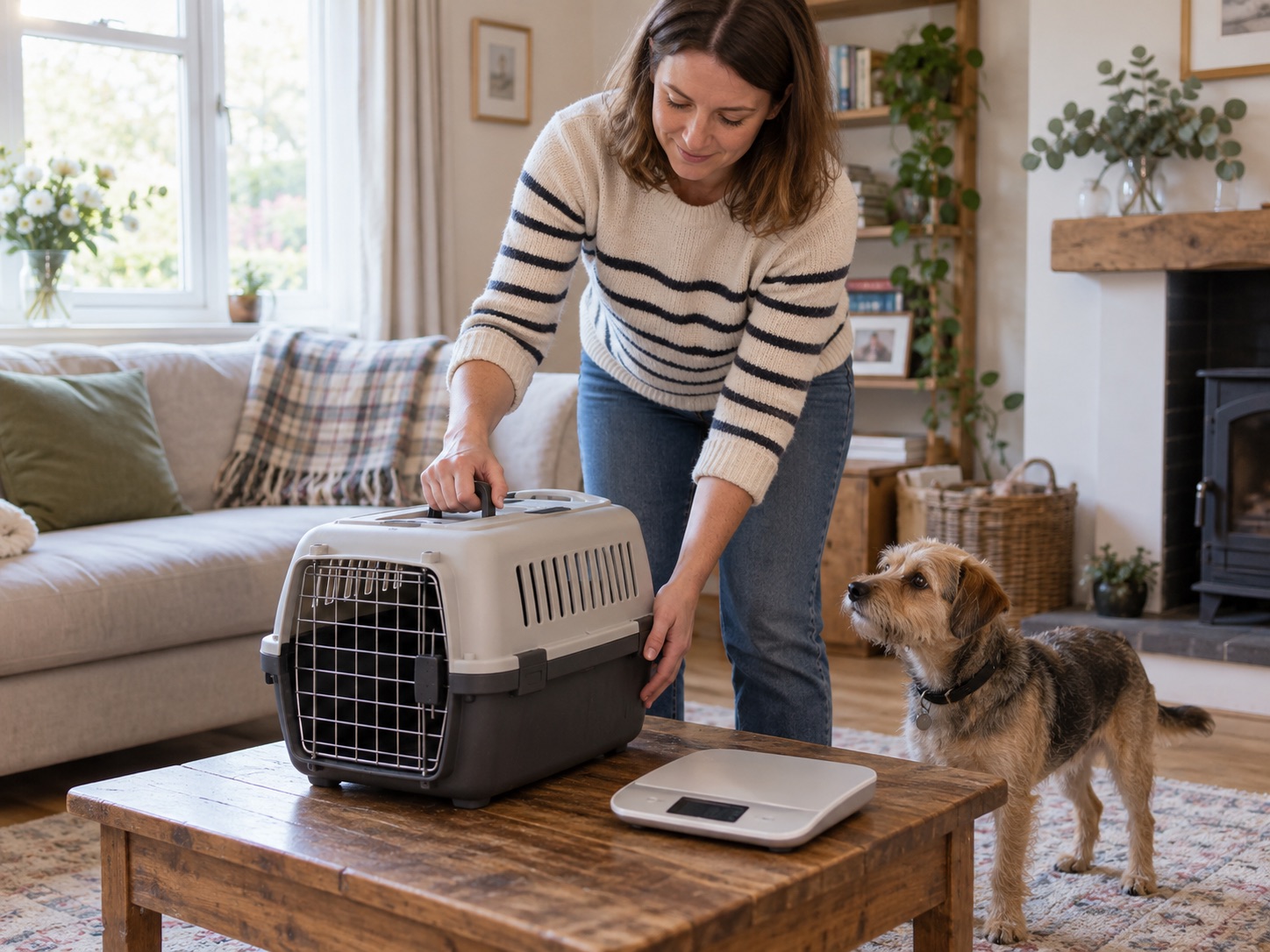
Compare dog weight with the exact manufacturer's permitted pet load.
Measure natural posture inside the actual usable interior.
Add dog, carrier, bedding and permitted contents for the total load.
Separate load capacity from living space
Imagine a carrier with a 15kg stated maximum but an exterior only 43 × 33 × 35cm. That load figure cannot establish that every 15kg dog will have enough interior room. A longer-legged dog might fail to stand naturally at half that weight. Check standing, turning and lying fit before looking at the load label.
The COSTWAY trolley illustrates this distinction. The grey 43 × 33 × 35cm variant, model 2101UP, lists a maximum pet load of 15kg and item weight of 1.8kg. Neither figure supplies its usable interior dimensions. Wheels reduce rolling effort, not the need to lift the fully loaded carrier over steps. Check its internal floor and the maker's instructions for each carrying configuration.
Calculate the load you actually handle
Write down dog weight + complete empty carrier + additional permitted contents. Include fitted pads, straps, wheels and rods in the empty setup if you will lift them; add bedding separately only when it is not already counted. If you use a shoulder sling, all of that rests on you; a padded strap changes pressure distribution but does not reduce mass. The Noah & Paw sling lists a dog range of 2.2–8kg. A dog under 8kg may still be too long, unsupported or difficult for an individual to carry safely.
Sourced carrier mass, clearly labelled example loads
The table uses COSTWAY's published 1.8kg item weight as its carrier input. Dog and added-content weights are illustrative, not observations of actual travel setups. The listing does not break that item weight down by removable component, so establish the mass of your fully equipped empty carrier before using the arithmetic for a real journey. Do not substitute package weight or a similar-looking model's specification.
Scroll horizontally to see all columns →
| Illustrative dog | Published item mass | Illustrative added contents | Calculated total |
|---|---|---|---|
| 3.0kg | 1.8kg | 0.2kg | 5.0kg |
| 5.0kg | 1.8kg | 0.3kg | 7.1kg |
| 6.0kg | 1.8kg | 0.5kg | 8.3kg |
For the middle row, 5 + 1.8 + 0.3 = 7.1kg. The 0.3kg is an imagined addition beyond whatever is included in the published item figure. If a supplied pad is already included, adding it again would overstate the total. Conversely, leaving out detachable wheels that remain fitted would understate what you lift.
Each total answers a load question only. None establishes animal fit, safe human handling, suitability for a particular lifting method or airline eligibility. The dog may be too tall to stand naturally even when both a pet-load limit and a combined-weight rule are satisfied.
Pet limits and airline limits are different budgets
A maker's 15kg pet limit is not an airline's 8kg pet-and-carrier limit. Read which items each rule includes; never subtract carrier weight from a pet-only rating unless the manufacturer actually defines it as a combined limit.
KLM, for example, publishes an 8kg combined cabin ceiling and a closed bag size limit of 46 × 28 × 24cm for eligible services. The COSTWAY example above is listed at 35cm high, so its published height exceeds that bag-height limit even where a worked total is below 8kg. It is a mass-calculation example here, not a KLM cabin recommendation. A sling's dog-weight rating likewise does not establish suitability as a closed under-seat carrier.
For a purely illustrative combined allowance of 8kg, a 1.8kg carrier and 0.3kg of additions leave 8 − 1.8 − 0.3 = 5.9kg for the dog, not 8kg. This mathematical budget cannot override the carrier's own pet limit or dimensional fit. KLM's route rules also prohibit pets travelling to the UK as passenger baggage; do not assume that eligibility works in both directions. Read airline and route checks and confirm the operating airline's rules before booking.
Your loaded-carrier worksheet
Copy or print the record below. Keep a separate dog measurement record and note the exact carrier variant, permitted configuration and items included in each weight. Repeat the calculation if the dog grows or you change the carrier setup.
Scroll horizontally to see all columns →
| Record | Your notes | Use it for |
|---|---|---|
| Dog's actual weight | ____ kg | Compare with the exact maker's pet-load rule; record the dog's body dimensions separately. |
| Complete empty carrier | ____ kg; included pad / straps / wheels: ____ | Include every fitted component you will lift; distinguish item mass from shipping weight. |
| Added permitted contents | ____ kg; items: ____ | Count only additions not already included in the empty-carrier figure. |
| Total and rule | Dog + carrier + additions = ____ kg | Check the operating carrier's actual wording and route, plus safe human handling. |
Finally, assess human handling. Lift an empty carrier with its proposed contents, practise the movement to car or platform height and enlist help if needed. Do not place a dog in an unstable carrier to test a difficult lift.
Common questions
Frequently asked questions
What counts towards an airline's pet-and-carrier limit?
Check that airline's current wording. A combined limit commonly includes the animal and its closed carrier, sometimes with bedding or other contents; the operating carrier decides.
Can a carrier rated 15kg fit a 15kg dog?
Not necessarily. A 15kg structural load rating may appear on a compact product. The dog still needs sufficient usable length, width and height for natural posture.
How do I weigh a carrier at home?
Weigh the empty carrier, add intended bedding and allowed contents, then weigh the dog separately. A luggage scale may help for a securely suspended empty carrier; use a safe floor-scale method for the dog.
Should I buy exactly at the weight limit?
Leave room for measurement uncertainty and the manufacturer's stated conditions. Never exceed the published limit, but remember that posture may rule out the carrier even well below it.
Does a trolley mean I never lift the load?
No. Kerbs, stairs, vehicle loading and wheel failure can require lifting. Plan for the full weight and use the maker's lift points.
Can I use shipping weight as the empty-carrier weight?
No. Shipping weight can include packaging and may describe a different configuration. Look for item weight for the exact variant, then establish the complete empty setup with its fitted components. Count supplied bedding once, not again as an addition.
Sources
- IATA — traveller pet guidance and animal fit
- KLM — pet reservation and combined-weight example
- COSTWAY grey 43 × 33 × 35cm carrier, model 2101UP — item weight and pet limit — published item weight 1.8kg; listed maximum pet load 15kg
- Noah & Paw sling — listed pet-weight range