
Crate door sizing guide
How to check a dog crate's door opening
Measure a crate's actual clear door opening, threshold and swing so your dog can enter comfortably and you can position the crate safely.
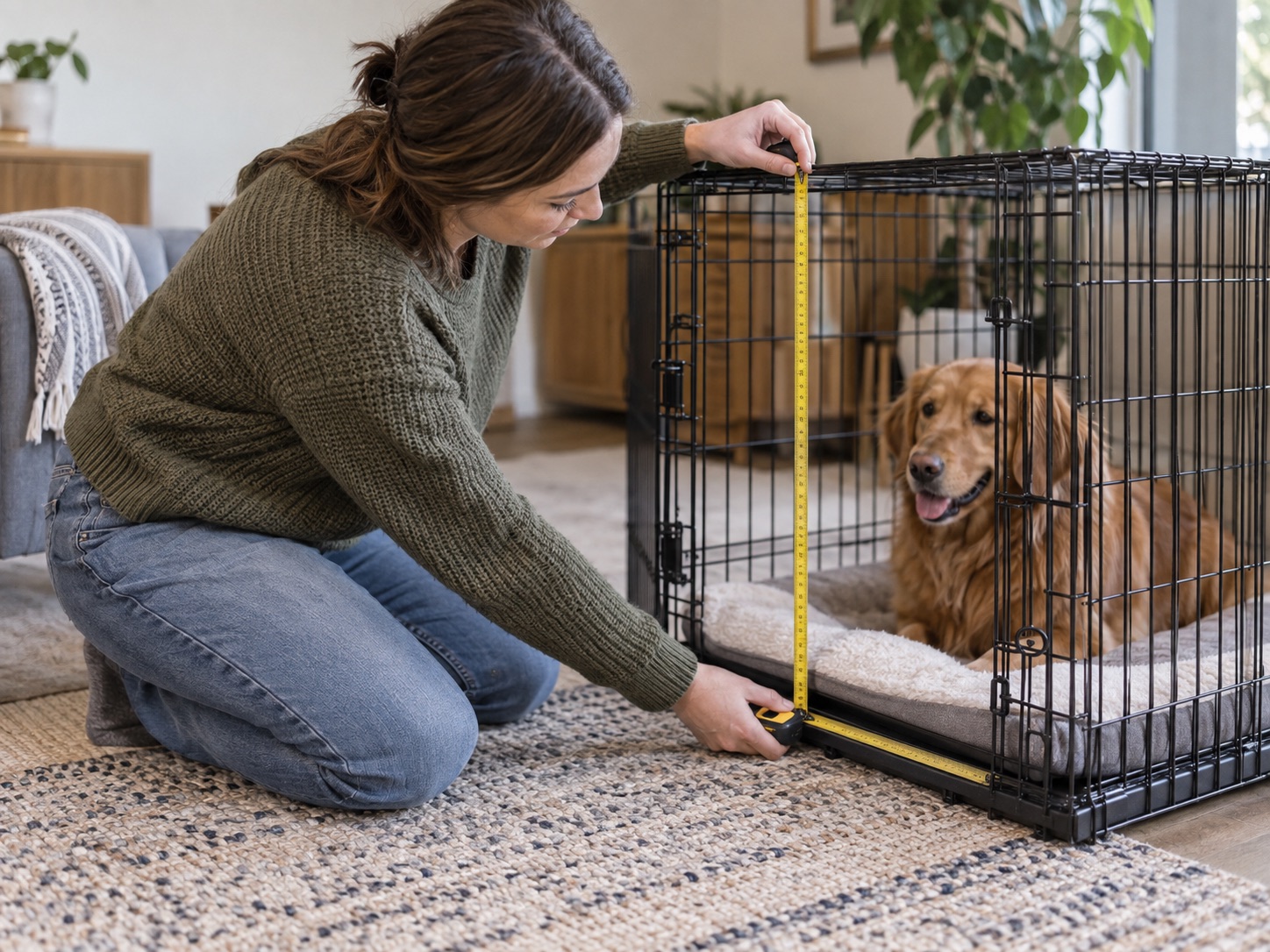
Record narrowest clear width and height, not the door-panel size.
Check threshold height, protruding latch parts and which way the door swings.
Observe an unhurried entry and exit without coaxing the dog through a tight gap.
Why the door is a separate sizing decision
You can choose a crate with sufficient floor and standing room yet still end up with an awkward entrance. The front frame, hinge, sliding bolt and bottom rail all take away from the apparent opening. A dog that must squeeze, crouch sharply or jump a high threshold may avoid the crate even if the interior is generous.
This matters especially for broad-chested dogs, long-bodied dogs navigating a short entry, older dogs and puppies learning to use the space. Measure the dog's body and resting posture as usual; treat door access as an additional check.
Published door dimensions and clear access
The comparison below keeps three different quantities separate: the door's published dimensions, the actual unobstructed passage and the step over the sill. A number in the first column is not automatically a number for the second. “Not specified” is not zero clearance or a flush threshold.
Scroll horizontally to see all columns →
| Exact model / door | Published door W × H | Clear width | Clear height | Threshold above tray | Interpretation |
|---|---|---|---|---|---|
| PawHut D00-024 · Door 1 | 54 × 60cm | Not defined | Not defined | Not quantified | Maker labels door dimensions, not clear aperture; UK variant match needs confirmation. |
| PawHut D00-024 · Door 2 | 55 × 58cm | Not defined | Not defined | Not quantified | Maker does not assign front/side in this specification; measure each accessible gap separately. |
| Amazon Basics 24-inch · B09G4C8PNB | Not specified | Not specified | Not specified | Not specified | 61 × 45.7 × 50.8cm exterior is not doorway clearance. |
| Feandrea compact · B00QF6OAPO | Not specified | Not specified | Not specified | Not specified | Current listing gives 77 × 48 × 56cm outside size and two doors, not entry clearance. |
PawHut's D00-024 specification lists two door dimensions: 54 × 60cm and 55 × 58cm, width first. That is a useful illustration of two entrances having different proportions: one is 1cm wider but 2cm shorter. However, the specification neither defines these as clear gaps nor assigns them to front and side. It also does not quantify the sill. They are therefore not confirmed clear-opening measurements, and the exact UK retail variant still needs matching to the model document.
The selected Amazon Basics and Feandrea sources give an outside envelope and door arrangement, not numerical clear access. Do not subtract an assumed frame thickness or estimate a threshold from a photograph. If a clear dimension is decisive for your dog, establish it for the exact assembled model before committing to the fit.
Measure an assembled crate in three places
Open the door as far as the maker intends. Measure the clear horizontal gap at shoulder height, near the lower frame and wherever a latch or hinge projects furthest. Record the smallest of those numbers. Then measure the clear height from the top of the threshold to the lowest point of the upper frame. Finally measure the threshold from the floor or tray surface.
If you are comparing a listing online, ask for these usable dimensions for the exact size and variant. A photograph at an angle will not establish the opening. Be wary of using the product's outside width or height as a stand-in.
The Amazon Basics 24-inch single-door crate is a useful example of why the distinction matters: its published outside size helps you plan the floor, but you still need to establish the clear entrance for your particular dog.
Include the dog's movement, not just static width
Watch how your dog naturally enters an open space. Some step straight through; others angle their shoulders, pause at the sill or turn before lying down. The goal is a relaxed movement, not a mathematically exact fit. Do not lure a dog repeatedly through an opening that causes obvious hesitation or body contact.
If mobility or pain is a concern, ask your vet for advice on access and handling. A lower threshold, a different door format or a pen may be more useful than increasing crate length alone.
Check the room outside the opening
Tape the crate footprint on the floor. Then mark the whole door arc and a clear approach zone. Leave room for a person to kneel, clean the tray and assist the dog if needed. Avoid a door that opens directly into a main walkway or catches a table leg.
The Feandrea PPD30H illustrates a two-door layout: front and side access can offer flexibility, but each opening and swing must be checked separately. A second door behind a sofa adds no usable access.
Your crate-door access worksheet
Use a separate record for each intended entrance, even on the same crate. A wider side door is not a benefit if the divider blocks it or furniture prevents full opening. Keep the dog's natural posture and approach route alongside the measurements rather than reducing the decision to one width.
Scroll horizontally to see all columns →
| Record | Your value / observation | How to define it |
|---|---|---|
| Identity and intended door | Model / size / door: ____ | Check variant and fully open position in its instructions. |
| Narrowest clear width | Low: ____; shoulder level: ____; latch: ____ | Inside obstruction to inside obstruction; record smallest usable gap. |
| Clear height | Threshold top to lowest upper obstruction: ____ | Not outside frame height or door-panel height. |
| Threshold / floor level | Above bare tray: ____; final bedding surface: ____ | Keep reference surfaces separate; note exposed bars and projections. |
| Approach and movement | Door arc / turn / paw catches / contact: ____ | A rectangle alone cannot establish comfortable entry or mobility suitability. |
Adding a mat changes the surface the dog approaches from and stands on; it does not remove a projecting bar. Check bedding allowances separately. Do not pad over, cut or remove structural parts to create an improvised entrance. For a dog with painful or limited movement, a more accessible pen or a different door format may be preferable to a crate with a difficult sill.
A final fit check at home
With the door secured fully open, invite rather than force the dog to explore. Check for ribcage or ear contact, repeated paw catches at the bottom rail and whether the dog can reverse or turn safely. Then close and open the latch several times while the dog is outside to confirm smooth operation. Continue with single-door versus double-door choices if placement is the main constraint.
Common questions
Frequently asked questions
Is the door opening the same as the crate width?
No. Frame bars, hinges, the latch and door stop can substantially reduce clear access. Ask for an opening measurement or check the assembled crate.
What dog measurement should I compare with the door?
Use shoulder and chest width, natural standing height and the dog's real entry movement. Allow comfortable clearance rather than matching body measurements exactly to a tight opening.
Does the door threshold matter?
Yes. A raised bottom bar can be awkward for puppies, older dogs and dogs with limited mobility. Observe whether the dog steps over it naturally and safely.
Can a dog crate door open against furniture?
Do not plan a tight partial opening. The door should open fully without blocking household circulation or preventing you from helping the dog.
Does a double-door crate solve a narrow doorway?
Not necessarily. Its side opening may have different dimensions and could be blocked by furniture. Measure both clear openings on the exact model.
Can I use published door dimensions as the clear opening?
Only when the source explicitly defines them as the unobstructed aperture. A door panel or an undefined door dimension can differ from the gap left by the frame, hinge and latch. Threshold height needs its own reference surface.
Sources
- PDSA — crate training and fit
- RSPCA — dog crates and puppy playpens
- Amazon UK example products linked in the guide
- PawHut / Aosom — D00-024 manufacturer specifications — Door dimensions are not defined as clear apertures; no quantified threshold.