
Practical crate guide
How to size and position a dog crate divider
Plan a crate divider with labelled length and floor-area examples, a bedding and water diagram, and a practical fit worksheet for a growing puppy.
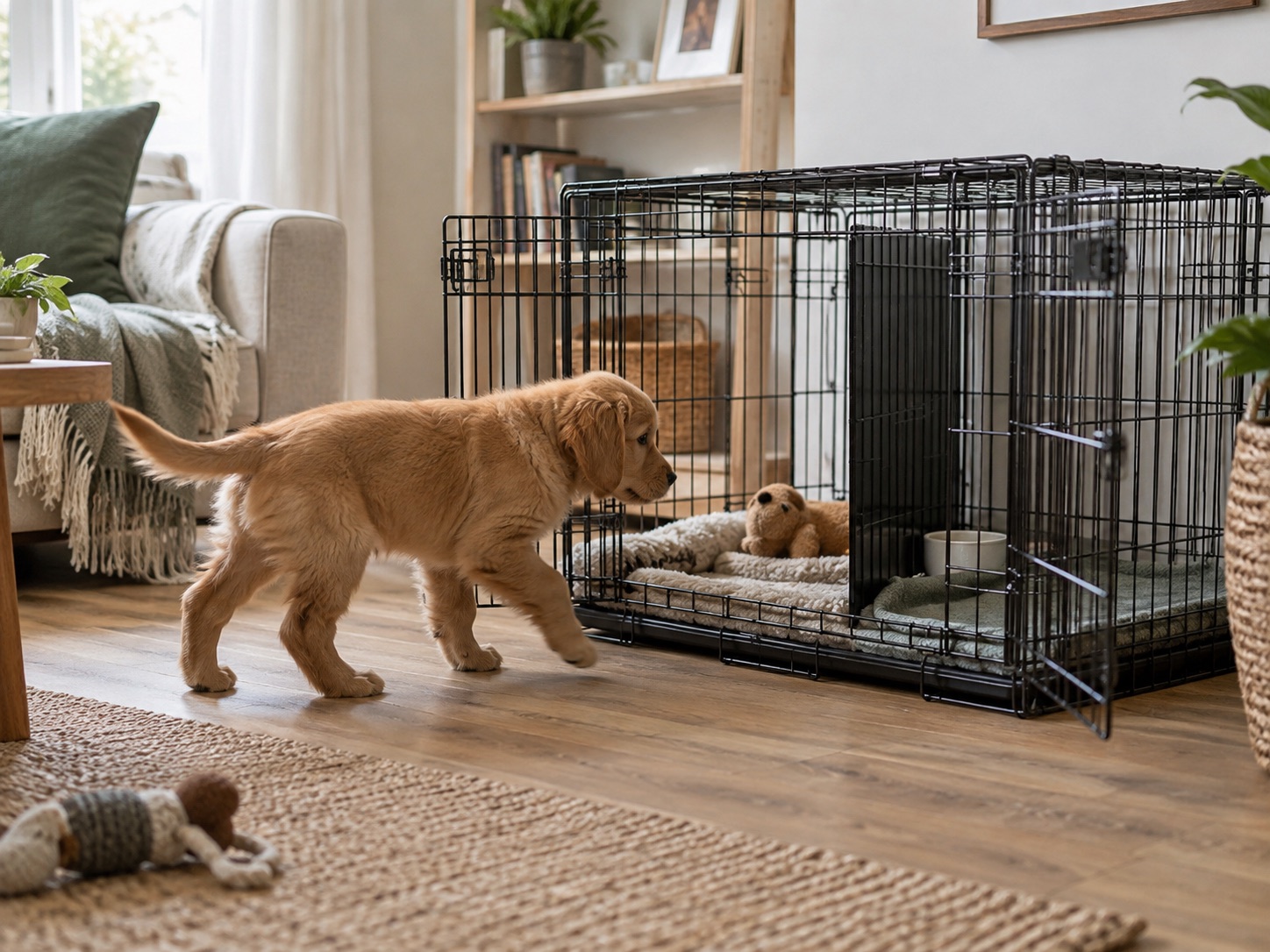
Use the divider made for the exact crate model and follow its fitting instructions.
Check for sharp edges, gaps and access to bedding and water.
Reassess the usable section frequently during rapid growth.
What a divider is for
A divider changes the usable length of a larger wire crate while a puppy grows. It can help avoid buying several full crates, provided the crate's height, width and door are suitable now and its full size is likely to suit the adult dog. It does not make a too-small crate fit, and it should never be placed so close that a puppy must curl or crouch.
Begin with the puppy's current measurements and estimate adult dimensions separately. Buy a divider designed for the exact crate if the maker offers one. The MidWest iCrate 36-inch listing includes a divider; confirm the selected size and that the panel supplied matches the model before assembly.
How divider position changes available length
Measure from the inside front face to the dog-facing surface of the divider, not from the exterior front rail to the back of the crate. That definition already excludes the divider's thickness and any space behind it. It also avoids treating a nominal “36-inch” shell as 36 inches of puppy space.
Here is a deliberately hypothetical example: a 100 × 60cm clear interior, with accessible lengths of 60, 75 or 90cm. These are labelled positions for comparing geometry, not dimensions of the products below, confirmed fixing increments or suggested minimums for puppies. The imagined equipment is a 45 × 35cm bed plus a separate 15 × 15cm water reservation. All rectangles lie inside the compartment and do not overlap.
Scroll horizontally to see all columns →
| Front-to-divider clear length | Floor area | Length excluded behind divider | Uncovered floor after bed + water |
|---|---|---|---|
| 60cm | 0.3600m² | 40cm | 0.1800m² |
| 75cm | 0.4500m² | 25cm | 0.2700m² |
| 90cm | 0.5400m² | 10cm | 0.3600m² |
The calculation is accessible length × clear width ÷ 10,000 = floor area in m², with dimensions entered in centimetres. The bed occupies 0.1575m² and the water reservation 0.0225m². Subtracting those footprints gives uncovered floor, not all usable space: the bed remains a resting surface. Moving the panel 15cm adds 0.09m² to this particular 60cm-wide rectangle; it says nothing about which position a real puppy needs.
The same bed and water reservation are shown in both plans so only the divider position changes. A bowl's drawn square does not describe its inward projection, rim height or drinking approach. The geometry also does not account for the dog's turning path, a side door crossing the divider or a sloping roof. Those are separate checks with the actual arrangement.
Position it with the puppy's real resting shape
Place the crate on a level floor with its tray fitted. Install the divider according to the manufacturer's instructions, then add the planned mat and water. Allow enough length for the puppy to turn and lie naturally, not just touch nose and tail to opposite ends. Check the dog sitting and standing with ears and head clear of the roof.
Do not follow a rigid rule such as “one body length only.” A growing puppy's preferred sleeping posture, long legs or deep bed can all change the usable space. If the divider makes the area tight, move it back. More room is preferable to restricting normal posture.
The manufacturer’s CA-series iCrate instructions provide a useful model-specific fitting example: hooks face away from the front entrance and the dog's section; the panel sits close to the pan and hooks engage the sides. That document is not a universal instruction for every iCrate generation or another brand. Use the manual supplied with the exact crate and panel, and preserve natural standing, sitting, turning and lying room.
Length, width and height cannot substitute for one another. If a thick bed leaves insufficient standing height, moving the divider back will not raise the roof. If the water bracket projects into the shoulder path, a larger floor-area number does not remove the obstruction. Compare furnished bedding allowances and clear door access as part of the same decision.
Check the fixings and gaps
Inspect every hook, clip and bar after assembly. The panel should remain upright when gently pressed, without exposed wire ends or gaps that could trap a paw or muzzle. Keep collars, tags and harnesses out of an unsupervised crate unless your vet or trainer has advised an individual safety plan; hardware can catch on a divider or door.
The MidWest 18-inch crate also includes a divider, but its compact full size is quickly outgrown by many puppies. A divider is only useful if the overall crate remains appropriate at each stage.
Your divider fit-planning worksheet
Fill this in after adding the bedding and water you intend to use. Record the compartment on the dog's side only. The unused space behind a panel is not an extra accessible zone, and a puppy divider should not be repurposed as a two-dog partition unless the maker explicitly designs it for that purpose.
Scroll horizontally to see all columns →
| Record | Your arrangement | Separate check |
|---|---|---|
| Exact crate and panel | Model / compatible panel / instructions: ____ | Permitted fixing positions and hook direction, not an improvised attachment. |
| Dog-facing compartment | Front inside face to divider inside face: ____ | Record clear width and height too; exterior length does not give this value. |
| Bedding | Outer L × W: ____; loaded depth: ____ | Keep natural lying / sitting / standing room; the bed remains resting space. |
| Water | Footprint / inward projection / rim height: ____ | Water must be reachable without narrowing entry or trapping gaps. |
| Posture and access | Turn / stretch / entry / drink: ____ | Recheck after moving panel; arithmetic is not a comfort certificate. |
Move it before growth makes the section tight
Look at the puppy's natural lie and turn each week during rapid growth and after any visible growth spurt. A puppy that suddenly presses the side, avoids stretching or knocks bedding into the panel needs more usable space. Move the divider in the maker's permitted increments and recheck all fixings.
When the divider is no longer needed, remove it as instructed and inspect the full floor. Reposition water and bedding, then repeat the complete furnished-crate fit check.
Keep training separate from sizing
A divider can help shape the physical space but cannot teach a puppy to feel comfortable alone. Introduce the crate gradually, leave the door open at first, reward voluntary entry and respond to distress. Our puppy crate introduction guide covers the behavioural side; puppy crate sizing covers how the whole crate should evolve.
Common questions
Frequently asked questions
How much room should a puppy have behind a crate divider?
Enough to stand and sit without touching the roof, turn easily and lie naturally with the bedding in place. There is no universal length that works for every puppy.
Should a divider touch the crate floor?
Follow the specific manufacturer's fitting instructions. It should be securely held with no gap that can trap a head, paw or collar and no sharp projecting attachment.
How often should I move the divider?
Check the puppy's posture and sleeping length regularly, especially during growth spurts. Move it before the available space becomes restrictive rather than on a fixed calendar.
Can I use a divider from another brand?
Only if the crate manufacturer confirms compatibility. Improvised or mismatched panels may leave trapping gaps or fail to stay secure.
Does a divider replace toilet training?
No. Puppies still need frequent toilet opportunities and gradual, positive crate introduction. The divider is a sizing aid, not a way to extend confinement time.
Does moving a divider add height or width?
No. It changes the accessible compartment's length, not the crate's roof clearance or width. Check the actual furnished compartment, including bed depth, water projection, entry and natural postures; extra length cannot solve insufficient headroom.
Sources
- PDSA — crate training and fit
- RSPCA — dog crates and puppy playpens
- Amazon UK example products linked in the guide
- MidWest — iCrate CA-series divider instructions, printed page 2 — Model-specific hook orientation and fitting example; follow the instructions supplied with your exact crate.