
Portable dog crate buying guide
Best portable dog crates for temporary spaces
Compare portable dog crates by assembled room, carrying weight, packed shape and setup, with clear limits for fabric, plastic and folding wire.
Our recommendations
Portable formats to compare
The assembled size still has to fit the dog. Packed size, total carried load and how the crate is secured at its destination are separate checks.

Amazon Basics four-door soft crate, medium
Best for: Flexible access in a lightweight indoor or destination setup
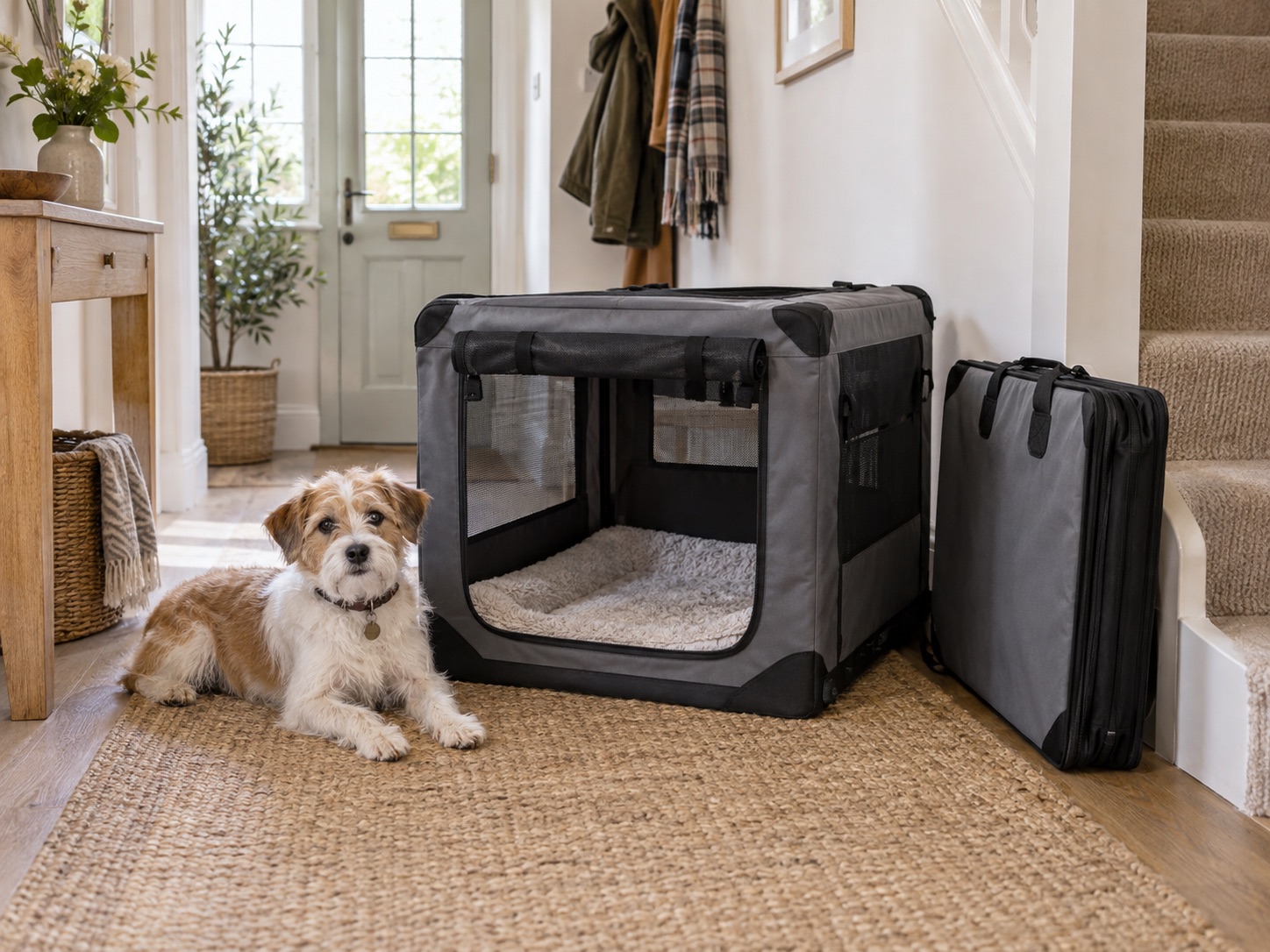
A 76cm soft-sided crate with four openings, mesh ventilation, a shoulder strap and removable fleece pad. The water-resistant base helps with everyday cleaning, but fabric remains less durable than wire.
What stands out
- Four access points
- Removable fleece pad
- Folds for storage
Keep in mind
- Unsuitable for puppies or persistent chewers
- Less secure than a rigid crate
- Not a documented vehicle restraint
- 76 × 54 × 54cm
- Four doors
- Mesh panels
- Water-resistant base

CADOCA foldable soft crate, medium
Best for: Short stays and destination use with a settled smaller dog
A fold-flat fabric crate with mesh panels, carry handles and an included bowl. The listing's weight suggestion is secondary to the dog's measured posture and floor-space needs.
What stands out
- Folds flat
- Carry handles
- Bowl included
Keep in mind
- Weight guidance is not a sizing method
- Fabric can be damaged by chewing
- Car wording does not establish crash protection
- Medium variant
- Mesh ventilation
- Carry handles
- Included bowl

Ferplast Atlas 30 plastic carrier
Best for: A small dog that fits a short, rigid, easy-clean carrier
A 60 × 40 × 38cm recycled-plastic shell with side ventilation, a roof handle and a four-point metal door. It separates for cleaning.
What stands out
- Published outside size
- Rigid wipe-clean shell
- Roof handle and ventilated sides
Keep in mind
- Short internal floor
- Less all-round view than wire
- Transport form differs from a home crate
- 60 × 40 × 38cm external
- Recycled plastic
- Four-point door

Amazon Basics 24-inch single-door wire crate
Best for: A measured small dog needing a fold-flat 61cm home crate
A 61 × 45.7 × 50.8cm wire crate with a single front door, top handle and removable plastic tray.
What stands out
- Compact published footprint
- Fold-flat frame
- Removable tray
Keep in mind
- One entrance limits placement
- Internal size not stated
- Small footprint is not universally suitable
- 61 × 45.7 × 50.8cm
- One door
- Removable tray
Scroll horizontally to see all columns →
| Model | Assembled form | Packing | Main limit |
|---|---|---|---|
| Amazon Basics soft medium | 76 × 54 × 54cm | Folds, shoulder strap | Not for persistent chewers |
| CADOCA soft medium | Check selected variant | Folds, carry handles | Fabric security and fit |
| Ferplast Atlas 30 | 60 × 40 × 38cm | Rigid shell | Does not fold |
| Amazon Basics wire 24-inch | 61 × 45.7 × 50.8cm | Flat metal panel | Small dog only |
Portable means more than foldable
A crate may fold flat but still be difficult to lift through a narrow hallway or fit in a car boot alongside luggage. A small rigid carrier may be light enough to carry but impossible to flatten for storage. The useful question is therefore not simply “does it fold?” but “can I move this particular crate, set it up safely and give this dog enough room at the other end?”
Measure the dog first using our crate measurement guide. PDSA recommends enough space to stand and sit without touching the roof, turn, lie down and stretch. Then look for the exact assembled and packed figures; do not assume an “M” label means the same thing across brands.
Choose a format for the destination
Fabric: lowest packing burden, narrowest suitability
Soft-sided crates can be useful for a calm adult dog already comfortable with a crate. Mesh panels improve airflow and a flat pack is convenient for a holiday cottage or family visit. Yet mesh, zips and fabric can be damaged by chewing or frantic escape attempts. A dog that paws or bites the door needs a different setup and welfare attention, not a thicker fabric label.
Plastic: rigid and wipeable, but always three-dimensional
A moulded carrier has a firm base and can be cleaned around its corners. It may offer more visual shelter than wire, but its curved roof and shell thickness reduce usable space. The whole box stays bulky, so measure the cupboard, car luggage area and route through doorways before buying. Read the plastic crate guide for the difference between a transport carrier and a daily home crate.
Folding wire: flat to store, heavy to carry
A wire frame keeps an open view and may be more practical at home. Folded panels can still be long, sharp-edged at the corners and awkward on stairs. Remove the dog and all loose contents before folding. Secure the folded frame and tray for carrying; do not use the top handle to lift an occupied crate.
The portable options in detail
Amazon Basics soft medium: multiple entrances
The 76 × 54 × 54cm soft crate has four access points, mesh panels, a shoulder strap and removable fleece pad. That makes it flexible for positioning at a destination. Its water-resistant base helps with spills, but neither fabric nor zips are a sound barrier for a dog that chews or panics. Check the base board remains level when the crate is moved.
CADOCA soft medium: carry handles and simple setup
The CADOCA offers fold-flat fabric construction, mesh panels, handles and a bowl. Confirm the exact medium variant's floor and roof dimensions before buying; the listing's weight suggestion cannot establish comfort. Inspect every zip, seam and mesh panel after folding, and place the opened crate on a level, non-slip floor.
Ferplast Atlas 30: small rigid shell
At 60 × 40 × 38cm externally, the Atlas 30 is for a dog that genuinely fits a compact carrier. The plastic shell and four-point door are easy to understand and the top separates for cleaning. Its convenience comes with an important limit: it does not fold, and the inside is smaller than those outside numbers.
Amazon Basics 24-inch wire: compact flat storage
The 61cm single-door wire model folds and includes a carry handle and removable tray. It may be practical when the dog needs an open-wire space at a second home, but the 45.7cm external width and 50.8cm height require careful dog-fit checks. The single front entrance can restrict room placement.
Pack and set up without creating a new risk
Before travel, measure the packed crate with handles and straps included, not just the body. At the destination, unfold or assemble it fully, test locks and joints, place the bed without blocking ventilation and ensure water can be reached. Keep it away from heaters, direct sun, draughts and external doors. Let the dog explore voluntarily with the door open before asking it to settle.
For car journeys, a destination crate is not automatically a suitable restraint. Use the car-crate guide and Highway Code Rule 57 guidance to plan the vehicle portion separately. If your main need is compact storage at home, compare assembled dimensions, folded dimensions and item weights rather than assuming every portable design suits daily use.
Common questions
Frequently asked questions
What is the lightest type of portable dog crate?
A fabric crate is often easier to carry than a comparable wire or rigid plastic format, but listed weight and packed dimensions vary. The dog still needs a stable floor, adequate ventilation and enough space to move naturally.
Can a portable soft crate be used for a puppy?
Fabric is usually a poor choice for a puppy that chews, scratches or has not learned to settle in a crate. PDSA notes that fabric crates are less durable and not suitable for dogs that like to chew. A wire crate or supervised pen may be safer.
Is a portable dog crate safe for car travel?
Portability is not vehicle-restraint evidence. Use the manufacturer's exact car instructions and check whether the specific model has documented testing; otherwise choose an appropriate restraint for the journey.
What should I measure before buying a travel crate?
Measure the dog for standing, sitting, turning and stretched rest. Also measure the crate's packed thickness and length, the storage space, your carrying route and the destination floor area.
Can I leave a dog alone in a portable crate at a holiday property?
Do not assume an unfamiliar room or crate is safe for unsupervised use. Introduce the setup gradually, follow property rules, manage heat and hazards, and avoid closing the dog in if it shows distress.
Sources
- PDSA — crate training your dog — fabric-crate limits and welfare sizing
- RSPCA — how to crate train a puppy — positive introduction and space
- Amazon UK product specification pages linked from the product cards