
Puppy pen height guide
How tall should a puppy pen be?
Choose puppy pen height from standing reach, jumping, climbing and growth, with practical checks for 60cm, 80cm and taller panels.
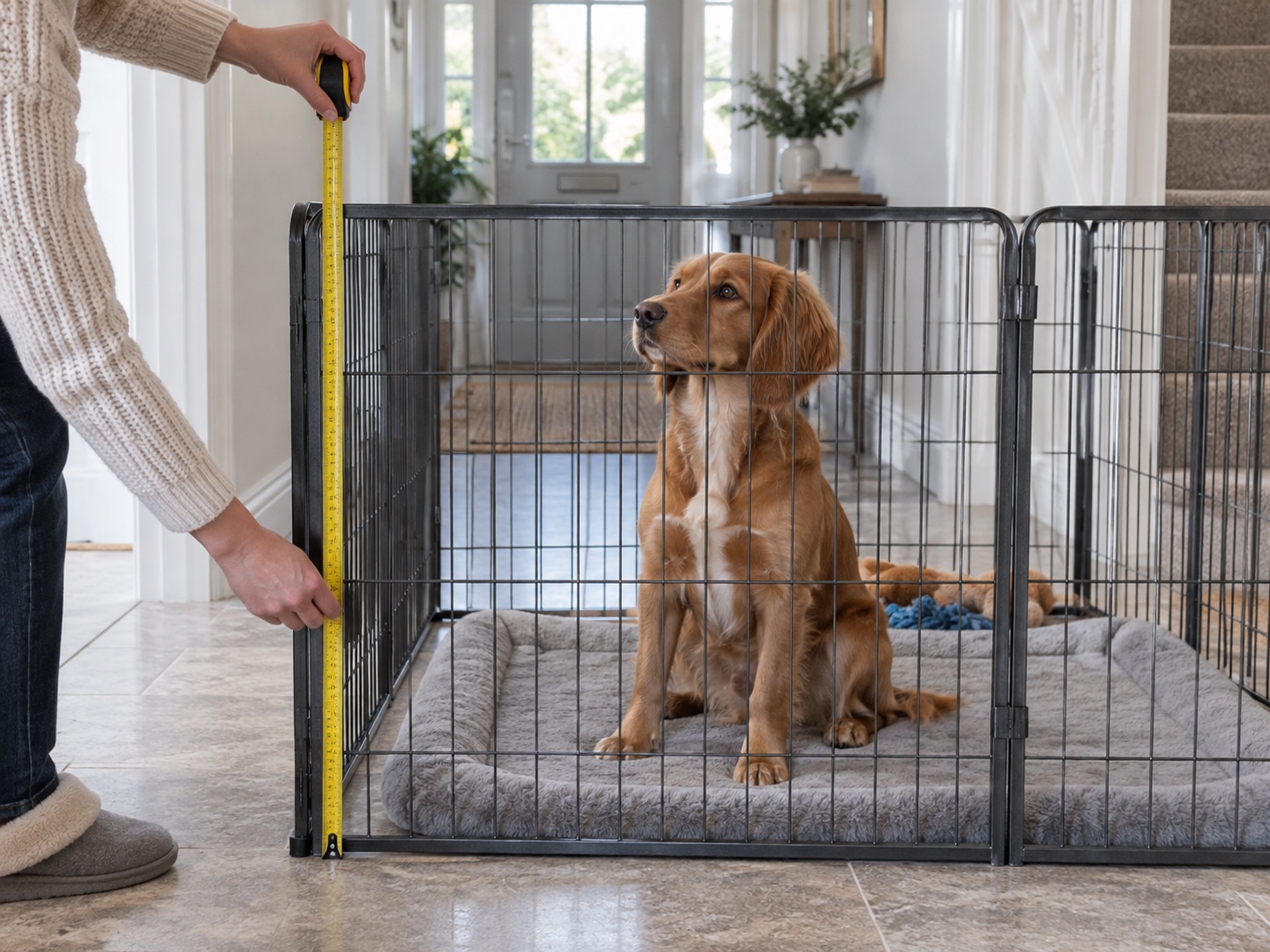
Measure natural sitting height and front-paw reach without encouraging the puppy to jump.
Smooth vertical panels offer fewer footholds than a horizontal grid, but their joints still need testing.
Never stack pens, lift a pen off the floor or improvise a loose fabric roof to gain height.
Begin with three observations
Measure natural sitting height from floor to the top of the head or ears, whichever is higher. Watch how high the front paws reach when the puppy stands normally against a safe surface. Finally, note whether the puppy jumps vertically, climbs grids or needs a run-up.
Do not encourage a jump against the pen to test it. Use behaviour you have already observed and choose conservatively. A puppy's capability can change before its body measurements look dramatically different.
What common heights mean
Around 60cm is a low playpen. It can suit a small young puppy for a limited growth period, but many medium and large-breed puppies soon place paws near the top. Around 80cm provides more margin for a non-climbing small or medium dog. Heights around 100–110cm are intended for taller or more athletic dogs, but they are heavier and still open at the top.
These are not guarantees. A compact terrier can jump, a poodle can use long reach and a clever puppy can climb. Choose for the individual rather than the breed average.
Construction changes effective height
A grid with horizontal rails can function like a ladder. Smooth clear panels remove those obvious footholds, although a puppy may still jump and push the joints. Frost IX's selected version illustrates the trade-off: smooth sides at only 60cm high.
The Amazon Basics selected pen moves to 107cm and a familiar metal grid. It offers much more vertical margin but still requires supervision for a climber and a stable complete shape indoors.
Remove false height reducers
A low chair, storage box or sofa beside the pen gives the puppy a launch point. Inside, a deep bed pushed against the panels raises the standing surface. Outside, hanging clothing or a draped cover can be grabbed through bars.
Keep both sides of the boundary clear. Centre a bed with sufficient room around it and position toys away from the wall. If the layout cannot maintain that clearance, the pen is too small or the room is wrong.
Do not improvise vertical extensions
Stacking two pens creates joints and loads the manufacturers did not design. Raising the lower edge creates a gap where a head or body can become trapped. Loose netting and blankets reduce visibility and ventilation while adding entanglement points.
If the available product is too low, choose a purpose-made taller model or change to a secure room gate. If a dog repeatedly tries to escape any barrier, address why rather than building a taller trap.
Plan for growth
Estimate adult height with help from a vet, breeder or rescue, but treat that as planning rather than proof. A taller pen can avoid an early replacement if the room can hold it safely. On the other hand, a compact temporary pen may be reasonable for the first weeks if you already expect to switch to a room boundary.
Check height after growth spurts and at the first new behaviour. Front paws reaching the top, repeated looking over, bouncing off a bed or mouthing upper rails are early warnings.
When height is not the answer
Panic, persistent barking, panting in a cool room, drooling and frantic climbing suggest distress. More height may increase injury risk. Reduce the duration and difficulty, keep the puppy within a comfortable distance and seek professional help when the reaction is intense or persistent.
For the horizontal plan, use our puppy pen size guide. To compare specific formats and heights, see the best puppy playpens in the UK.
Common questions
Frequently asked questions
Is a 60cm puppy pen high enough?
It may be for a small, young puppy that does not jump or climb, but it is too low for many growing dogs. Compare it with standing reach and behaviour, then reassess frequently.
Is an 80cm pen high enough for a puppy?
It offers more margin than 60cm, but an athletic or climbing puppy may still escape. Panel construction and the surrounding room matter as much as the number.
Can I put a cover over a puppy pen?
Only if the manufacturer provides and approves a fitted cover that preserves ventilation and cannot entangle the puppy. Loose blankets or improvised mesh can create climbing and strangulation hazards.
Should I buy the tallest puppy pen available?
Not automatically. Very tall panels are heavier and need a stable layout and enough room. Choose the lowest height that safely contains the individual with a sensible growth margin, or use a different boundary.
What should I do after a puppy climbs the pen?
Stop leaving the puppy in that setup, remove climbable surroundings and choose a more suitable height or panel design. Do not allow repeated escape practice while you wait for an upgrade.
Sources
- RSPCA — dog crates and puppy playpens — positive playpen use and distress signs
- PDSA — making your home dog friendly — removing household hazards and setting boundaries
- Amazon UK example products linked in the guide