
Crate comparison guide
Single-door vs double-door dog crates
Choose a dog crate door layout from access, room placement, opening width and everyday cleaning—not the number of doors alone.
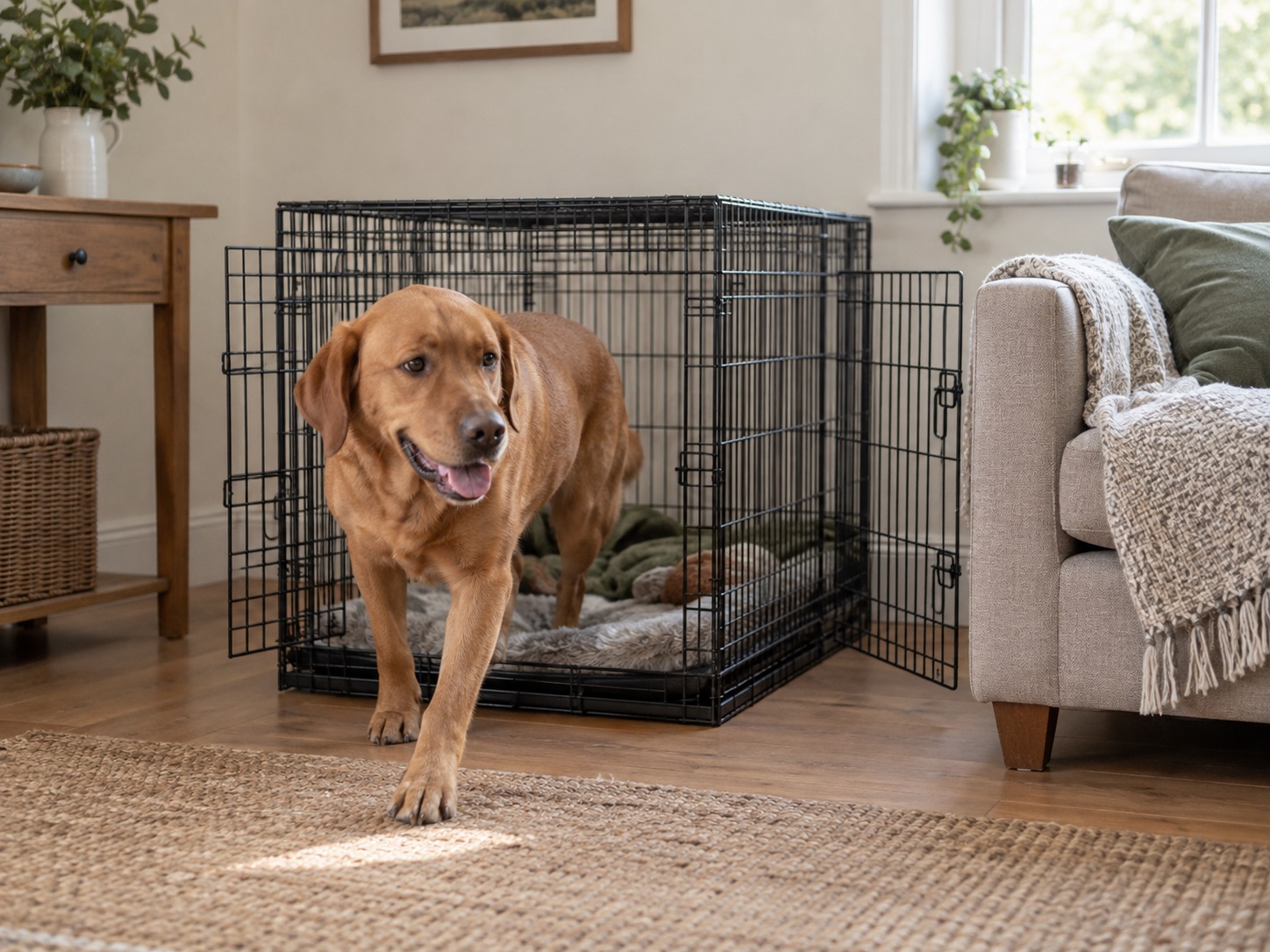
Check the clear opening, not just the size of the door panel.
Test the dog's approach and your access for cleaning or assistance.
Check both latches and any blocked-side door before every use.
What the door layout changes
Door count is a room-planning feature, not a measure of crate quality. A single front door can be entirely sufficient when a dog has a comfortable straight approach and a person can reach the dog and clean the crate easily. A front-and-side layout lets you rotate the crate or use a different access route when furniture changes, but only if both doors are unobstructed and secure.
Scroll horizontally to see all columns →
| Layout | Main advantage | Main constraint | Suits best when |
|---|---|---|---|
| Single front door | Simpler access plan | Front swing must remain clear | One stable approach works in the room |
| Front and side doors | More placement options | Two latches and swings to check | The crate may move between layouts |
Start with a sketch of the actual room. Mark the outside of the crate, the hinges, the full swing of each door and the path your dog takes to enter. Include the tray-pull direction. A side door shown in a product photo may be useless once the crate is tucked beside a sofa.
Single-door crates: simpler, but not always easier
The Amazon Basics 24-inch wire model is a compact single-door example. It folds and has a pull-out tray, but the one entrance commits you to a front approach. If the door swings into a corridor or furniture, moving to another location may be better than squeezing the opening.
Single-door designs still vary substantially. Hinges can be left- or right-oriented, raised thresholds can make entry harder for a dog with reduced mobility, and a latch can project into the doorway. Ask for a clear opening measurement if the retailer publishes only the full crate dimensions.
Double-door crates: flexibility with another check
The Feandrea PPD30H has front and side doors. That can work in a living room where the long side is the comfortable approach, or when a person needs to reach bedding without leaning through the front. The second opening does not enlarge the interior and can add a second source of draught or distraction in a busy room.
Close and test both doors before use, including the one you rarely open. Watch for a bed edge or cover caught in a latch. If the dog paws at a particular door, address the behaviour and setup rather than assuming a different latch count solves it.
Compare the usable doorway
Measure the narrowest clear width and height after hinges, frame bars and latches. For an adult dog, compare that opening with shoulder width, natural standing posture and how the dog actually steps over the threshold. A dog should not have to twist or compress the ribcage to enter.
The door must also permit help in a hurry. Consider whether you can reach a bowl, remove bedding and guide a reluctant dog out without forcing or startling them. Our door-dimension comparison and annotated access diagram separates published door sizes from confirmed clear gaps, with a practical worksheet.
The decision in one room test
If one door faces a quiet, open route and cleaning is straightforward, a single-door format is often enough. If room use changes or a side approach is materially easier, a double-door format may justify its footprint. In either case, choose the dog's measured crate fit first and introduce the space positively.
Common questions
Frequently asked questions
Is a double-door crate better for a puppy?
Not automatically. It can give easier access during introduction or cleaning, but both doors must close securely and the puppy still needs suitable size, a safe floor and a positive introduction.
Is a single-door crate safer?
Door count alone does not determine safety. A single door can simplify checks, while a well-made double-door crate can improve access. Inspect latch operation, bar gaps and the dog's behaviour in the actual setup.
Can a side door face a wall?
Only if the manufacturer permits that layout and the unused door cannot create a pinch or escape point. The other door must stay fully accessible, with enough swing and a clear route for the dog.
Do double doors make cleaning easier?
They often help you reach bedding and corners, but a removable tray and the crate's interior layout may matter more. Never rely on the side door if surrounding furniture blocks it.
What if my dog struggles through the opening?
Check the clear opening width and height, threshold and the dog's posture. A larger external crate or a second door may still have a narrow usable opening; measure the exact model.
Sources
- PDSA — crate training and fit
- RSPCA — dog crates and puppy playpens
- Amazon UK example products linked in the guide